

Insider Brief
- Florida has launched Florida Quantum, a privately led statewide initiative designed to position the state as a major hub for quantum technology and attract companies, researchers, and investors.
- The initiative will coordinate public–private partners, offer companies a single point of entry, and build an ecosystem spanning research, commercial deployment, policy alignment, and workforce development.
- Florida aims to leverage unique assets—including the National High Magnetic Field Laboratory, ISS National Lab access, the Florida LambdaRail, and a strong industry base—to compete with states like Maryland, Illinois, New Mexico, and Connecticut in the growing quantum-technology sector.
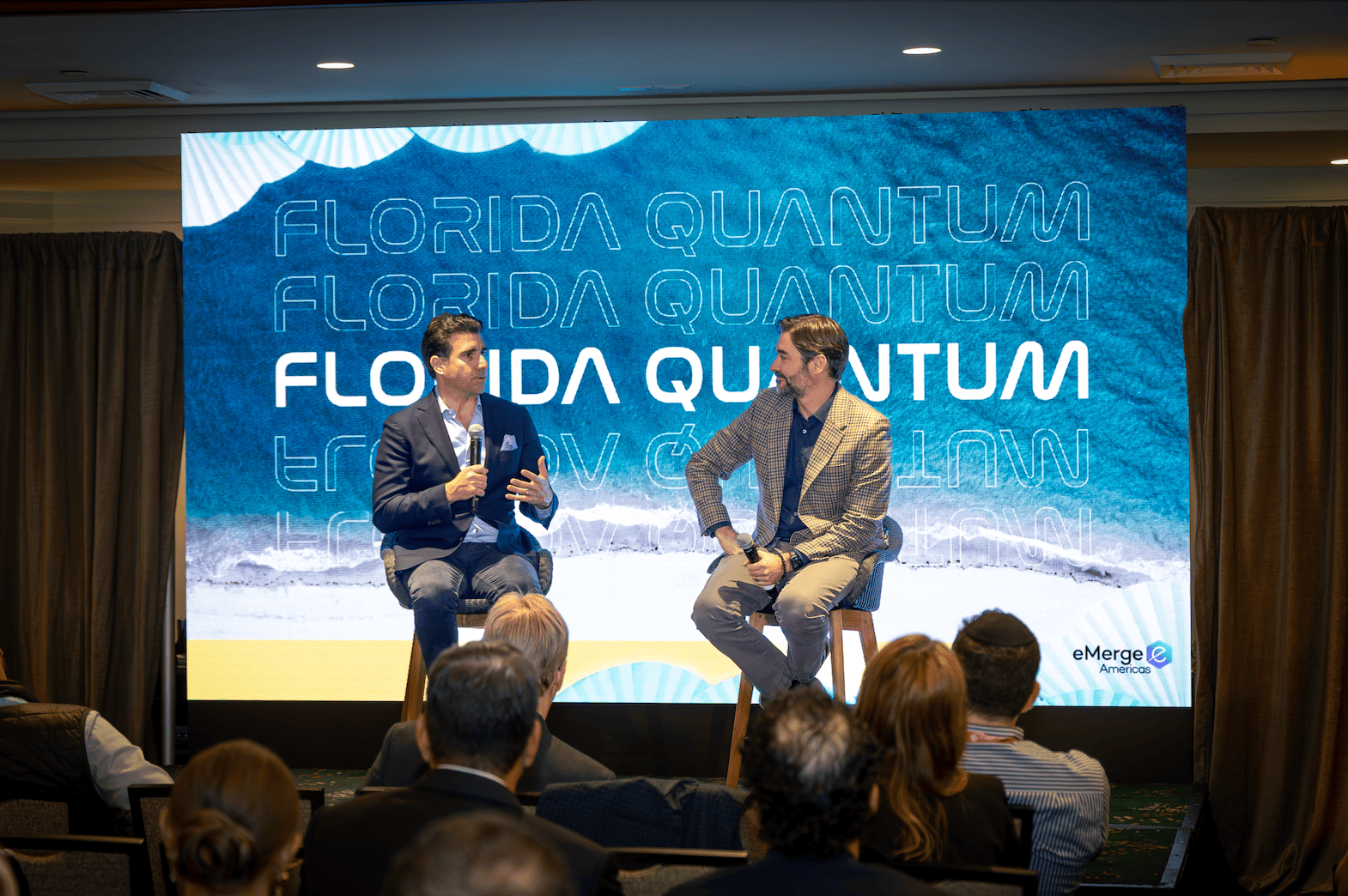
- Matt Cimaglia (left) and Tony Jimenez (right) speak during the Florida Quantum announcement at eMerge Americas’ Tech Basel event in Coral Gables, Fla., Dec. 3, 2025.
Florida is positioning itself to become the next major hub for quantum technology, launching a statewide initiative aimed at luring companies, researchers, and investors in one of the world’s most competitive emerging sectors.
The effort, called Florida Quantum, was announced Wednesday (Dec. 3) at the Tech Basel Miami AI Summit, an event held during eMerge Americas’ Innovation Week that has become an increasingly influential gathering for investors and policymakers. The move comes just a week after the federal government unveiled the Genesis Mission, a sweeping national strategy to accelerate U.S. leadership in artificial intelligence, quantum technologies and next-generation computing.
Together, the timing signals a widening recognition: states that organize early may have an advantage in attracting companies developing technologies seen as central to national security, advanced manufacturing, and future economic competitiveness.

A Coalition to Catch Up and Leap Ahead
Florida Quantum is co-led by Matt Cimaglia, managing partner of Quantum Coast Capital, and Tony Jimenez, managing partner of Medina Ventures, with support from the Florida Alliance for Quantum Technology (FAQT), eMerge Americas, and FloridaCommerce.
The initiative aims to function as a statewide organizing force, similar to structures recently implemented in Maryland, Illinois, New Mexico, and Connecticut, all of which have launched quantum alliances or statewide collaboratives backed by universities and government agencies.
“Florida has long been a launchpad for technological revolutions, from early computing to aerospace,” Cimaglia said. “With quantum, we’re organizing early to ensure Florida doesn’t just participate, we lead.”
Jimenez, whose firm focuses on dual-use and national-security-aligned investments, said the group plans to connect companies directly with federal agencies, universities, and emerging capital networks.
“By connecting Florida’s universities, investors and leading quantum companies with federal and private partners, we’re building an ecosystem that supports research with a path to commercialization,” Jimenez said. “Companies want predictable support, defined strategy and a clear point of entry. Florida Quantum provides them that.”
A Strategy Rooted in Industry First, Workforce Next
While most states frame talent development as the first step in competing for advanced industries, Florida Quantum is flipping the script.
Its leaders say real commercial traction, not education policy, drives lasting workforce change. As evidence, they point to Texas, where a boom in semiconductor investment has pushed universities and community colleges to rapidly overhaul their training programs.
Florida officials say they see a similar model emerging for quantum.
“Florida Quantum represents a bold step by the private sector to expand and strengthen Florida’s quantum ecosystem, working to compliment the recently launched 15-university Florida Alliance for Quantum Technologies (FAQT) mission,” said Florida Secretary of Commerce J. Alex Kelly. “By uniting public and private partners across education and the quantum industry, this initiative will support the technologies essential to national defense, cybersecurity, health innovations, financial services, data security and the future of transportation and logistics.”
Competition Among States Intensifies
Quantum technology, once the domain of university labs, has become a top economic development target for states seeking to attract the next generation of advanced industries. Billions in federal CHIPS Act funding and new Department of Commerce, NIST, and DOE programs have triggered what some analysts call a “50-state quantum race.”
Maryland and Illinois are viewed as early leaders due to federal lab proximity and university research strength. New Mexico has leaned on its national laboratories. Connecticut recently joined the field with a statewide consortium anchored by defense and aerospace companies.
Florida Quantum aims to follow a similar playbook:
- provide companies a single point of contact
- coordinate state and federal engagement
- build partnerships with accelerators
- attract relocation and expansion
- and shape policy and legislative frameworks to incentivize growth
Florida stands alone as the only state capable of supporting the entire quantum lifecycle, anchored by the National High Magnetic Field Laboratory for material creation and the ISS National Laboratory for microgravity testing. This ecosystem is supercharged by the Florida LambdaRail, which provides high-speed, secure access to the University of Florida’s HiPerGator, the world’s most powerful university-owned supercomputer, allowing companies to run complex quantum simulations before validating them in orbit. With Florida currently leading the nation in successful space launches, the state already offers quantum companies an unparalleled direct pipeline from digital simulation to physical deployment in space.
A Market Moving From Promise to Deployment
Quantum technology is no longer confined to research labs. Companies such as D-Wave, IonQ, and Atom Computing have each delivered commercially deployable systems within the past year, marking a shift from theoretical potential to practical, revenue-generating hardware. Across the sector—from neutral-atom platforms and trapped-ion systems to photonics startups, cryogenics suppliers, and quantum-secure cybersecurity firms—federal and private investment is accelerating.
For early-stage firms, geography has become a strategic advantage. Companies increasingly look for proximity to strong universities, access to specialized engineering talent, supportive regulatory environments, and state-level economic development programs.
Cimaglia and Jimenez argue that Florida has a competitive edge: a rapidly growing population, a business-friendly climate, and a diversified industry base—finance, health care, logistics, aerospace, and defense—that is well positioned to become a set of early adopters for quantum technologies as they mature.
Momentum Already Building
Produced by The Quantum Insider, Florida has hosted three Quantum Beach conferences, drawing national companies and researchers to South Florida. eMerge Americas, which attracts over 22,000 executive leaders to its annual flagship conference in Miami Beach, has expanded its national-security and deep-tech programming. Several universities and colleges have started quantum-science initiatives, and investors have shown interest in dual-use startups tied to cybersecurity, energy, and AI.
The new initiative, leaders say, is intended to unify these efforts under a single statewide strategy.
“This is about coordination,” Jimenez said. “States that organize early will shape the trajectory. We intend for Florida to be one of them.”
The Road Ahead
Florida Quantum remains privately funded and non-governmental. Leaders say they expect more corporate partners and founding members to be announced in 2026.
For now, the goal is to build a statewide initiative that companies, large and small, can join as a signal of alignment with federal programs and market maturation.
Analysts say states that fail to organize may struggle later, as quantum companies increasingly choose locations where policy, workforce and capital are aligned.
“Quantum is no longer theoretical,” Cimaglia said. “States are competing for it. Florida plans to compete at the highest level.”