


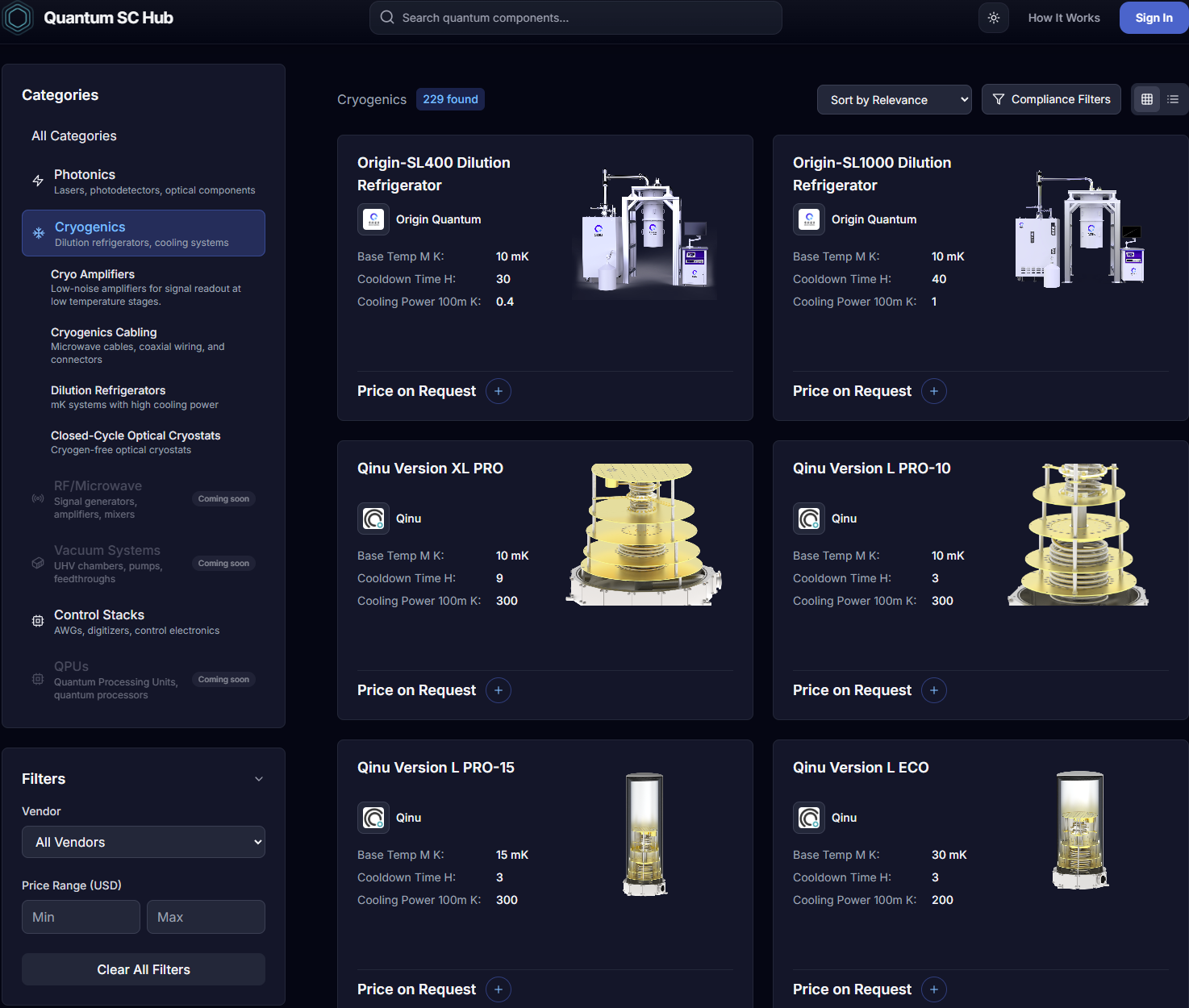

Imagine you’re building the next pioneering quantum startup or a solo researcher with a breakthrough experiment in mind. Whether you’re a company or an individual, finding and comparing specialized quantum hardware has always been slow, opaque, and fragmented. The Quantum Supply Chain Hub (QHub) changes this by creating a transparent, data-driven marketplace where anyone can discover, compare, and source cutting-edge quantum components in one centralized, easy-to-use platform.
What Is QHub?
QHub is a global marketplace that aggregates over 60 verified vendors and more than 400 products across the quantum hardware stack, from Arbitrary Waveform Generators and cryogenic systems to control electronics and photonics components. Key features include:
- Advanced filtering: Search by technical specifications (e.g., wavelength, cooling power, dark counts) to find exactly what your setup requires.
- Normalized data: Cross-vendor comparisons using standardized metrics for objective evaluation.
- Compliance Filtering: Use the advanced compliance filtering to filter by Countries or agreements (e.g., Wassenaar Arrangement)
- Streamlined procurement: Structured RFQs, direct vendor messaging, and compliance tracking simplify and accelerate purchasing workflows.
In summary, QHub is the most comprehensive marketplace for sourcing verified quantum hardware efficiently and transparently.
Why Does QHub Matter for Today’s Quantum Supply Chain?
Quantum supply chains are increasingly under international scrutiny. As global governments and industry alliances prioritize supply chain resilience and transparency, quantum technologies are now seen as strategic infrastructure, subject to export controls, security screening, and localization mandates. QHub aligns with this shift by creating an open-access platform that maps and connects the quantum hardware ecosystem. It strengthens visibility across suppliers, accelerates research-to-market translation, and supports global efforts to ensure secure, diversified, and interoperable quantum supply chains.

Overall, QHub stands out as a trusted platform for navigating an increasingly regulated global quantum market.
How Is QHub Used by Researchers and Companies?
Teams use QHub to locate verified suppliers, evaluate products side by side, and accelerate procurement through standardized workflows.
Labs, startups, and industrial R&D teams use QHub to:
- Identify verified suppliers through granular filtering
- Compare components with normalized, cross-vendor metrics
- Submit RFQs to multiple vendors simultaneously
- Onboard as vendors to reach a global customer base and gain visibility through The Quantum Insider’s ecosystem.
Sample Use Cases
- Use Case 1: How Do Research Labs Optimize Procurement with QHub?
A university quantum optics lab needs single-photon detectors with specific dark count rates and detection efficiencies. Using QHub, they filter across parameters, compare models from ID Quantique and AUREA Technology, and issue RFQs in minutes, cutting procurement cycles from weeks to days. - Use Case 2: How Do Startups Use QHub to Scale Hardware Decisions?
A quantum computing startup preparing for Series A expansion needs cryogenic amplifiers and waveform generators. QHub enables quick benchmarking of hardware from multiple vendors, ensuring compatibility and cost transparency before purchase.
What Does QHub Offer
| Feature | What It Does | Benefit |
|---|---|---|
| Advanced Filtering | Search by specs like wavelength or cooling power | Faster identification of compatible components |
| Normalized Vendor Data | Cross-platform comparisons with standardized metrics | Objective evaluation across suppliers |
| Compliance Filtering | Filter by export rules and agreements | Reduces regulatory risk and speeds approval |
| Structured RFQs | Submit one RFQ to multiple vendors | Saves time and improves response quality |
| Vendor Onboarding | Global exposure within The Quantum Insider ecosystem | Expands reach for suppliers |
Why Is QHub Important for the Quantum Economy?
As noted by The Quantum Insider, the quantum economy’s next phase will depend on robust, transparent supply chains. Hybrid quantum-classical systems are already improving logistics, security, and resource optimization. Marketplaces like QHub are becoming foundational digital infrastructure, the connective tissue transforming quantum from niche research to scalable industry.
In summary, QHub plays a pivotal role as the quantum industry matures toward commercial deployment.
Explore QHub today to find, compare, and connect with the global quantum hardware ecosystem: hub.thequantuminsider.com
Frequently Asked Questions
What is QHub?
QHub is a global marketplace that aggregates over 60 verified vendors and more than 400 products across the quantum hardware stack. It provides a transparent, data-driven platform where researchers and companies can discover, compare, and source quantum components in one centralized location.
What types of products are available on QHub?
QHub covers the entire quantum hardware stack, including Arbitrary Waveform Generators, cryogenic systems, control electronics, photonics components, single-photon detectors, cryogenic amplifiers, and other specialized quantum equipment.
Who can use QHub?
Labs, startups, industrial R&D teams, university research groups, and individual researchers can all use QHub to source quantum hardware. Both buyers and vendors can participate in the platform.
What are the key features of QHub?
Key features include advanced filtering by technical specifications (wavelength, cooling power, dark counts), normalized data for cross-vendor comparisons using standardized metrics, compliance filtering by countries or agreements like the Wassenaar Arrangement, and streamlined procurement through structured RFQs and direct vendor messaging.
How does QHub help with procurement?
QHub enables users to submit structured Request for Quotations (RFQs) to multiple vendors simultaneously, compare components side-by-side with technical normalization, and communicate directly with vendors, simplifying and accelerating purchasing workflows from weeks to days.
What is compliance filtering?
The compliance filtering feature allows users to filter products and vendors by countries or international agreements such as the Wassenaar Arrangement, helping ensure purchases align with export controls and regulatory requirements.
Why are quantum supply chains strategically important?
Quantum technologies are now seen as strategic infrastructure subject to export controls, security screening, and localization mandates. Global governments and industry alliances prioritize supply chain resilience and transparency as quantum computing becomes more critical to national security and economic competitiveness.
How does QHub support supply chain transparency?
QHub creates visibility across suppliers, maps the quantum hardware ecosystem, and provides standardized data that helps ensure secure, diversified, and interoperable quantum supply chains aligned with international scrutiny and regulatory requirements.
Can vendors join QHub?
Yes, vendors can onboard to QHub to reach an international customer base and gain visibility through The Quantum Insider’s ecosystem, expanding their market reach across the global quantum community.
How does QHub accelerate research?
By enabling researchers to quickly filter products by granular specifications, compare options from multiple vendors, and submit RFQs in minutes rather than weeks, QHub significantly reduces procurement cycles and speeds up research-to-market translation.
What is an example of how a university lab would use QHub?
A university quantum optics lab needing single-photon detectors with specific dark count rates and detection efficiencies can use QHub to filter across parameters, compare models from multiple vendors like ID Quantique and AUREA Technology, and issue RFQs in minutes, cutting procurement from weeks to days.
How does QHub help quantum startups?
Startups can use QHub to quickly benchmark hardware from multiple vendors, ensuring compatibility and cost transparency before making purchasing decisions, which is particularly valuable during funding rounds or scale-up phases.
Why is QHub considered digital infrastructure for quantum?
QHub serves as connective tissue, transforming quantum from niche research to scalable industry by providing the foundational marketplace infrastructure needed for robust, transparent supply chains as the quantum economy matures.