

Insider Brief
- A delegation of Australian quantum companies visited Korea to discuss joint R&D and commercialization in quantum computing, communication, and sensing.
- Officials from Austrade and the Korea Quantum Industry Association emphasized complementary strengths — Australia’s research leadership and Korea’s industrialization expertise — as the basis for deeper cooperation.
- The event included presentations, roundtables, and one-on-one meetings, where participants proposed joint projects on quantum chip development, secure communications, sensing, and international technical standards.
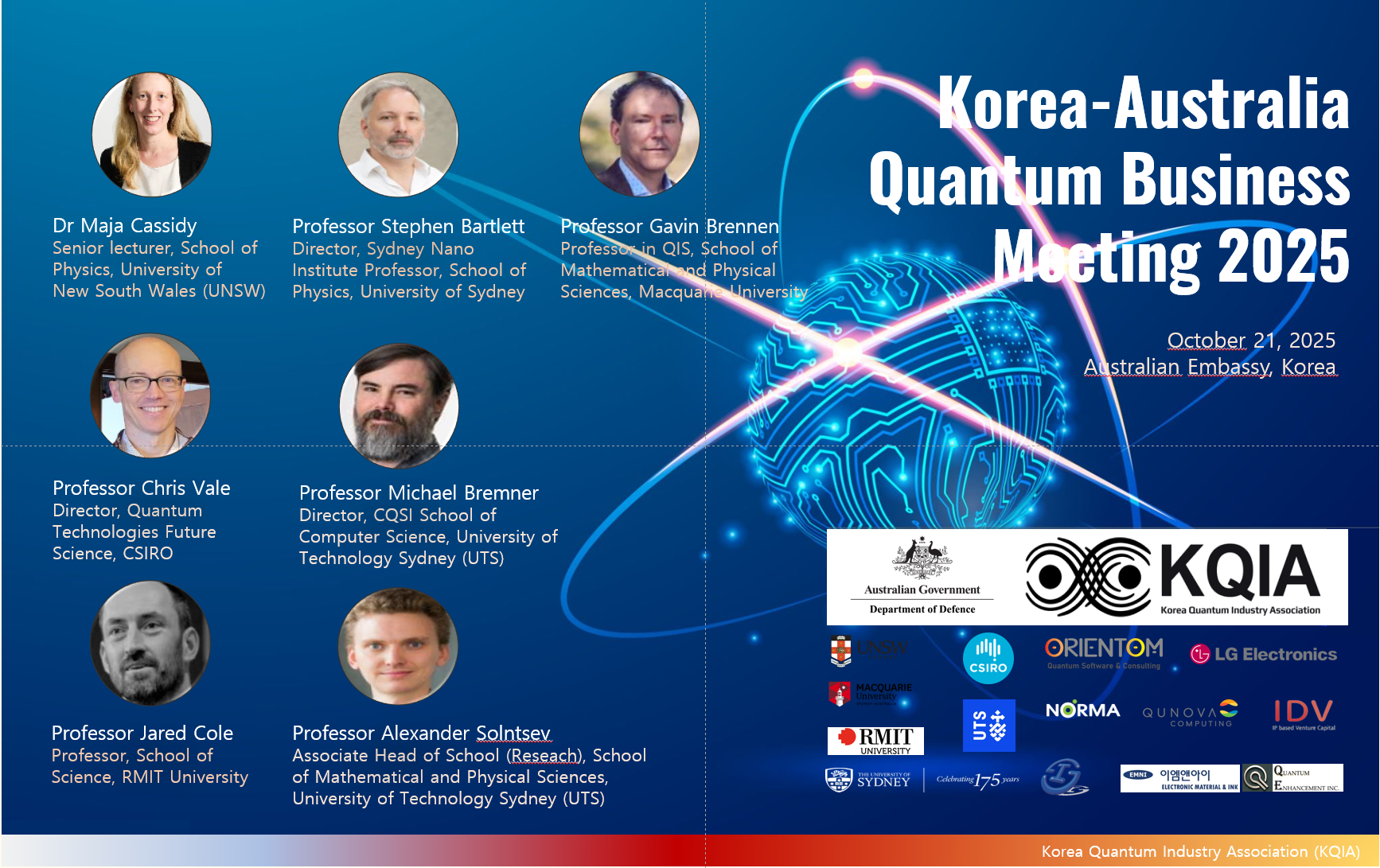
PRESS RELEASE — The Korea Quantum Industry Association (KQIA) and the Australian Trade and Investment Representative Office (Austrade) at the Australian Embassy in Korea jointly hosted the ‘Korea-Australia Quantum Technology Business Roundtable’ with major domestic companies and institutions including Orientom, LG Electronics, and Noruma. They engaged in in-depth discussions on strengthening international cooperation and advancing industrialization in the quantum technology sector.
This meeting served as an official event where a delegation of Australian quantum companies visited Korea to engage directly with the Korean quantum industry. Key agenda items included joint research and development (R&D) and commercialization efforts in cutting-edge quantum technology fields such as quantum computing, quantum communication, and quantum sensing.
Vivian Lim, Head of the Australian Trade and Investment Commission (Austrade) at the Australian Embassy in Korea, emphasized strengthening bilateral technology cooperation between Australia and Korea in her opening remarks. She introduced Austrade’s role as an Australian government agency connecting Australia’s innovation and research capabilities with global partners, supporting Australian companies’ overseas expansion, and attracting Korean investment into Australia.

He also stated, “Australia has established itself as a leader in quantum technology, leveraging its world-class research capabilities and vibrant startup ecosystem. Korea, too, continues to expand its R&D investment, particularly in cutting-edge industries such as semiconductors, batteries, and biotechnology.” He added, “We look forward to exploring opportunities for collaboration between research and industry, joint R&D, and commercialization, building on the complementary strengths of both nations.”
At the event, Chairman AlfredBang, President of the Korea Quantum Industry Association (KQIA) and CEO of Orientom, delivered a keynote presentation titled “Korea’s Quantum Industry Ecosystem and Global Trends.”
Chairman Bang stated, “Korea is rapidly expanding its quantum industry ecosystem based on semiconductor and telecommunications technology. Cooperation with Australia will play a crucial role in the global advancement and industrialization of Korean quantum technology.”
Following this, Dr. Ryan Kim from the Global Cooperation Team at the Technology Information Promotion Agency (TIPA) introduced the Ministry of SMEs and Startups’ Global Joint R&D Program.
Dr. Kim stated, “The government operates various international cooperation programs to enable SMEs to develop innovative technologies in collaboration with overseas research institutions and global partners,” adding, “We expect this Korea-Australia cooperation to contribute to strengthening the technological competitiveness of SMEs and expanding their entry into global markets.”
During the roundtable discussion session, participants included Orientom, LG Electronics, Qunova, Noruma, ID Ventures, Isotech, Quantum Enhancement, EM&I, and Danal. From the Australian delegation, CSIRO, the University of New South Wales (UNSW), the University of Sydney, RMIT University, Macquarie University, and the University of Technology Sydney (UTS), among other universities and companies, participated.
The technological capabilities and research fields of individual Korean companies and research institutions were introduced, and discussions were held on key challenges and policy issues in the industrialization process of quantum technology.
Participants in the discussion proposed specific cooperation projects between the two countries, focusing on quantum computer applications, quantum chip development, quantum secure communications, sensor commercialization, and international technical standardization cooperation.
During the subsequent networking session and one-on-one business meetings, in-depth discussions took place between companies from both countries regarding joint research and development, technology exchange, and investment cooperation. Practical consultations were held between some companies regarding the future signing of MOUs and the promotion of joint projects.
An official from the Australian Trade and Investment Commission (Austrade) stated, “Australia is expanding its investment to build a world-class quantum technology research base, while Korea possesses strong industrialization capabilities and manufacturing and application technologies.” They added, “Through this meeting, the two countries can establish a mutually complementary cooperative framework and lead the development of the global quantum ecosystem.”
Alfred Bang, Chairman of the Korea Quantum Industry Association (KQIA), stated, “This event is a meaningful occasion to promote joint research and development and commercialization of quantum technology, as well as to expand the global reach of small and medium-sized enterprises.” He added, “Through close cooperation between industry, academia, and government, we will strive to enable Korea and Australia to grow into global leaders in quantum technology.”