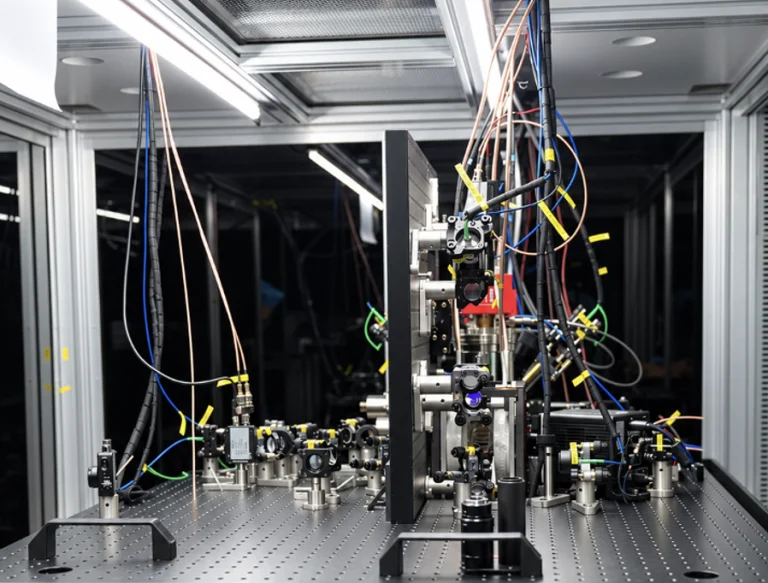
SEC Documents Confirm Larger Quantinuum Funding Round


Insider Brief
- SEC Form D filings show Quantinuum has raised at least $593 million in a private funding round, more than the earlier reported $400 million and pushing its valuation to $10 billion.
- The placement was led by JPMorgan Chase, with Quanta and Serendipity Capital confirmed as an investor and there are indications that NVIDIA may participate.
- Alongside the financing, Quantinuum is preparing to launch its next-generation Helios quantum computer with a new full-stack platform featuring the Guppy programming language, Selene emulator and expanded integration with NVIDIA tools to support progress toward fault-tolerant systems.
Following a recent report of $50 million investment from Taiwanese Quanta and media stories on a pending large funding round, Form D documents filed by Quantinuum with the Security and Exchange Commission (SEC) now confirm the company has completed a fund raise of at least $593 million, making the potential final tally significantly more than the $400 million that was initially reported by market sources last week. A Form D is a notice companies file with the SEC disclosing details of private fundraising rounds exempt from full registration.
Quantinuum has not yet made a formal statement about the funding round or who the other investors might be in addition to Serendipity Capital and Quanta, but the Quanta filing pinpoints a valuation of $10 billion.
According to the SEC filing the placement was lead managed by JPMorgan Chase (JPMC), which is also the exclusive financial advisor to Quantinuum.

Prior to this financing, the company’s major shareholders were Honeywell with a reported stake of over 50% and Cambridge Quantum Holdings, controlled by founder Ilyas Khan with a stake reported to be somewhere between 35% to 40%.
The total amount of capital raised by Quantinuum since it came into being following a merger of Honeywell Quantum Solutions and Cambridge Quantum in late 2021 is close to $1.2 billion.
Existing investors in Quantinuum include JPMC, Amgen, Mitsui, IBM, Serendipity Capital and JSR Corp. Financial reports have also indicated that Nvidia might be involved in the fund raise, although this has not yet been confirmed. Quantinuum and Nvidia are working together as previously reported.
Last week, the company also reported on a string of recent technical announcements including details of the upgraded software stack and a new programming language have been supplemented by commercial advances that continue to point to a launch of Quantinuum’s next generation quantum computer that is named Helios.
Quantinuum’s Helios Stack
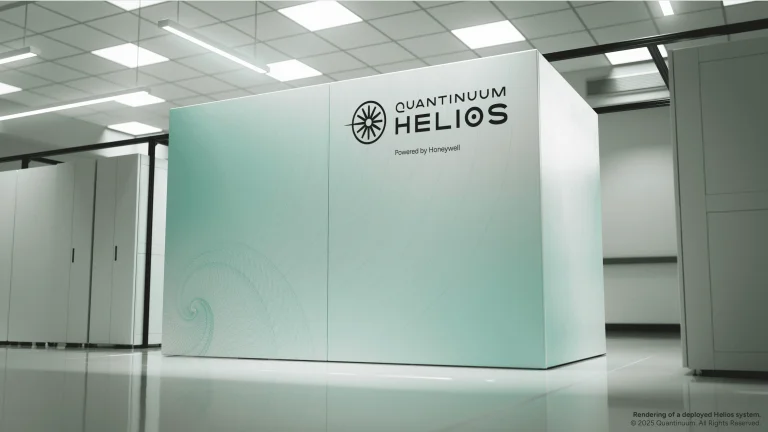
The Helios system is shaping up to be the heart of what the company calls its “full-stack” platform, technology meant to make quantum programming more accessible while pushing toward fault tolerance. The company reports the stack is designed to address two of the sector’s persistent challenges – the complexity of writing code for quantum systems and the limited availability of hardware.
Helios adds two major components: Guppy, a new programming language embedded in Python, and Selene, an emulator built to mirror Helios’s behavior. The company says this allows developers to move beyond tedious gate-by-gate programming toward structured, dynamic software, enabling features such as loops, conditionals, and real-time feedback.
The company said that Guppy is a departure from traditional circuit construction, supporting more flexible approaches to error correction and allowing users to test protocols like magic state distillation and teleportation. Integration with NVIDIA’s CUDA-Q tools provides out-of-the-box decoders for error correction, linking Quantinuum’s hardware to broader high-performance computing workflows.
A new control system is also being introduced to allow operations to adapt dynamically as measurements are made, according to the recent announcement. This real-time responsiveness, will be essential for scaling from thousands to millions of qubits, the company suggests. At a practical level, the system brings recursion and feedback loops – standard in classical computing but difficult in quantum systems – into the workflow, with the promise of reducing memory errors and speeding time-to-solution.
On the accessibility side, Selene is positioned as a “digital sister” to Helios. It extends beyond traditional simulators by reproducing runtime behaviors unique to Quantinuum’s architecture, giving developers the ability to test Guppy programs on classical machines before deploying them to quantum hardware. Selene supports multiple backends, including GPU-optimized simulations, enabling larger-scale experimentation.
These layers remain tied together through Nexus, which now supports the Quantum Intermediate Representation (QIR), allowing users to program in Microsoft’s Q#, NVIDIA’s CUDA-Q, or Oak Ridge’s XACC. Quantinuum’s position is that Helios and its stack deliver practical improvements today while laying the groundwork for fault-tolerant systems.
The launch is scheduled for later this year, with a demo of the new software stack set for Sept. 18.

Keep track of everything going on in the Quantum Technology Market. In one place.
Topics

Matt Swayne
With a several-decades long background in journalism and communications, Matt Swayne has worked as a science communicator for an R1 university for more than 12 years, specializing in translating high tech and deep tech for the general audience. He has served as a writer, editor and analyst at The Quantum Insider since its inception. In addition to his service as a science communicator, Matt also develops courses to improve the media and communications skills of scientists and has taught courses.
[email protected]

Stay Ahead of Quantum
Get the latest research, company news, and market intelligence every week.
MENTIONED IN THE ARTICLE

Quantinuum
Quantinuum builds full-stack quantum computing solutions for practical deployment. Leveraging proprietary enhancements to trapped-ion QCCD architecture, the company has launched multiple commercial hardware generations that deliver leading two-qubit gate fidelity and industry-topping accuracy.
→

JPMorgan Chase
JPMorgan Chase & Co. is an American multinational investment bank and financial services holding company
→

Serendipity Capital
Serendipity Capital, founded in 2020, is a permanent capital vehicle investing in Financial Services, technology and climate focused businesses. Serendipity Capital combines deep domain expertise, operating experience, quality relationships and long-term capital. We believe the combination of these elements are key to building a differentiated, sustainable and successful Financial Services investment business.
→
NVIDIA
NVIDIA Corporation is an American multinational technology company and a global player in accelerated computing and Artificial Intelligence (AI). Founded in 1993, the company pushes the aerospace frontier with the Space-1 Vera Rubin Module, a platform for orbital data centers that delivers massive AI-compute Space Computing. This NVIDIA technology enables satellites and autonomous spacecraft to process and fuse sensor data rapidly Space Computing.
→

Honeywell
Honeywell Aerospace, founded in 1906, is a global company focused on aviation technology, with hardware and avionics utilized on nearly all commercial and military aircraft. The division specializes in designing and manufacturing advanced aircraft engines, flight decks, satellite communications, and auxiliary power systems.
→
IBM
IBM is an iconic technology pioneer founded in 1911 as the Computing-Tabulating-Recording Company and officially renamed International Business Machines Corporation in 1924. Beyond foundational computing, IBM possesses a deep legacy in aerospace and defense from building the guidance computers and Instrument Unit for NASA's historic Apollo missions to partnering with Airbus on CIMON, the first AI assistant on the ISS.
→

Microsoft
Microsoft engages in the creation and licensing of software for both consumer and enterprise use. The company is renowned for its development of Windows operating systems and the Office suite designed for productivity. Microsoft's structure encompasses three major segments of roughly equal size: productivity and business processes, which encompasses legacy Microsoft Office, cloud-based Office 365, Exchange, SharePoint, Skype, LinkedIn, and Dynamics; the intelligence cloud, which includes offerings like Azure, Windows Server OS, and SQL Server; and more personal computing, which covers Windows Client, Xbox, Bing search, display advertising, and a range of Surface laptops, tablets, and desktops.
→