Quantum Sensors Tested for Next-Generation Particle Physics Experiments



Insider Brief
- A team of researchers from Fermilab, Caltech, JPL, and international partners has successfully tested quantum sensors called superconducting microwire single-photon detectors (SMSPDs) for high-energy particle detection.
- The SMSPDs demonstrated high efficiency and improved spatial and time resolution when exposed to beams of protons, electrons, and pions at Fermilab, making them suitable for future high-intensity particle colliders.
- Unlike traditional sensors, SMSPDs can detect charged particles with precision in four dimensions—space and time—supporting next-generation searches for new particles and dark matter.
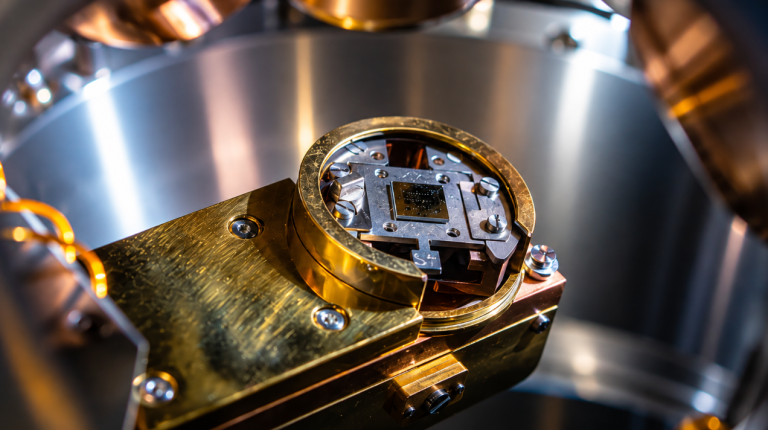
- Image: The SMSPDs can precisely detect single particles at a time. The detectors were designed and fabricated at JPL and commissioned at the INQNET-Caltech labs. (Cristián Peña, Fermilab)
PRESS RELEASE — To learn more about the nature of matter, energy, space, and time, physicists smash high-energy particles together in large accelerator machines, creating sprays of millions of particles per second of a variety of masses and speeds. The collisions may also produce entirely new particles not predicted by the standard model, the prevailing theory of fundamental particles and forces in our universe. Plans are underway to create more powerful particle accelerators, whose collisions will unleash even larger subatomic storms. How will researchers sift through the chaos?
The answer may lie in quantum sensors. Researchers from the U.S. Department of Energy‘s Fermi National Accelerator Laboratory (Fermilab), Caltech, NASA‘s Jet Propulsion Laboratory (which is managed by Caltech), and other collaborating institutions have developed a novel high-energy particle detection instrumentation approach that leverages the power of quantum sensors—devices capable of precisely detecting single particles.
“In the next 20 to 30 years, we will see a paradigm shift in particle colliders as they become more powerful in energy and intensity,” says Maria Spiropulu, the Shang-Yi Ch’en Professor of Physics at Caltech. “And that means we need more precise detectors. This is why we are developing the quantum technology today. We want to include quantum sensing in our toolbox to optimize next-generation searches for new particles and dark matter, and to study the origins of space and time.”

Reporting in the Journal of Instrumentation, the research team, which also includes collaborators at the University of Geneva and Federico Santa María Technical University in Chile, tested its new technology, called superconducting microwire single-photon detectors (SMSPDs), for the first time at Fermilab near Chicago. They exposed the quantum sensors to high-energy beams of protons, electrons, and pions, and demonstrated that the sensors were highly efficient at detecting the particles with improved time and spatial resolution compared to traditional detectors.
This is a significant step toward developing advanced detectors for future particle physics experiments, says co-author Si Xie, a scientist at Fermilab who has a joint appointment at Caltech as a research scientist. “This is just the beginning,” he says. “We have the potential to detect particles lower in mass than we could before as well as exotic particles like those that may constitute dark matter.”

The quantum sensors used in the study are similar to a related family of sensors (called superconducting nanowire single-photon detectors, or SNSPDs), which have applications in quantum networks and astronomy experiments. For example, researchers at JPL—who are among the world’s top experts at designing and fabricating these sensors—recently used them in the Deep Space Optical Communications experiment, a technology demonstration that used lasers to transmit high-definition data from space to the ground.
Spiropulu, Xie, and other scientists from Fermilab, Caltech, and JPL have also used the SNSPD sensors in quantum networking experiments, in which they teleported information across long distances—an important step in developing a quantum internet in the future. That program, called Intelligent Quantum Networks and Technologies (INQNET), was jointly founded in 2017 by Caltech and AT&T.
For the particle physics tests, the researchers used SMSPDs rather than the SNSPDs, because they have a larger surface area for collecting the sprays of particles. They used the sensors to detect charged particles for the first time, an ability that is not needed for quantum networks or astronomy applications but is essential for particle physics experiments. “The novelty of this study is that we proved the sensors can efficiently detect charged particles,” Xie says.
The SMSPD sensors can also more precisely detect particles in both space and time. “We call them 4D sensors because they can achieve better spatial and time resolution all at once,” Xie says. “Normally in particle physics experiments, you have to tune the sensors to have either more precise time or spatial resolution but not both simultaneously.”
When researchers analyze the bunches of particles that fly out of high-speed collisions, they want to be able to precisely trace their paths in space and time. As an analogy, imagine you want to use security images to track a suspicious person hiding in a crowd of people flooding into Grand Central Station from various trains. You would want the images to have enough spatial resolution to track individuals. But you would also want enough time resolution to make sure you catch your person of interest. If you can only obtain images taken every 10 seconds, you might miss the person, but if you have pictures captured every second, you will have better odds.
“In these collisions, you might want to track the performance of millions of events per second,” Spiropulu says. “You are swamped with hundreds of interactions, and it can be hard to find the primary interactions with precision. Back in the 1980s, we thought having the spatial coordinates were enough, but now, as the particle collisions become more intense, producing more particles, we also need to track time.”
“We are very excited to work on cutting-edge detector R&D like SMSPDs because they may play a vital role in capstone projects in the field such as the planned Future Circular Collider or a muon collider, says Fermilab scientist and Caltech alumnus Cristián Peña (PhD ’17), who led the research. “And we are thrilled to have assembled a world-class team across several institutions to push this emerging research to the next level.”
The study, titled “High energy particle detection with large area superconducting microwire array,” was funded by the US Department of Energy, Fermilab, the National Agency for Research and Development (ANID) in Chile, and the Federico Santa María Technical University. Other Caltech authors include former graduate student Christina Wang (PhD ’24), research scientist Adi Bornheim, postdoc Andrew Mueller (PhD ’24), and graduate student Sahil Patel (MS ’22). Other JPL authors are Boris Korzh (now a professor at the University of Geneva), Jamie Luskin, and Matthew Shaw.

Keep track of everything going on in the Quantum Technology Market. In one place.
Topics

Matt Swayne
With a several-decades long background in journalism and communications, Matt Swayne has worked as a science communicator for an R1 university for more than 12 years, specializing in translating high tech and deep tech for the general audience. He has served as a writer, editor and analyst at The Quantum Insider since its inception. In addition to his service as a science communicator, Matt also develops courses to improve the media and communications skills of scientists and has taught courses.
[email protected]

Stay Ahead of Quantum
Get the latest research, company news, and market intelligence every week.
MENTIONED IN THE ARTICLE

California Institute of Technology
The California Institute of Technology, situated in Pasadena, California, is a private research university. It has played a crucial role in numerous contemporary scientific breakthroughs and stands alongside a select few technology institutes in the United States that prioritize teaching in pure and applied sciences.
→

U.S. Department of Energy (DOE)
The mission of the Department of Energy is to ensure America's security and prosperity by addressing its energy, environmental, and nuclear challenges through transformative science and technology solutions. In September, 2022, Research supported by ASCR demonstrated that classical machine learning algorithms can accurately predict ground state properties and classify quantum phases of matter using data generated from quantum experiments. In November, 2022, Research supported by Q-NEXT revealed that the performance of a sensor network is constrained by the intrinsic noise associated with the quantum states used in the network. In March, 2023, Research funded by DOE SC NP achieved the first experimental observation of entanglement between dissimilar particles, specifically positive and negative pions. In August, 2023, Research funded by DOE SC BER demonstrated strong preservation of entanglement in a two-photon absorption process involving organic molecules, offering a new approach for developing quantum light-based spectroscopy and microscopy.
→

Fermi National Accelerator Laboratory
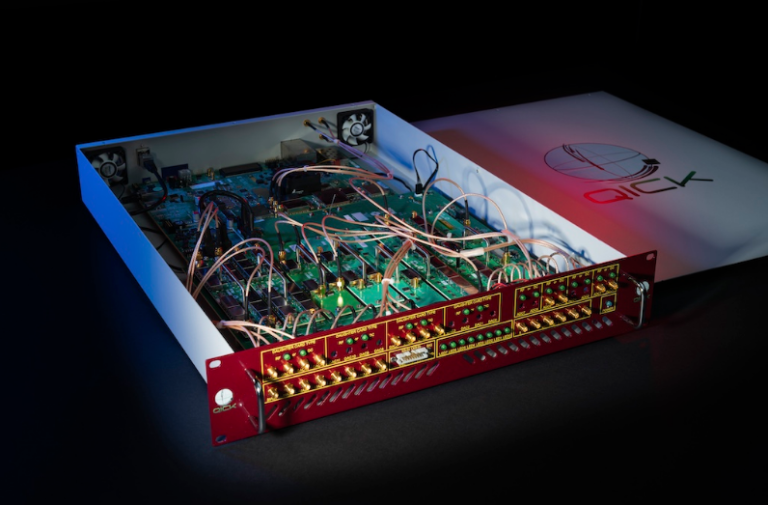
Fermi National Accelerator Laboratory, located just outside Batavia, Illinois, near Chicago, is a United States Department of Energy national laboratory specializing in high-energy particle physics. Fermilab's QICK box, an integrated system for quantum control, simplifies and enhances quantum research by consolidating hardware like FPGA boards, amplifiers, and filters into a compact, modular package. Building on the original Quantum Instrumentation Control Kit, the QICK box improves signal-to-noise ratios and qubit control, offering scalability and adaptability for evolving experiments. Developed with collaborators like Yale and the University of Chicago, it has become a widely adopted tool with over 350 users, aiding scientists in advancing quantum information science.
→

NASA
The National Aeronautics and Space Administration (NASA) is the U.S. government agency driving pioneering research and technological development in both atmospheric flight (aeronautics) and space exploration (astronautics). NASA acts as a research organization, utilizing advanced wind tunnels, supercomputing, and flight test laboratories to advance aircraft aerodynamics, propulsion, and materials, while simultaneously involved in the design, construction, and operation of launch vehicles and spacecraft for deep space exploration. Through its aeronautics research directorate, the agency works to improve the safety, efficiency, and environmental impact of aviation, whereas its space programs focus on developing cutting-edge flight systems, robotic explorers, and human transportation capabilities.
→

US Department of Energy
The United States Department of Energy is a cabinet-level department of the United States Government concerned with the United States' policies regarding energy and safety in handling nuclear material.
→