Researchers Explore Quantum Inspired AI Repair


Insider Brief
- Researchers from QDeep and ITMO University developed Tree-Ising, a method that repairs repetitive reasoning in small language models through targeted changes to their internal weights.
- Running on conventional GPUs, the method achieved 55.1% accuracy on MATH-500 for one model and increased another model’s GSM8K accuracy from 21.6% to 69.4% under specific test conditions.
- The team executed an eight-variable repair subproblem on an IBM quantum processor as a proof of concept, without demonstrating a quantum advantage or a complete model repair on quantum hardware.
Researchers have developed a method that repairs repetitive reasoning in small language models by changing selected internal weights, with a separate quantum hardware experiment testing a possible route for future work.
The study, by Hadi Salloum of QDeep in Riyadh, Saudi Arabia, and Ammar Ali of ITMO University’s Lab for Efficient AI and Data, introduces Tree-Ising, a system for turning model repairs into mathematical optimization problems. The researchers describe the method in a preprint posted to arXiv.
The main repairs ran on conventional graphics processors. One solver uses simulated bifurcation, a quantum-inspired computing method that runs on classical hardware. The quantum experiment addressed only a small part of a repair problem and did not demonstrate a quantum advantage.

The work targets reasoning loops, in which a language model keeps repeating parts of its answer instead of reaching a conclusion. Such behavior can consume the available response length without producing a useful result.
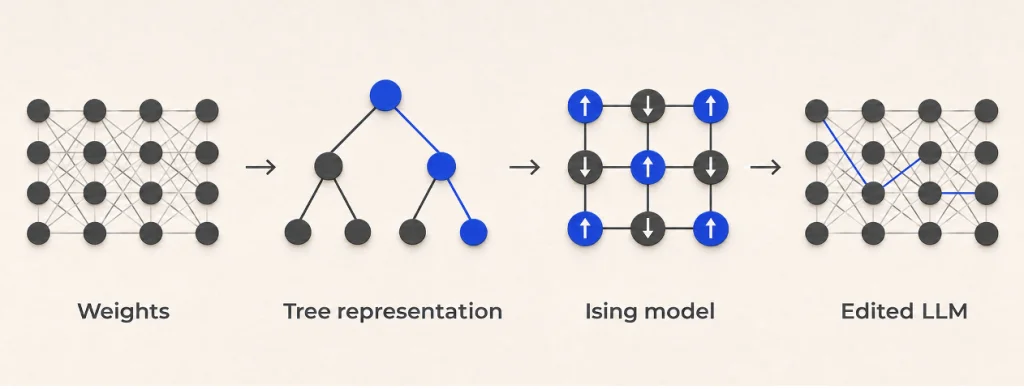
Tree-Ising addresses the problem through targeted edits to weights, the numerical settings that shape a neural network’s responses. Rather than retraining the entire model, the method searches for selected changes intended to repair the unwanted behavior.
The approach represents weights as trees of decisions and converts candidate edits into Ising problems, a mathematical framework for choosing among interacting alternatives. Computer solvers then select edits to apply to the model.
Using simulated bifurcation, the researchers reported 55.1% accuracy on MATH-500, a mathematics benchmark, for the Qwen3.5-0.8B model. An alternative conventional solver produced 54.6%, compared with 51.7% for an earlier AI-agent repair under the same evaluation protocol, according to the study.
In a separate experiment on Qwen3.5-2B, Tree-Ising increased accuracy on the GSM8K mathematics benchmark from 21.6% to 69.4%. That test used greedy decoding, which selects the most likely next piece of text at each step.
The researchers report that at this point the findings establish results under specific conditions, rather than a general improvement across uses. Broader applications will depend on successful scaling and practical validation.
For the quantum demonstration, the team ran an eight-variable repair subproblem on an IBM Heron processor using the Quantum Approximate Optimization Algorithm, or QAOA. This algorithm searches for solutions to optimization problems through a combination of quantum operations and classical computation.
The experiment tested whether a small repair problem could be executed on quantum hardware. It did not repair the full language model using a quantum computer.
“Our results show that targeted model repair can be expressed as an optimization problem. The IBM hardware experiment is an initial proof of concept. If this approach can be scaled and deliver practical benefits, it could become a promising direction for quantum computers to help improve large language models,” Salloum said in the accompanying news release.
For a deeper, more technical dive, please review the paper on arXiv. It’s important to note that arXiv is a pre-print server, which allows researchers to receive quick feedback on their work. However, it is not — nor is this article, itself — official peer-review publications. Peer-review is an important step in the scientific process to verify results.

Keep track of everything going on in the Quantum Technology Market. In one place.
Topics

Matt Swayne
With a several-decades long background in journalism and communications, Matt Swayne has worked as a science communicator for an R1 university for more than 12 years, specializing in translating high tech and deep tech for the general audience. He has served as a writer, editor and analyst at The Quantum Insider since its inception. In addition to his service as a science communicator, Matt also develops courses to improve the media and communications skills of scientists and has taught courses.
[email protected]

Stay Ahead of Quantum
Get the latest research, company news, and market intelligence every week.
MENTIONED IN THE ARTICLE

ITMO University
ITMO University is a leading Russian research university specializing in information technologies, photonics, and quantum technologies. Based in Saint Petersburg, it conducts advanced research in quantum computing, quantum optics, and quantum sensing, and is recognized for its innovation ecosystem, including the ITMO Highpark research and innovation center. The university collaborates with industry and international partners to advance scientific knowledge and develop practical applications in quantum and photonic technologies.
→

IBM
IBM is an iconic technology pioneer founded in 1911 as the Computing-Tabulating-Recording Company and officially renamed International Business Machines Corporation in 1924. Beyond foundational computing, IBM possesses a deep legacy in aerospace and defense from building the guidance computers and Instrument Unit for NASA's historic Apollo missions to partnering with Airbus on CIMON, the first AI assistant on the ISS.
→