ESA and European Commission to Build Quantum-Secure Space Communications Network


Insider Brief
- The European Space Agency (ESA) and the European Commission finalized their agreement on the European Quantum Communication Infrastructure (EuroQCI), enabling the development of a quantum-secure network across Europe.
- EuroQCI will use quantum key distribution (QKD) to enhance cybersecurity for critical government data and infrastructure by detecting interception attempts through quantum physics principles.
- ESA is leading the space-based component of EuroQCI through the Scylight program, including the Eagle-1 satellite, set to launch in 2026 to expand quantum-secure communications beyond terrestrial fiber networks.
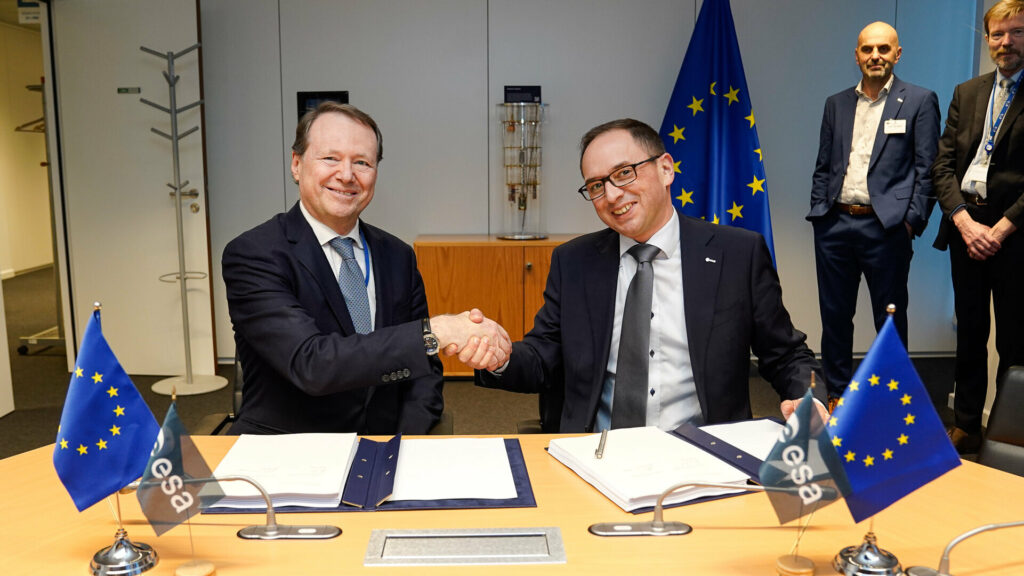
PRESS RELEASE — The European Space Agency (ESA) and the European Commission consolidated their cooperation on the European Quantum Communication Infrastructure (EuroQCI), marking the successful conclusion of negotiations and clearing the way for development to begin. EuroQCI is an advanced network that aims to protect everything from personal data to Europe’s critical infrastructure, using proven principles of quantum physics.
EuroQCI will enhance the security of critical government data by leveraging quantum key distribution (QKD), a technology that uses the principles of quantum physics to detect any attempt at interception. The system will also protect Europe’s vital infrastructure – from power grids that supply our electricity to emergency services that protect our communities in times of crises. This marks a significant step toward meeting the EU’s Digital Decade target of being at the forefront of quantum capabilities by 2030.
The technology works through two complementary systems. On Earth, it leverages existing fibre-optic internet cables enhanced with quantum security features. In space, ESA is leading the development of a satellite constellation through its Optical and Quantum Communications – Scylight programme to expand the reach of the QKD secure network across Europe and beyond.

This effort is being advanced through ESA’s Security And cryptoGrAphic mission (SAGA), which will demonstrate and validate space-based quantum technologies in orbit. In partnership with an industrial consortium led by SES Techcom and the European Commission, ESA is also supporting the development of Eagle-1, the first satellite for this space-based QKD system, scheduled for launch in 2026.
The project has received strong backing from all 27 EU Member States, demonstrating its importance for Europe’s future. The European Commission launched its first implementation phase for EuroQCI in 2023, with the next milestone focused on its gradual integration into IRIS², Europe’s new secure satellite constellation.
“Today, we celebrate the successful conclusion of negotiations and the signing of this Agreement, a pivotal step forward that highlights the power of partnership in achieving ambitious goals,” said Josef Aschbacher, ESA’s Director General. “Through our collaboration with the European Commission and Member States, we will ensure EuroQCI sets the global standard for secure and innovative quantum communication. ESA will lead the Contracting, Design, and Qualification authority, developing EuroQCI to protect critical information and assets, and spearheading R&D activities in space-based quantum technologies.”
Laurent Jaffart, ESA’s Director of Connectivity and Secure Communications, said: “By integrating quantum-based systems into existing infrastructures, EuroQCI will create a secure communication layer resistant to emerging cyber threats, advancing Europe’s cybersecurity strategy and strengthening our leadership in quantum technologies.”
Roberto Viola, the European Commission’s Director-General of Communications Networks, Content and Technology, said: “Yesterday, the Commission had announced the Competitiveness Compass, the key policy agenda for the coming years, which includes maintaining a leading position in quantum technologies. I therefore welcome the agreement with ESA under the EuroQCI, which brings us one step closer to realising our vision in quantum and more specifically of a quantum safe communication network for Europe based on terrestrial and satellite technologies. This agreement builds on our long-standing partnership with ESA in key space technologies and applications such as Copernicus, Galileo and IRIS² initiative.”

Keep track of everything going on in the Quantum Technology Market. In one place.

Matt Swayne
With a several-decades long background in journalism and communications, Matt Swayne has worked as a science communicator for an R1 university for more than 12 years, specializing in translating high tech and deep tech for the general audience. He has served as a writer, editor and analyst at The Quantum Insider since its inception. In addition to his service as a science communicator, Matt also develops courses to improve the media and communications skills of scientists and has taught courses.
[email protected]

Stay Ahead of Quantum
Get the latest research, company news, and market intelligence every week.
MENTIONED IN THE ARTICLE
European Space Agency
The European Space Agency (ESA) is an intergovernmental organization established in 1975 to shape European space capabilities, focusing on exploration, research, and technology development. The ESA Convention was signed in 1975, with the agency fully established by 1980, merging ELDO (launchers) and ESRO (research). Headquartered in Paris, it serves as Europe's gateway to space, uniting 22 member states to develop launchers, satellites, and robotic missions, collaborating frequently with NASA.
→

European Commission
The Commission represents and upholds the interests of the EU as a whole, and is independent of national governments. The European Commission prepares legislation for adoption by the Council (representing the member countries) and the Parliament (representing the citizens). It administers the budget and the policy programmes (agriculture, fisheries, research etc.) in cooperation with authorities in the member countries.
→

EuroQCI
The Quantum Technologies Flagship is a large-scale, long-term research initiative funded by the EU that brings together research institutions, industry and public funders, consolidating and expanding European scientific leadership and excellence in this field.
→