Orientom, Quandela Sign Agreement to Explore The Use of Quantum Computers to Solve Energy Grid Problems



Insider Brief
- Orientom announced that it had signed an agreement with Quandela to jointly develop a quantum software platform.
- The companies will work to develop practical quantum hybrid applications that utilize both classical and quantum computing resources and apply them to the next-generation power grid.
- Both companies focus on optimization problems related to distributed energy generation and transmission.
PRESS RELEASE — Orientom (CEO Seung-Hyeon Alfred Bang) announced that it had signed an agreement with Quandela, a global quantum computing company, to jointly develop a quantum software platform.
Both companies are focusing on using quantum computer technology to develop innovative solutions that address both power grid optimization and security issues and increase the efficiency of distributed energy systems.
The goal is for companies to develop practical quantum hybrid applications that utilize both classical and quantum computing resources and apply them to the next-generation power grid, with new energy management and planning that has not been solved for decades.

Both companies focus on optimization problems related to distributed energy generation and transmission, as well as new energy transportation and exchange methods, such as energy trading or forming microgrids. It aims to evaluate potential quantum utility optimization applications in the energy grid with Orientem’s quantum software platform (Atom-QTm).
Qandela, a French quantum computing company, recently launched its first pilot manufacturing line for high-performance photonic qubit devices, aiming to accelerate the deployment of error-correcting quantum computers. The company opened its first quantum computer factory in 2023 and has already provided two quantum computers to industrial customers.
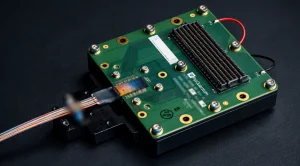
To build large-scale quantum computers, Qandela uses a pioneering approach that combines integrated photonics technology with semiconductor quantum dot-based devices that act as both spin qubits and photon generators. The technology is rooted in 20 years of top-level scientific research conducted at the French Institute of Communications and the French National Research Institute CNRS. The know-how was transferred to Qandela in 2017, and packaged devices have been commercialized since 2018.
To discover, learn, test, and develop the distributed traffic processing and energy (electric grid) algorithms being developed by Orientom, Qandela provides advanced quantum servers and easy-to-use software for creating and manipulating quantum circuits. It also provides access to middleware for running hybrid quantum-classical workflows in heterogeneous computing environments.
Niccolo Somaschi, CEO of Qandela, said, “Through this cooperation, we will apply the various use cases of quantum computers that are being demonstrated in Europe and North America to Korea, helping Korea take the lead as a global quantum test bed.”
“As global energy demand is rapidly increasing due to the spread of new renewable energy and electric vehicles, the importance of an energy grid with high efficiency and low carbon emissions is increasing,” said Orientom CEO Bang Seung-hyun. “Quantum computing solves problems that cannot be solved with existing methods.” “It will become a core technology in the future energy transition.”

Keep track of everything going on in the Quantum Technology Market. In one place.
Topics

Matt Swayne
With a several-decades long background in journalism and communications, Matt Swayne has worked as a science communicator for an R1 university for more than 12 years, specializing in translating high tech and deep tech for the general audience. He has served as a writer, editor and analyst at The Quantum Insider since its inception. In addition to his service as a science communicator, Matt also develops courses to improve the media and communications skills of scientists and has taught courses.
[email protected]

Stay Ahead of Quantum
Get the latest research, company news, and market intelligence every week.
MENTIONED IN THE ARTICLE

Orientom
Orientom develops application software and middleware that enable the use of quantum computing in fields such as finance, climate prediction, transportation, and energy management. The company works with industry and academic partners to explore practical applications of quantum algorithms.
→

Quandela
Quandela is a French startup that specializes in photonic quantum computing by providing modular, scalable, and energy-efficient photonic quantum computers, accessible both on the cloud and on premise. They provide prototyping services with their Perceval simulator alongside their general purpose chips optimized chips, and development of algorithms and protocols which provide photonic solutions for applications ranging from pharmaceutical and material design, to quantum machine learning, networking and optimization.
→

CNRS
The French National Centre for Scientific Research is among the world's leading research institutions. Its scientists explore the living world, matter, the Universe, and the functioning of human societies in order to meet the major challenges of today and tomorrow. Internationally recognised for the excellence of its scientific research, the CNRS is a reference in the world of research and development, as well as for the general public.
→