Argonne National Laboratory Launches Full-Stack Approach For Scalable Quantum Networks


Insider Brief
- Argonne National Laboratory is launching an initiative to to advance scalable quantum communications.
- InterQnet focuses on improving devices, error handling and network architecture.
- Quantum networks have evolved from small-scale experiments to metropolitan-scale demonstrations, yet scalability remains a critical hurdle.
Argonne National Laboratory has launched a project to advance scalable quantum communications, according to an update on the lab’s website.
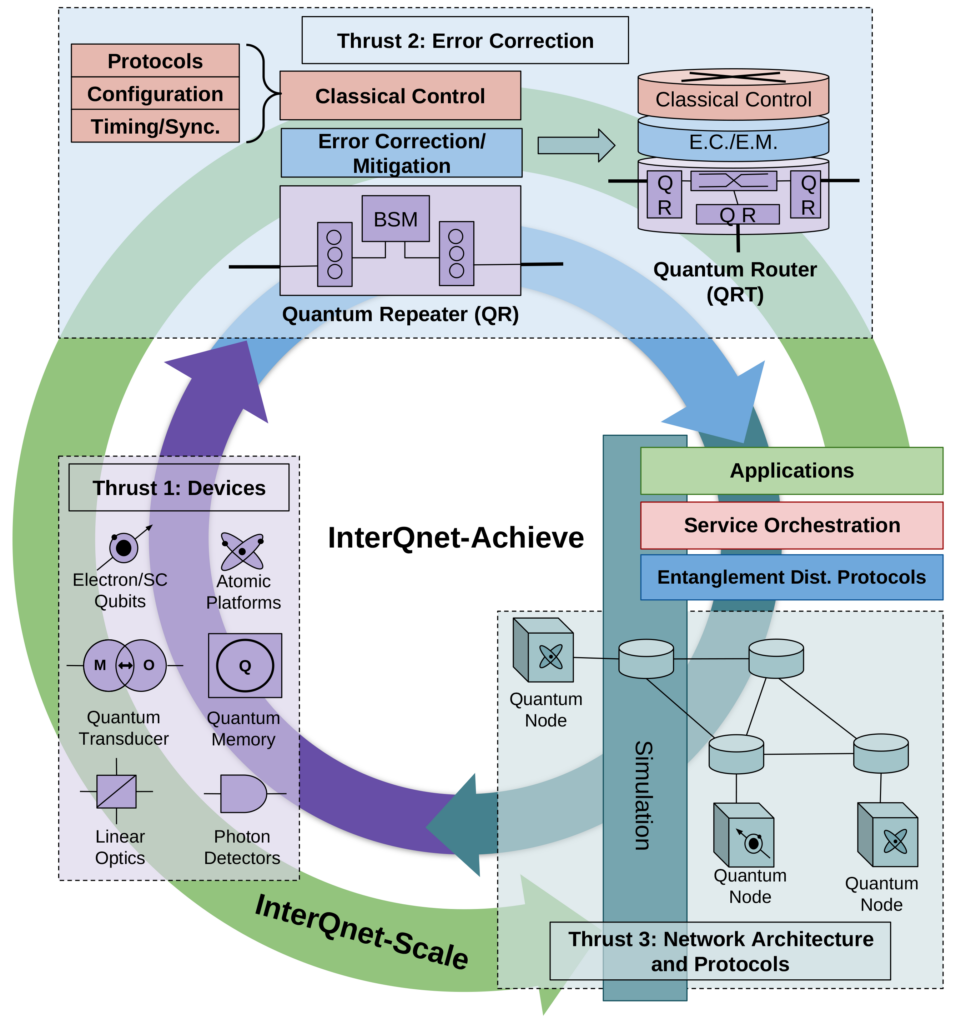
The initiative — called InterQnet — aims to confront many of the challenges of quantum networks through a comprehensive, systems-oriented approach. InterQnet focuses on improving devices, error handling and network architecture.
Quantum networks have evolved from small-scale experiments to metropolitan-scale demonstrations, yet scalability remains a critical hurdle, the team indicates. The increasing number of nodes, the distances between them, the diversity of applications, and the growing number of users compound the complexity of these networks. InterQnet addresses these challenges through a two-pronged strategy, integrating a systems approach into scalable quantum communications.

The team reports that the first prong, known as InterQnet-Achieve, emphasizes the practical realization of a heterogeneous quantum network. A heterogenous quantum communication network that involves different types of quantum systems or platforms that can interoperate with each other. In this context, the network involves constructing and integrating a prototype first-generation quantum repeater with an error mitigation scheme and a centralized automated network control system. The aim is to enable seamless quantum communications between two different quantum platforms, facilitated by a third platform functioning as a repeater node.
Argonne National Laboratory researchers suggest InterQnet-Achieve’s approach is poised to bridge the gap between disparate quantum systems, enhancing the robustness and reliability of quantum communications. If successful, a centralized control system could streamline operations and mitigate errors.
The second prong, InterQnet-Scale, focuses on a systems study of architectural choices for scalable quantum networks. The approach could lead to futuristic models of quantum network devices, advanced error correction schemes and entanglement protocols. Argonne researchers plan to conduct complex simulations combining these architectural choices within SeQUeNCe, a quantum network simulator under development at the laboratory.
By leveraging SeQUeNCe, InterQnet-Scale aims to explore and validate various architectural configurations, pushing the boundaries of what is possible in quantum network design. This strategic approach is designed to inform future implementations, ensuring that the networks are not only scalable but also efficient and resilient.
Overall, Argonne is laying out a comprehensive strategy that demonstrates importance of a holistic approach to quantum network development.
Argonne National Laboratory is a multidisciplinary science and engineering research center located near Chicago, Illinois, operated by the U.S. Department of Energy. It conducts leading-edge research in areas such as energy, materials science, biological systems and national security, aiming to solve some of the most pressing national challenges and drive technological innovation.
You can read more at Argonne National Laboratory’s website.

Keep track of everything going on in the Quantum Technology Market. In one place.

Matt Swayne
With a several-decades long background in journalism and communications, Matt Swayne has worked as a science communicator for an R1 university for more than 12 years, specializing in translating high tech and deep tech for the general audience. He has served as a writer, editor and analyst at The Quantum Insider since its inception. In addition to his service as a science communicator, Matt also develops courses to improve the media and communications skills of scientists and has taught courses.
[email protected]

Stay Ahead of Quantum
Get the latest research, company news, and market intelligence every week.
MENTIONED IN THE ARTICLE

Argonne National Laboratory
Argonne National Laboratory, one of the U.S. Department of Energy's national laboratories for science and engineering research, employs 3,400 employees, including 1,400 scientists and engineers, three-quarters of whom hold doctoral degrees. Argonne's annual operating budget of around $1 billion supports upwards of 200 research projects. Since 1990, Argonne has worked with more than 600 companies and numerous federal agencies and other organizations. The Lab has successfully launched its own Quantum Foundry to accelerate quantum information research.
→

U.S. Department of Energy (DOE)
The mission of the Department of Energy is to ensure America's security and prosperity by addressing its energy, environmental, and nuclear challenges through transformative science and technology solutions. In September, 2022, Research supported by ASCR demonstrated that classical machine learning algorithms can accurately predict ground state properties and classify quantum phases of matter using data generated from quantum experiments. In November, 2022, Research supported by Q-NEXT revealed that the performance of a sensor network is constrained by the intrinsic noise associated with the quantum states used in the network. In March, 2023, Research funded by DOE SC NP achieved the first experimental observation of entanglement between dissimilar particles, specifically positive and negative pions. In August, 2023, Research funded by DOE SC BER demonstrated strong preservation of entanglement in a two-photon absorption process involving organic molecules, offering a new approach for developing quantum light-based spectroscopy and microscopy.
→