


Insider Brief
- Alice & Bob announce the publication of its foundational research in Nature, showcasing the company’s advances in cat qubit technology.
- The researchers report on extending the bit-flip times from milliseconds to tens of seconds—thousands of times better than any other superconducting qubit type.
- The researchers used Alice & Bob’s ‘Boson 3’ chipset for this result.
PRESS RELEASE — Alice & Bob, a global leader in the race for fault-tolerant quantum computing, today announces the publication of its foundational research in Nature, showcasing significant advancements in cat qubit technology. This study, Quantum control of a cat-qubit with bit-flip times exceeding ten seconds, realized in collaboration with the QUANTIC Team (Mines Paris – PSL, Ecole Normale Supérieure and INRIA), demonstrates an unprecedented improvement in the stability of superconducting qubits, marking a critical milestone towards useful fault-tolerant quantum computing.
The researchers have dramatically extended the bit-flip times from milliseconds to tens of seconds—thousands of times better than any other superconducting qubit type.
Quantum computers face two types of errors: bit-flips and phase-flips. Cat qubits exponentially reduce bit-flips, which are analogous to classical bit flips in digital computing. As a result, the remaining phase-flips can be addressed more efficiently with simpler error correcting codes.

“This successful collaboration made the most of our cat qubit design to achieve very long bit-flip times while preserving quantum control,” said Raphaël Lescanne, CTO of Alice & Bob. “Although the journey is still unfolding, we remain dedicated to efficiently tackling the challenges of quantum error correction.”
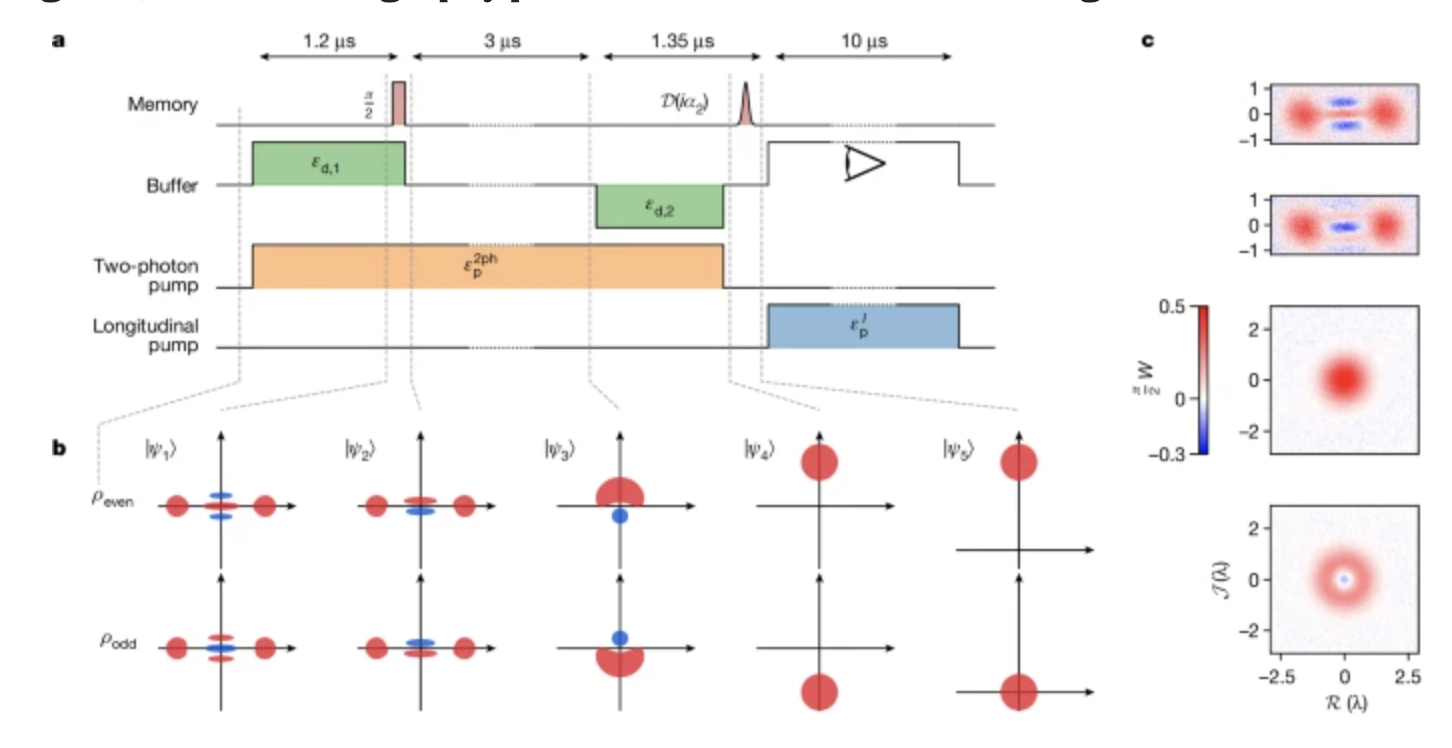
The researchers used Alice & Bob’s ‘Boson 3’ chipset for this record-breaking result, which features a cat qubit design named TomCat. TomCat employs an efficient quantum tomography (measurement) protocol that allows for the control of quantum states without the use of a transmon, a common circuit used by many quantum companies, but one of the major sources of bit-flips for cat qubits. This design also minimizes the footprint of the qubit on the chip, removing drivelines, cables, instruments, making this stable qubit scalable.
Recently, Alice & Bob made publicly available their new Boson 4 chipset that reaches over 7 minutes of bit-flip lifetime. The results from this Nature Publication can therefore be reproduced by users on Boson 4 over Google Cloud.
Although Alice & Bob’s latest Boson chips are getting closer to the company bit-flip protection targets, Alice & Bob plans to further advance their technology. The next iterations will focus on boosting the cat qubit phase-flip time and readout fidelity to reach the requirements of their latest architecture to deliver a 100 logical qubit quantum computer.
Key advances highlighted in the research include:
- Enhanced Quantum Control: The team demonstrated control of the phase of coherent superpositions while achieving macroscopic bit-flip times, a necessary step to scale these dynamical qubits into fully protected hardware-efficient architectures.
- Significant Reduction in Quantum Errors: By leveraging a system that inherently stabilizes against bit-flips, only phase-flips remain as the significant source of error, which can be corrected more efficiently. Instead of using a two-dimensional code to correct for both error types, a more efficient one-dimensional code addresses the phase flips.
“Alice & Bob is committed to further extending the stability of cat qubits and improving quantum error correction methods,” said Théau Peronnin, CEO of Alice & Bob. “This research, which has been recognized by Nature, highlights the feasibility of prolonged bit-flip times unmatched by other superconducting qubits.”