

Insider Brief
- The Air Force Research Laboratory is working to advance quantum computing and networking capabilities.
- With congressional support and funding, the AFRL has collaborated with several industry and academic partners to help build an industrial support system to advance quantum tech capabilities.
- Partnerships include IonQ, Rigetti, IBM and PsiQuantum.
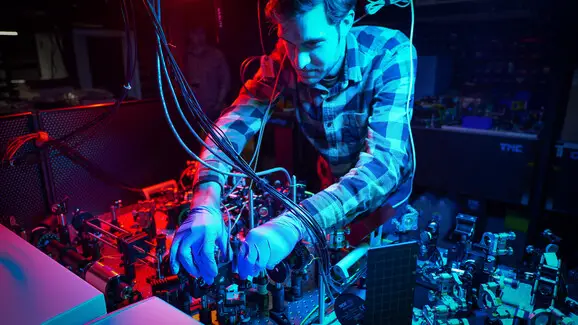
- Image and Story: U.S. Air Force photo / Keith Lewis, Story Air Force Research Laboratory
PRESS RELEASE — The Air Force Research Laboratory, or AFRL, is using all resources at its disposal to advance quantum computing and networking capabilities. In the past year, AFRL’s Information Directorate with congressional support and funding has collaborated with several industry and academic partners to help build an industrial support system that is advancing the United States’ capabilities in quantum technology.
AFRL has partnered with quantum technology companies like IonQ, Rigetti, IBM and PsiQuantum to utilize unique systems that explore quantum technologies from sensing to computing, all using fundamental principles of quantum mechanics to process data.
While AFRL researchers have been making advancements in various aspects of quantum information technologies for over 10 years, AFRL’s scientists have been able to accelerate the pace of development by incorporating commercial assets into ongoing research at the new AFRL Extreme Computing facility and the Innovare Advancement Center at the Griffiss Institute in Rome, New York.

“By gaining hands-on access to commercial technologies, we believe we are enabling greater progress toward quantum technology breakthroughs,” said Dr. Kathy-Anne Soderberg, AFRL senior scientist for quantum science and technology.
Soderberg and other scientists and researchers are advancing quantum technologies from the individual quantum bit, or qubit, level to the system level, to potentially connect different qubit types together in a network which could provide the U.S. Air Force with ultra-secure quantum communications with military applications.
A qubit is the quantum counterpart to a bit in classical computing, which is the basic unit or the smallest informational unit within a computer. The qubit plays a similar role in information storage. However, the use of qubits unlocks new computational abilities owing to their quantum properties such as entanglement, a state where two particles link together in a certain way; no matter how far apart they are in space, they remain the same.
“These collaborations are supporting Air Force-relevant research focused on delivering a future network to connect diverse quantum technologies across the battlefield, giving the warfighter tremendous advantages,” said Dr. Don Telesca, chief of the Quantum Information Sciences and Technology Branch at AFRL’s Information Directorate.
Commercial sector support is providing infrastructure that can assist AFRL research in quantum networks to realize distributed quantum computing. Quantum computers connected via a network can transmit classical and quantum bits of information between themselves. These quantum computers could then simulate complex scientific processes inaccessible to current computational platforms and integrate quantum sensors that promise measurements of unprecedented precision, according to Telesca.
“The commercial sector is an added asset to the research being conducted by AFRL,” said Dr. Michael Hayduk, deputy director of AFRL’s Information Directorate. “The computers, components, research and work that have been achieved and documented by these companies and academic institutions are accelerating quantum research and development for the economic and national security of the United States.”
According to Hayduk, AFRL is consistently seeking industry and academic partners to work with in the quantum space to expand the research capacity. Working together with industry AFRL researchers can identify and address gaps in technology, standards and workforce development through collaboration to benefit the U.S. Department of the Air Force and the warfighter.
About AFRL
The Air Force Research Laboratory, or AFRL, is the primary scientific research and development center for the Department of the Air Force. AFRL plays an integral role in leading the discovery, development and integration of affordable warfighting technologies for our air, space and cyberspace force. With a workforce of more than 12,500 across nine technology areas and 40 other operations across the globe, AFRL provides a diverse portfolio of science and technology ranging from fundamental to advanced research and technology development. For more information, visit www.afresearchlab.com.
If you found this article to be informative, you can explore more current quantum news here, exclusives, interviews, and podcasts.