

Insider Brief
- Harvard announced a significant breakthrough published in the scientific journal Nature.
- The researchers successfully executed large-scale algorithms on an error-corrected quantum computer with 48 logical qubits and hundreds of entangling logical operations.
- The experiments were led by Harvard University researchers in close collaboration with QuEra Computing, MIT, and NIST/UMD.
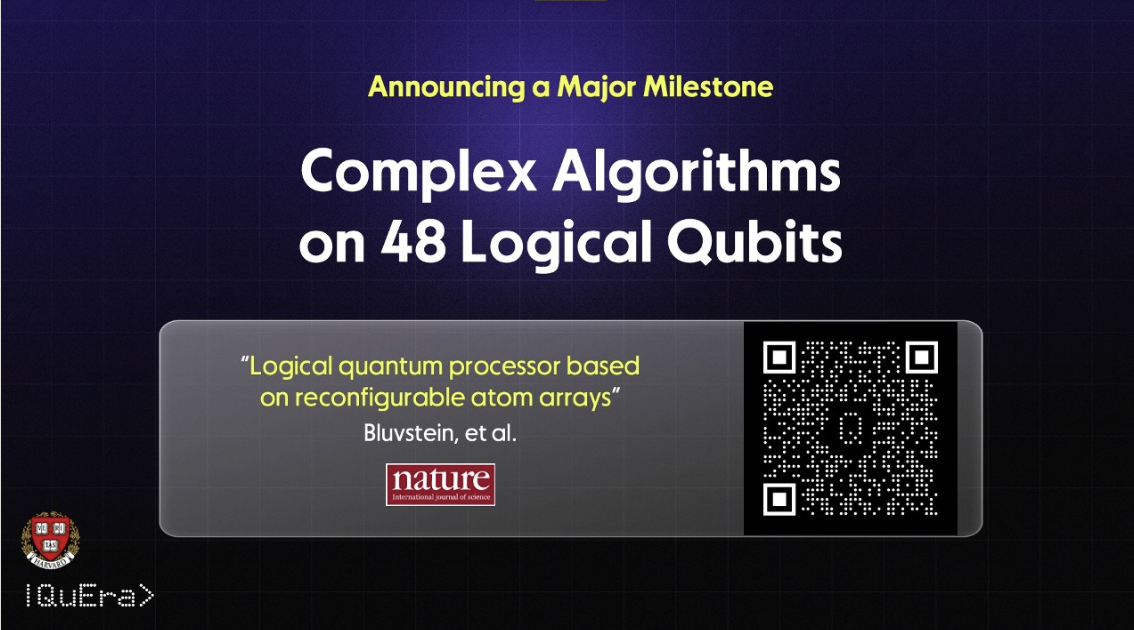
PRESS RELEASE — QuEra Computing, the leader in neutral-atom quantum computers, today announced a significant breakthrough published in the scientific journal Nature. In experiments led by Harvard University in close collaboration with QuEra Computing, MIT, and NIST/UMD, researchers successfully executed large-scale algorithms on an error-corrected quantum computer with 48 logical qubits and hundreds of entangling logical operations. This advancement, a significant leap in quantum computing, sets the stage for developing truly scalable and fault-tolerant quantum computers that could solve practical classically intractable problems. The complete paper can be accessed on Nature at https://www.nature.com/
“We at Moody’s Analytics recognize the monumental significance of achieving 48 logical qubits in a fault-tolerant quantum computing environment and its potential to revolutionize data analytics and financial simulations,” said Sergio Gago, Managing Director of Quantum and AI at Moody’s Analytics, “This brings us closer to a future where quantum computing is not just an experimental endeavor but a practical tool that can deliver real-world solutions for our clients. This pivotal moment could redefine how industries approach complex computational challenges.”
A critical challenge preventing quantum computing from reaching its enormous potential is the noise that affects qubits, corrupting computations before reaching the desired results. Quantum error correction overcomes these limitations by creating “logical qubits,” groups of physical qubits that are entangled to store information redundantly. This redundancy allows for identifying and correcting errors that may occur during quantum computations. By using logical qubits instead of individual physical qubits, quantum systems can achieve a level of fault tolerance, making them more robust and reliable for complex computations.

“This is a truly exciting time in our field as the fundamental ideas of quantum error correction and fault tolerance are starting to bear fruit,” said Mikhail Lukin, the Joshua and Beth Friedman University Professor, co-director of the Harvard Quantum Initiative, and co-founder of QuEra Computing. “This work, leveraging the outstanding recent progress in the neutral-atom quantum computing community, is a testament to the incredible effort of exceptionally talented students and postdocs as well as our remarkable collaborators at QuEra, MIT, and NIST/UMD. Although we are clear-eyed about the challenges ahead, we expect that this new advance will greatly accelerate the progress towards large-scale, useful quantum computers, enabling the next phase of discovery and innovation.”
Previous demonstrations of error correction have showcased one, two, or three logical qubits. This new work demonstrates quantum error correction in 48 logical qubits, enhancing computational stability and reliability while addressing the error problem. On the path to large-scale quantum computation, Harvard, QuEra, and the collaborators reported the following critical achievements:
-
Creation and entanglement of the largest logical qubits to date, demonstrating a code distance of 7, enabling the detection and correction of arbitrary errors occurring during the entangling logical gate operations. Larger code distances imply higher resistance to quantum errors. Furthermore, the research showed for the first time that increasing the code distance indeed reduces the error rate in logical operations.
-
Realization of 48 small logical qubits that were used to execute complex algorithms, surpassing the performance of the same algorithms when executed with physical qubits.
-
Construction of 40 medium-sized error-correcting codes by controlling 280 physical qubits.
The breakthrough utilized an advanced neutral-atom system quantum computer, combining hundreds of qubits, high two-qubit gate fidelities, arbitrary connectivity, fully programmable single-qubit rotations, and mid-circuit readout.
The system also included hardware-efficient control in reconfigurable neutral-atom arrays, employing direct, parallel control over an entire group of logical qubits. This parallel control dramatically reduces the control overhead and complexity of performing logical operations. While using as many as 280 physical qubits, researchers needed to program fewer than ten control signals to execute all of the required operations in the study. Other quantum modalities typically require hundreds of control signals for the same number of qubits. As quantum computers scale to many thousands of qubits, efficient control becomes critically important.
“The achievement of 48 logical qubits with high fault tolerance is a watershed moment in the quantum computing industry,” said Matt Langione, Partner at the Boston Consulting Group. “This breakthrough not only accelerates the timeline for practical quantum applications but also opens up new avenues for solving problems that were previously considered intractable by classical computing methods. It’s a game-changer that significantly elevates the commercial viability of quantum computing. Businesses across sectors should take note, as the race to quantum advantage just got a major boost.”
“Today marks a historic milestone for QuEra and the broader quantum computing community,” said Alex Keesling, CEO, QuEra Computing, “These achievements are the culmination of a multi-year effort, led by our Harvard and MIT academic collaborators together with QuEra scientists and engineers, to push the boundaries of what’s possible in quantum computing. This isn’t just a technological leap; it’s a testament to the power of collaboration and investment in pioneering research. We’re thrilled to set the stage for a new era of scalable, fault-tolerant quantum computing that can tackle some of the world’s most complex problems. The future of quantum is here, and QuEra is proud to be at the forefront of this revolution.”
“Our experience in manufacturing and operating quantum computers – such as our first-generation machine available on a public cloud since 2022 – coupled with this groundbreaking research, puts us in a prime position to lead the quantum revolution,” added Keesling.
The work was supported by the Defense Advanced Research Projects Agency through the Optimization with Noisy Intermediate-Scale Quantum devices (ONISQ) program, the National Science Foundation, the Center for Ultracold Atoms (an NSF Physics Frontiers Center), and the Army Research Office.
QuEra also announced a special event on Jan 9th at 11:30 AM ET, where QuEra will reveal its commercial roadmap for fault-tolerant quantum computers. Register for this online event at https://quera.link/roadmap
If you found this article to be informative, you can explore more current quantum news here, exclusives, interviews, and podcasts.