2023 Open Quantum Fellows: Undergrads Leading Quantum Innovations



The Chicago Quantum Exchange (CQE), through its Open Quantum Initiative (OQI) Fellowship Program, in collaboration with the Argonne National Laboratory, recently facilitated a unique opportunity for undergraduate students. This summer, eight out of 18 OQI fellows participated in the program, contributing significantly to the Q-NEXT research and development, a project under the U.S. Department of Energy’s National Quantum Information Science Research Center led by Argonne.
These fellows, immersed in quantum science laboratories and research groups, experienced first-hand the dynamic world of quantum information science and engineering (QISE). For many, it was their inaugural foray into the realm of QISE, offering them a comprehensive understanding of the life and responsibilities of a scientist in a laboratory setting. They learned to actively participate in research groups and effectively communicate complex experimental results.
A highlight of the program was a visit to HRL Laboratories in California, coupled with a symposium where the fellows presented their research findings.
In a recent Q&A, these eight fellows shared their experiences and insights gained from investigating various aspects of quantum information science and engineering during their summer with the Q-NEXT program. This fellowship has been a crucial step in driving the advancement of technology using the properties of nature’s smallest particles.

Atlas Sébastien Bailly
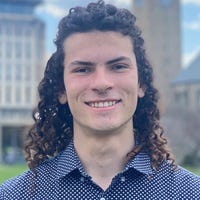
Atlas Sébastien Bailly.
Home institution: Cornell University
Major: Physics, mathematics
OQI institution: Argonne National Laboratory
Faculty mentor: Paul Kairys, postdoctoral appointee
Q: What was the focus of your OQI research this summer?
A: Autonomous characterization of nitrogen-vacancy centers in diamond. Initially, I worked on a computer model of the nitrogen-vacancy center, then used the model to explore optimal Bayesian experimentation.
Q: What was your role?
A: I was given a lot of freedom to explore my own ideas while working with my mentor on an existing project.
Q: What have you gained from the OQI experience?
A: By working with scientists and constantly being engaged with researchers or new startups through the OQI, I gained a lot of soft knowledge about QISE and science at large. Through my work, I built many practical skills and a foundational image of how science is done.
Q: What new perspectives do you have about QISE?
A: “Quantum stuff” has taken on an almost mythical/sci-fi aura in the public eye. This summer I learned that QISE is not composed of a top-secret Google basement but of a wide range of people with different technical goals and interests.
Q: What’s next for you?
A: I greatly enjoyed my work in QISE but feel that it would be premature to commit myself to any field. I want to explore more science and math and discover what else people are working on.
Q: What do you enjoy doing outside of research?
A: I’m an avid rock climber and outdoorsman, I love reading of all sorts, and in the past year I’ve rediscovered my passion for football (soccer).
Q: What advice do you have for other young people who are interested in pursuing a career in QISE?
A: Explore your interests before anything! The world is broad and QISE itself is unimaginably diverse.
Anais El Akkad
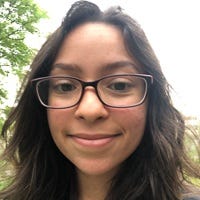
Anais El Akkad.
Home institution: Georgia Institute of Technology
Major: Physics
OQI institution: University of Illinois Urbana-Champaign
Faculty mentor: Elizabeth Goldschmidt, assistant professor of atomic, molecular and optical physics
Q: What was the focus of your OQI research this summer?
A: My OQI research this summer focused on studying the phenomenon of superradiance in a rare-earth doped crystal, which has potential applications to the development of quantum memories.
Q: What was your role?
A: I mainly worked on the experimental set-up, gaining lots of hands-on experience with arranging and aligning optics, as well as learning how to operate the laser.
Q: What have you gained from the OQI experience?
A: So much! I think I learned more this past summer than I have in any class. Being able to do hands-on work and see how science is done has truly reaffirmed my passion for physics. I also think the community is phenomenal — everybody involved in OQI, including my labmates, my peer OQI fellows and everybody who worked tirelessly to ensure we had a good experience were incredibly supportive and friendly and really made me feel like I belong in QISE.
Q: What new perspectives do you have about QISE?
A: I’ve learned how diverse and interdisciplinary QISE is. There are so many people from all sorts of different backgrounds working on various problems in quantum information. It’s such a vast field — there are so many ways to be involved in quantum.
Q: What’s next for you?
A: After my undergrad, I hope to pursue graduate studies and further immerse myself in the exciting research within QISE.
Q: What do you enjoy doing outside of research?
A: I love reading, hiking, baking and playing piano.
Q: What advice do you have for other young people who are interested in pursuing a career in QISE?
A: Don’t be afraid to seek new opportunities! Even if you don’t feel qualified, take every chance you get to meet professionals in the field, gain some hands-on experience and just put yourself out there. I never would have expected to find myself working in a quantum optics lab, and I’m so grateful to the OQI program for this amazing opportunity.
Gabriel Gaeta
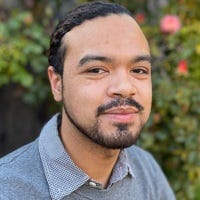
Gabriel Gaeta.
Home institution: San Jose State University
Major: Physics
OQI institution: Argonne National Laboratory
Faculty mentor: Jiefei Zhang, applied physicist, assistant staff scientist
Q: What was the focus of your OQI research this summer?
A: My research was focused on the growth of single-crystal thin films doped with rare-earth spin qubits and characterizing those qubits in the crystals through optical measurements in order to find optimal coherence times for quantum memory applications. I was primarily focused on growing erbium in cerium dioxide that would be used as a memory qubit for a quantum network.
Q: What was your role?
A: My role was that of a student researcher — I was given a lot of freedom within the constraints of working within a group, and I was also offered the guidance needed to achieve my goals. My work consisted of material growth in which I formed thin-layer depositions of single-crystal cerium dioxide on a substrate surface. I also gathered data through optical measurements by shooting a laser at the grown film and looked at emission as a way of characterizing the quality of grown film.
Q: What have you gained from the OQI experience?
A: I have gained numerous skills from simply working in the lab through this summer. But something I gained that was invaluable was experiencing the dynamic of working in a research group. It gave me insight into what goes on behind the research as well as into the different types of roles you can have as a researcher.
Q: What new perspectives do you have about QISE?
A: It’s a field of science that is still young and has immense potential and implications in the future. Quantum computers, quantum sensing and quantum communication were all things that I had no idea were possible prior to my opportunity with OQI and the CQE.
Q: What’s next for you?
A: Continuing my undergraduate program at San Jose State and pursuing other research opportunities in the future. I always want to have a plan as to what I will do once I am done with my main goal, and after my bachelor’s degree, I would love to pursue graduate school.
Q: What do you enjoy doing outside of research?
A: I am an avid film and TV lover. I love being immersed in entire other worlds and storylines, especially films that simply explore the human experience and the difficulties that go along with that. My favorite genres consist of dramas, science fiction, thrillers and biopics.
Q: What advice do you have for other young people who are interested in pursuing a career in QISE?
A: Have an open mind and go for it! I love being receptive to new ideas, and quantum was one of those. I had no idea that I was going to enjoy quantum research as much as I did, but I tried it and got to experience a wonderful time with so many like-minded people. Don’t let your doubts hold you back!
Kenneth Muhammad
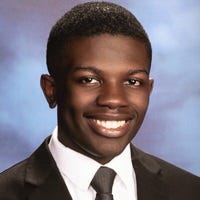
Kenneth Muhammad.
Home institution: Massachusetts Institute of Technology
Major: Electrical science and engineering
OQI institution: University of Illinois Urbana-Champaign
Faculty mentor: Paul Kwiat, Sony Bardeen chair in physics and electrical and computer engineering
Q: What was the focus of your OQI research this summer?
A: Our goal was to implement an active stabilization scheme for a tabletop interferometer setup and photonic integrated chip setup for use in time-bin encoding of quantum information.
Q: What was your role?
A: I built a tabletop Michelson interferometer setup and programmed a microcontroller to actively control the position of a translation stage using a piezoelectric actuator. I wrote some accompanying code to easily modify the control parameters and calculate the optimal set point using Python. I spent time learning theory as well and used this knowledge to inform my design.
Q: What have you gained from the OQI experience?
A: I have gained practical experience building optical setups, programming microcontrollers and designing a system that is user-friendly. Perhaps the most useful experience I have received is working with other researchers in the lab and both communicating my ideas clearly and asking them the right questions so as to learn as much as possible. Working in the lab allowed me the unique opportunity to learn things like quantum information science alongside building a project that uses the same theory, and I don’t think I could have gotten that anywhere else.
Q: What new perspectives do you have about QISE?
A: I used to not think much of the quantum technologies of today due to their lack of tangible applications and my lack of knowledge on the subject. Now, I believe that QISE is a rapidly growing field and there are likely many applications that we haven’t thought of yet. I’m excited to see what new branches of technology emerge as this whole thing unfolds.
Q: What’s next for you?
A: I am interested in learning more about applications of quantum information science, so I will likely find myself working in a lab continuing research in something that combines electronics and quantum mechanics. I’m also hoping to use my math background to dive deeper into the potential of this field.
Q: What do you enjoy doing outside of research?
A: I mainly enjoy playing video games, reading books and going for walks in places I’ve never been.
Q: What advice do you have for other young people who are interested in pursuing a career in QISE?
A: Pursue what you enjoy and play to your strengths.
Natasha Ninan
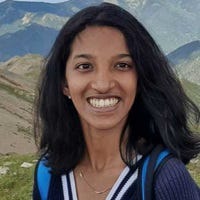
Natasha Ninan.
Home institution: University of Akron
Major: Electrical engineering
OQI institution: University of Wisconsin–Madison
Faculty mentor: Mikhail Kats, associate professor of electrical and computer engineering
Q: What was the focus of your OQI research this summer?
A: Our group is working on the design and fabrication of an optical bottle beam trap using a metasurface. Optical bottle beam traps are used to create optical tweezers for quantum devices such as atomic clocks or quantum computers. I worked on designing of the metasurface structure using the finite difference time domain (FDTD) method, which models the electrodynamics using Maxwell’s equations. Other group members are working on fabricating the resulting devices.
Q: What was your role?
A: The challenges in using scanning electron microscope imaging to assess the fabricated structure performance to the design necessitated the development of a simpler method to evaluate overall metasurface performance. I designed the witness sample metasurface that will be fabricated to easily evaluate the fabrication quality.
Q: What have you gained from the OQI experience?
A: Working in the Kats Research Group enabled me to learn more about optical trapping of atoms. In addition, I was able to learn how to design metasurfaces using FDTD and simulate possible fabrication error scenarios.
Q: What new perspectives do you have about QISE?
A: Being a part of Kats Research Group and the US Quantum Information Science School this summer has given me insight into different qubit creation methods. The various methods such as superconducting, trapped ions and photonic qubits present unique advantages. While these approaches have room for improvement, I expect the various qubit creation methods to become more application-specific.
Q: What’s next for you?
A: As a rising senior, I am working on applying for graduate school. This internship has given me the opportunity to explore my research interests. As I navigate the application process, I will be actively seeking projects in the fields of optical engineering, photonics and quantum sensing.
Q: What do you enjoy doing outside of research?
A: Traveling and hiking. When I’m not working on my coursework and research, I’m usually diving into researching new travel destinations and hiking adventures.
Q: What advice do you have for other young people who are interested in pursuing a career in QISE?
A: QISE is a multidisciplinary field. Having multiple opportunities in academia, industry and the national labs is very important to understand where you would like to contribute in QISE. In addition, it is equally as important to network and be open to hearing about the career paths of researchers in the field. This can provide valuable insights into your own path.
Peter Mugaba Noertoft
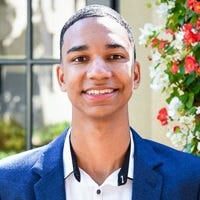
Peter Mugaba Noertoft.
Home institution: Stanford University
Major: Electrical engineering
OQI institution: University of Chicago
Faculty mentor: David Awschalom, Liew Family professor of molecular engineering, UChicago; senior scientist, Argonne; director of the Chicago Quantum Exchange
Q: What was the focus of your OQI research this summer?
A: This summer I joined the quantum sensing efforts in the Awschalom group working on magnetometry with the nitrogen-vacancy center in diamond.
Q: What was your role?
A: My role was to establish scanning probe magnetic field sensing capabilities to be used for characterization of various quantum devices. The goal is to use information about distributions of magnetic fields to learn about relevant device physics. This involved building an optical setup for confocal microscopy and creating instrument control code to network the necessary lab equipment.
Q: What have you gained from the OQI experience?
A: Through the OQI experience, I’m excited to have gained a deeper insight into what it means to be a scientist working in a lab. I’ve also enjoyed getting to know all the other fellows, who share a strong interest in quantum science and engineering.
Q: What new perspectives do you have about QISE?
A: This summer I’ve learned about the sheer breadth of opportunities related to quantum science and engineering. It has been very inspiring to hear how the problems people choose to work on are often related to their unique backgrounds and interests.
Q: What’s next for you?
A: I’ve really enjoyed spending my summer in a research lab, gaining hands-on experience as a scientist and engineer. During the upcoming academic year, I’m excited to continue working on my research project at my home institution and thinking about what role I can play in the world of science long term.
Q: What do you enjoy doing outside of research?
A: I am an avid cyclist and love outdoor bike rides. I also enjoy playing recreational soccer and basketball.
Q: What advice do you have for other young people who are interested in pursuing a career in QISE?
A: I would encourage anyone with an interest in quantum science and engineering to consider a wide range of ways to get involved. Doing is an excellent way of learning!
Rachelle Rosiles
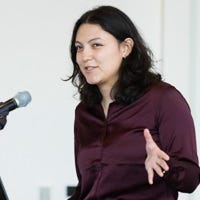
Rachelle Rosiles.
Home Institution: Illinois Institute of Technology
Major: Physics
OQI Institution: Argonne National Laboratory
Faculty Mentor: Nazar Delegan, assistant scientist
Q: What was the focus of your OQI research this summer?
A: The group I worked with this summer conducted experiments on the growth and characterization of nitrogen-vacancy centers in diamonds for quantum sensing on the diamond surface. I was particularly involved in the process of optically addressing and manipulating the qubit.
Q: What was your role?
A: For my role, I adapted the control software, nspyre, to integrate new optical devices and create more self-driven experiments.
Q: What have you gained from the OQI experience?
A: I gained perspective on different opportunities in quantum science in both industry and academia. The connections I made have been extremely rewarding by exposing me to new fields and opening up opportunities for me.
Q: What new perspectives do you have about QISE?
A: I see now that industry and academia are not mutually exclusive. Plenty of startups have spawned from research groups and have backgrounds in academia, while industries in quantum science rely heavily on people who can conduct research on the product they’re developing. I’ve also come to realize that there is a lot of investment and momentum in this field, so I know it is a great time to be getting in.
Q: What’s next for you?
A: I’m looking to continue my work in research as I figure out if graduate school is the path for me. There are some researchers I’m interested in working with next summer in quantum computing.
Q: What do you enjoy doing outside of research?
A: I enjoy caring for my plants, watching them grow and shaping the bonsai I have.
Q: What advice do you have for other young people who are interested in pursuing a career in QISE?
A: I would say that now is the perfect time to do so, whether your interest lies in the science, organization or the business side. There’s plenty of work to do, and many people are willing to talk and advise on how to get into the field, whether through the OQI fellowship or other means. Don’t let the word “quantum” intimidate because it is really not that inaccessible.
Rain Wang
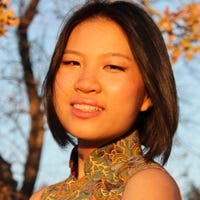
Rain Wang.
Home institution: Harvard University
Major: Physics
OQI institution: Argonne National Laboratory
Faculty mentor: F. Joseph Heremans, staff scientist, Argonne; affiliated scientist at the Pritzker School of Molecular Engineering at the University of Chicago
Q: What was the focus of your OQI research this summer?
A: Both projects that I worked on aimed toward realizing real-world quantum networking. In quantum networking, like any network, you have nodes, and you have connections that are essential to the network’s function. This summer, my main project optimized the connections in the Chicago Quantum Network, while my second project delved into characterizing a potential node for quantum communication.
Q: What was your role?
A: For my main project, I performed various analysis techniques to characterize the polarization drift in the fibers and eventually implement a protocol that would correct this drift (later phase as well). This was important for retaining information and clear communication. In my second project, I designed, optimized and built an optical/modulator setup that would enable the characterization of vanadium spin-defects in silicon carbide so that we can further understand its properties and potential for quantum communication.
Q: What have you gained from the OQI experience?
A: I am extremely grateful for the wealth of knowledge, relationships and resources that I have gained from the OQI experience. I had never been able to explore quantum this deeply prior to OQI, and this time has invigorated my curiosity and motivation to pursue such a new and exciting field through different avenues.
Q: What new perspectives do you have about QISE?
A: There is so much more opportunity in this field than I think I previously understood. There are research, entrepreneurial and communications opportunities — and more. Further, while current industry eyes are mostly on quantum computing, this experience has led to my developing interest in quantum sensing and communication. I’m excited to explore.
Q: What’s next for you?
A: I’m curious to explore the different sides of quantum beyond research. Quantum is such an interdisciplinary field — I want to see all its potential. While I love science, I am curious about industry-side roles and how to facilitate this science becoming accessible to the public. In summary: I’m not sure, but I am looking forward to finding out!
Q: What do you enjoy doing outside of research?
A: On campus, I am involved in activities from our Asian American Dance Troupe to Tech for Social Good club. I am very passionate about accessible education and empowering underrepresented people in STEM. I involve myself in mentorship programs and affinity groups that realize those goals. I also love to cook, bake, exercise and paint with friends and family.
Q: What advice do you have for other young people who are interested in pursuing a career in QISE?
A: It’s never too early to discover your passions! There are so many available opportunities and resources to start investigating quantum at any age, you just have to look (OQI is an amazing example). It can be extremely daunting, but you can take that first step. Don’t be afraid to reach out to people; people are always happy to help.
The experience of participating in the Open Quantum Initiative (OQI) Fellowship Program reaffirmed the above students’ passion for physics and science, broadening their perspectives and opening up new academic and career possibilities in QISE. Many expressed a desire to continue exploring this field through further studies and research, demonstrating the program’s success in inspiring the next generation of quantum scientists and engineers.
Funding was provided by the University of Chicago, The U.S. Department of Energy Office of Technology Transitions and Q-NEXT, the Illinois Quantum Information Science and Technology Center at the University of Illinois Urbana-Champaign, HQAN at the University of Wisconsin–Madison, the Ohio State University, Gordon and Betty Moore Foundation, and UChicago’s Inclusive Innovation in the Sciences Fund.
For more market insights, check out our latest quantum computing news here.

Keep track of everything going on in the Quantum Technology Market. In one place.
Topics

James Dargan
James Dargan is a writer and researcher at The Quantum Insider. His focus is on the QC startup ecosystem and he writes articles on the space that have a tone accessible to the average reader.

Stay Ahead of Quantum
Get the latest research, company news, and market intelligence every week.
MENTIONED IN THE ARTICLE

Argonne National Laboratory
Argonne National Laboratory, one of the U.S. Department of Energy's national laboratories for science and engineering research, employs 3,400 employees, including 1,400 scientists and engineers, three-quarters of whom hold doctoral degrees. Argonne's annual operating budget of around $1 billion supports upwards of 200 research projects. Since 1990, Argonne has worked with more than 600 companies and numerous federal agencies and other organizations. The Lab has successfully launched its own Quantum Foundry to accelerate quantum information research.
→

U.S. Department of Energy (DOE)
The mission of the Department of Energy is to ensure America's security and prosperity by addressing its energy, environmental, and nuclear challenges through transformative science and technology solutions. In September, 2022, Research supported by ASCR demonstrated that classical machine learning algorithms can accurately predict ground state properties and classify quantum phases of matter using data generated from quantum experiments. In November, 2022, Research supported by Q-NEXT revealed that the performance of a sensor network is constrained by the intrinsic noise associated with the quantum states used in the network. In March, 2023, Research funded by DOE SC NP achieved the first experimental observation of entanglement between dissimilar particles, specifically positive and negative pions. In August, 2023, Research funded by DOE SC BER demonstrated strong preservation of entanglement in a two-photon absorption process involving organic molecules, offering a new approach for developing quantum light-based spectroscopy and microscopy.
→
HRL Laboratories
HRL Laboratories is a world leader in developing solid-state technology for quantum computing and networking. They are advancing a variety of technologies including silicon heterostructure quantum dot qubits, silicon carbide photonics, superconducting nanowire single photon detectors, chip-scale atom-optics components, and microwave-dot hybrid systems. HRL’s campus in Malibu, CA is equipped with on-site epitaxial semiconductor growth tools, a 10,000-square-foot nano-fabrication cleanroom facility, high-performance computational resources for theory and simulation, and cryogenic test and measurement laboratories. It is the same site that originated with inventions such as the self-aligned gate MOSFET and the world’s first laser. HRL’s semiconductor quantum chip, known as SLEDGE, is one of the quantum computing devices that will be available for UW–Madison researchers and students under a new industry partnership through the LPS Qubit Collaboratory.
→

Cornell University
Cornell University, a private Ivy League research university, is situated in Ithaca, New York. It was established in 1865 by Ezra Cornell and Andrew Dickson White.
→

University of Illinois at Urbana-Champaign
The University of Illinois Urbana-Champaign, located in Champaign and Urbana, Illinois, United States, is a public land-grant research university. Established in 1867, it serves as the flagship university of the University of Illinois system.
→
Massachusetts Institute of Technology (MIT)
The Massachusetts Institute of Technology, located in Cambridge, Massachusetts, functions as a privately funded research university. It was founded in 1861 and has played a crucial part in advancing various fields of modern technology and science.
→

Sony
Sony Semiconductor Solutions specializes in the development and manufacturing of advanced semiconductor products, with a focus on CMOS image sensors for automotive, industrial, and consumer applications. The company is recognized for its innovations in pixel miniaturization, quantum efficiency, and on-chip signal processing, enabling high-performance imaging solutions such as the IMX775 RGB-IR sensor for in-cabin automotive monitoring. Sony Semiconductor Solutions contributes to enhanced safety and precision in automotive systems and maintains a leading position in the global image sensor market.
→

Stanford University
Stanford University is a teaching and research institution dedicated to providing graduate programs in the area of law, medicine, education or business.
→