

Quantum-based Companies Make it on XPRIZE, Bessemer Venture Partners’ List of Top 100 Private Deep Tech Companies

XB100
Hub Hub

Insider Brief

  • PsiQuantum, XtalPi and Xanadu are the quantum representatives on the just published XB100.
  • XB100 is a ranking of the world’s top 100 deep technology companies.
  • The list was commissioned by XPRIZE and Bessemer Venture Partners.
  • Image: XPRIZE, Bessemer Venture Partners

Three quantum-based companies are listed on the XB100, a ranking of the world’s top 100 private deep technology companies, a list commissioned by XPRIZE and Bessemer Venture Partners.

PsiQuantum, XtalPi and Xanadu are the quantum representatives on the list of deep tech companies that covers nine deep tech sectors — Agriculture, Artificial intelligence (AI), Aviation, Climate, Mobility, Next-gen biotech, Quantum, Robotics, and Space — and features luminaries, such as OpenAI and SpaceX.

PsiQuantum and Xanadu are both photonic-based quantum computer startups and XtalPi, number 89 on this list, is using quantum physics and artificial intelligence for drug discovery and development.

Introducing TQI 2.0Introducing TQI 2.0

PsiQuantum was placed at 67 on the list and Xanadu was listed at 92 on the XB100. Judges placed XtalPi at 89.

The businesses were evaluated on four criteria: impact on humanity, valuation, scientific difficulty and commercial traction.

Judges include:

  • Anousheh Ansari: Astronaut and CEO of XPRIZE
  • Emily Calandrelli: Science Communicator, Author, and Emmy-nominated TV Host
  • Lori Garver: Co-founder of the Brooke Owens Fellowship and former Deputy Administrator at NASA
  • Ray Johnson: CEO of Technology Innovation Institute and former CTO of Lockheed Martin
  • Stacy Kauk: Sustainability Expert
  • Ray Kurzweil: Author, Inventor, and Futurist
  • Tina Seelig: Executive Director of Knight-Hennessy Scholars at Stanford University
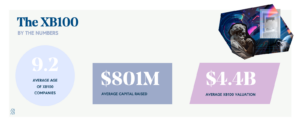
According to a blog post about the list, the average company on the XB100 has been around for 9.2 years, has raised, on average, $801 million in capital, and is valued at $4.4 billion, A total of 84 are unicorns, or valued over $1 billion.

In terms of the list’s technological readiness level — or TRL — quantum is the most frontier of the deep technologies covered on the XB100.

“The company category with the lowest TRL was quantum computing, with a TRL of 4, while the company categories with the highest TRL were robotics and mobility, each with a TRL of ~8.5,” according to a blog post on the state of deep tech.

TRL 4 is a level at which the technology has achieved “component and/or system validation in a lab environment.”

However, quantum computing is included on the list because of its potential to solve the world’s biggest scientific and commercial challenges, according to the post.

“When quantum computers reach “quantum advantage,” the point where they’re powerful and stable enough to outperform classical computers in solving commercially valuable problems, they will revolutionize pharmaceuticals, logistics, financial services, automotive, and other industries,” They write, adding, “For instance, if a deep tech company actually manages to build a commercial quantum computer, it’s a no-brainer that the market is more than big enough and that customers will clamor to use it.”

You can read about the XPRIZE and Bessemer Venture Partner’s State of Deep Tech here.

If you found this article to be informative, you can explore more current quantum news here, exclusives, interviews, and podcasts.


 

Keep track of everything going on in the Quantum Technology Market. In one place.

Share

Stay Ahead of Quantum

Get the latest research, company news, and market intelligence every week.

MENTIONED IN THE ARTICLE

PsiQuantum
CompanyUnited States · 501-1000 FTEs

PsiQuantum is developing a utility scale fault tolerant quantum computer utilizing photonic qubits and standard semiconductor manufacturing processes. Founded in 2015, the company collaborates with aerospace partners like Airbus and Lockheed Martin on algorithms for fluid mechanics, aerodynamics, and impact modeling.

→
Xanadu
CompanyCanada · 101-500 FTEs

Xanadu is a Canadian photonic quantum computing company founded in 2016 that is building fault tolerant systems utilizing light. The company collaborates with defense and hardware partners like AMD and Lockheed Martin to accelerate computational fluid dynamics simulations and train an aerospace engineering workforce.

→
Bessemer Venture Partners
InvestorUnited States · 101-500 FTEs

Bessemer Venture Partners (BVP) is one of the oldest and most established venture capital firms in the world, tracing its roots to 1911 as a private family office created by Henry Phipps Jr. Formally establishing itself as a dedicated venture capital firm in the 1970s and opening a Silicon Valley office in 1975, the firm now manages over $19-20 billion in assets and specializes in early-stage and growth investments across sectors including cloud computing, cybersecurity, fintech, and AI. With a global presence through offices in San Francisco, New York, Boston, Bangalore, and Tel Aviv, BVP has helped scale hundreds of companies, with a portfolio boasting over 150 IPOs, including notable successes such as Shopify, LinkedIn, Pinterest, Twilio, and Yelp.

→
OpenAI
Enterprise UserUnited States · 1001-5000 FTEs

OpenAI is an artificial intelligence research and deployment organization. Its stated mission is to ensure that artificial general intelligence (AGI) benefits all of humanity. The organization builds advanced AI models (e.g. large language models, multimodal systems) and provides them via APIs and consumer products, aiming to balance innovation with safety and governance.

→
NASA
InvestorUnited States · 10001+ FTEs

The National Aeronautics and Space Administration (NASA) is the U.S. government agency driving pioneering research and technological development in both atmospheric flight (aeronautics) and space exploration (astronautics). NASA acts as a research organization, utilizing advanced wind tunnels, supercomputing, and flight test laboratories to advance aircraft aerodynamics, propulsion, and materials, while simultaneously involved in the design, construction, and operation of launch vehicles and spacecraft for deep space exploration. Through its aeronautics research directorate, the agency works to improve the safety, efficiency, and environmental impact of aviation, whereas its space programs focus on developing cutting-edge flight systems, robotic explorers, and human transportation capabilities.

→
Lockheed Martin
InvestorUnited States · 10001+ FTEs

The Lockheed Martin Corporation is a preeminent global aerospace and defense powerhouse, tracing its roots to late 1912 when pioneers Glenn Martin and brothers Allan and Malcolm Lockheed established independent aviation firms. Officially formed in 1995 through the merger of Lockheed Corporation and Martin Marietta, its Aeronautics division researches, designs, and manufactures advanced tactical aircraft, including the F-35 Lightning II, while its Space division builds critical launch vehicles and satellites.

→
Stanford University
UniversityUnited States · 10001+ FTEs

Stanford University is a teaching and research institution dedicated to providing graduate programs in the area of law, medicine, education or business.

→

More in Research

Related Articles