

Insider Brief
- Researchers have developed a photon-number-resolving system to accurately resolve more than 100 photons.
- The team reports that it’s a step forward in capability for quantum computing development efforts, which may enable quantum generation of truly random numbers.
- Critical Quote: “They could predict that they were resolving 100 of these photons that were impacting upon the detectors with this extremely accurate resolution.” — Robert Edwards, senior staff scientist and deputy associate director for theoretical and computational physics at Jefferson Lab
PRESS RELEASE — Experts in nuclear physics and quantum information have demonstrated the application of a photon-number-resolving system to accurately resolve more than 100 photons. The feat is a major step forward in capability for quantum computing development efforts. It also may enable quantum generation of truly random numbers, a long-sought goal for developing unbreakable encryption techniques for applications in, for instance, military communications and financial transactions. The detector was recently reported in Nature Photonics.
Physicists around the world are hotly pursuing the promise of reliable and robust quantum computing. Not only would harnessing quantum computing herald a giant leap for science, but it would also elevate the economy and enhance national security. But getting there has so far eluded the best brains on the planet.
A pair of engineers at the U.S. Department of Energy’s Thomas Jefferson National Accelerator Facility has designed a crucial piece of a photon detection system that has brought physicists a step closer to fully operational photonics-based quantum computing — that is, a quantum computer built entirely with light. The engineers are part of an interdisciplinary team of federal and academic researchers led by Jefferson Lab who are working on advancing quantum computing in nuclear physics.

There are many different ways to try to make a fully functioning quantum computer. For photonics-based computing, quantum detection of light particles, or photons, is vital. Currently, individual detectors can resolve up to about 10 photons, but that number is too small for many quantum-state generation methods. No one had yet demonstrated detection of more than 16 photons, but simulations suggest that quantum computing will require detecting large numbers of photons — 50 or more.
Crossing that 50-photon threshold means being able to implement a “cubic gate” — a milestone toward building a complete gate set for universal quantum computing, explained Amr Hossameldin, team member and graduate research assistant in quantum computing and quantum optics at the University of Virginia.
The team blew past the record of 16 photons and demonstrated a photon count of about 35 per single detector and reached 100 photons with a three-detector system.
“They could predict that they were resolving 100 of these photons that were impacting upon the detectors with this extremely accurate resolution,” said Robert Edwards, senior staff scientist and deputy associate director for theoretical and computational physics at Jefferson Lab. “It’s super accurate — and that has never been achieved.
“The lack of detection has been a major limitation to this approach of quantum computing. The new photon number resolution is the necessary step to implementing a universal instruction set.”
The new detection system also has another highly valuable secondary benefit: quantum generation of truly random numbers — a boon to unbreakable secret codes or encryptions in such areas as military communications and financial transactions.
So-called random numbers generated by classical computer algorithms aren’t truly random. The algorithm they are generated from can be compromised with some effort by playing a numbers game — looking for which numbers pop up more often than others. True random-number generation using quantum physics has no such flaw or bias.
“There is an intrinsic randomness in quantum mechanics, where you can have a physical system that’s in two states at once,” explained Olivier Pfister, a physics professor at UVa who specializes in quantum fields and quantum information and served as external team leader for the project. “And when you want to know which it is, it’s random.
“Einstein got bugged by this. He called it ‘the Old One playing dice with the universe.’ And we don’t know any better than Einstein.”
Pfister and Hossameldin are co-authors of a paper presenting the team’s research in the peer-reviewed journal Nature Photonics. Other authors are Chris Cuevas and Hai Dong from Jefferson Lab, Richard Birrittella and Paul Alsing from the Air Force Research Laboratory in New York, Miller Eaton from UVa, and Christopher C. Gerry from the City University of New York.
Signals not seen before
The team effort was inspired by an announcement in 2019 by the DOE Office of Science offering funding opportunities for quantum information science research for nuclear physics under the Quantum Horizons program. Edwards secured a small grant to fund a lecture series bringing in experts in quantum computing.
Pfister was the first lecturer in March 2020. A week later, the COVID-19 pandemic shut down the lab, but the seed for joint research into photonics-based quantum computing had been planted.
A large team of physicists, engineers and postdocs was assembled. Funding was secured through the Laboratory Directed Research & Development (LDRD) program. The LDRD program supports projects on the forefront of science and technology. The collaboration began with the goal to use quantum photonics for calculations relevant to the Jefferson Lab science program.
UVa already had a photon-based system for making quantum calculations using a pulsed laser, but lacked the means to detect with great speed and accuracy the number of photons impacting on its detector before the signal decayed.
Meanwhile, detecting particles with speed and accuracy is Jefferson Lab’s forte. Its Continuous Electron Beam Accelerator Facility, or CEBAF, has been used for decades in experiments that rely on ultra-sensitive detectors to measure the cascade of fleeting subatomic particles created when a particle beam slams into targets at nearly the speed of light. CEBAF is a DOE Office of Science user facility that is accessed by more than 1,850 nuclear physicists for their research.
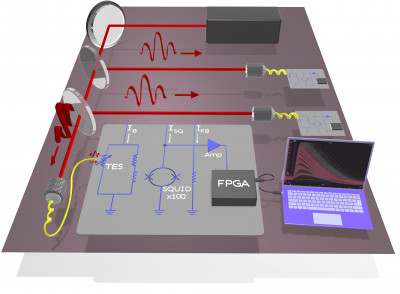
In a team experiment at Pfister’s Quantum Optics Lab at UVa, Hossameldin linked up three superconducting transition-edge sensor (TES) devices to make one detector, with each TES device capable of seeing 35 photons, and set them in front of the laser and turned on the beam.
A high-speed digitizer designed and developed by Dong at Jefferson Lab was a key piece of the detector electronics.
“The TES original digitizers did not have the high-speed capabilities that are included with our design,” said Cuevas. “Our digitizer has a 12-bit accuracy with a 4ns sampling time, so this allowed us to capture signals from the TES that were not seen before.”
Research for quantum computing is evolving at an exponential pace, and Cuevas predicts new technology will replace their system soon. But the larger collaboration to build a light-based quantum computer continues.
“The project is a very good example where designs can be reused and applied to a completely different scientific application,” Cuevas said. “Sharing technology is a core foundation for the scientific communities and, as electronics engineers, it is exciting to know our designs can further important discoveries.”
Jefferson Lab — By Tamara Dietrich
For more market insights, check out our latest quantum computing news here.