Cambrige Quantum, Honeywell Quantum Solutions Merger Official, Creating A Quantum Giant




Expected for months, Quantinuum, a merger between UK-based Cambridge Quantum and US-based Honeywell Quantum Solutions, officially launched today.
The Quantum Insider announced the merger of the two companies in June. Separately, the two companies were leaders in quantum hardware and software. Honeywell Quantum Solutions (HQS) is a pioneer in ion-trap quantum computer development and Cambridge Quantum has been in the forefront of the creation of quantum software and the commercialization of quantum technology.
The new company will be headed by Ilyas Khan, CEO, and Tony Uttley, president and COO. Honeywell CEO Darius Adamczyk will be Quantinuum’s chairman.
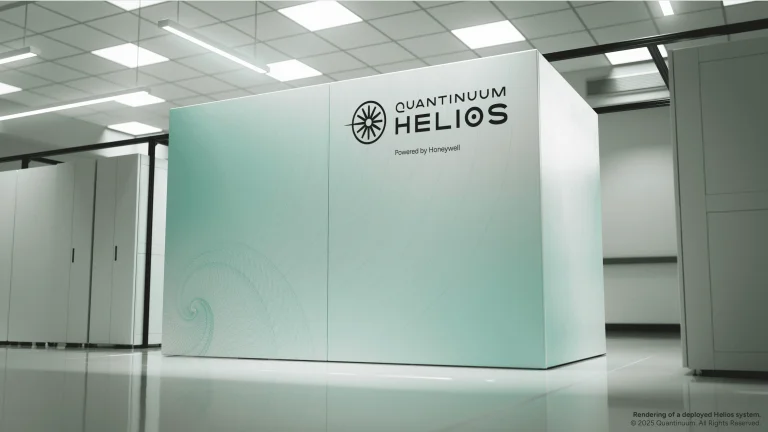
Perhaps now the world’s largest quantum computing company and the world’s only quantum firm with a full-stack software and hardware pairing, Quantinuum offers a juggernaut of quantum hardware and software solutions. The company will still hold to its is hardware agnostic approach and allow access to multiple quantum systems via the cloud. Plans are to continue serving as an IBM Quantum Hub and operating Honeywell’s Quantinuum System Model H1.

Quantinuum’s H1 has set numerous performance records. The system has consistently claimed records for quantum volume, for example. In March, The device passed the quantum volume 512 benchmark, outputting heavy outcomes 73.32% of the time, above the 2/3 threshold with 99.54% confidence.
On the software side, the new company will touch nearly every solution and use case theorized as ideal for quantum computers. Those solutions include TKET, a high-performance hardware-agnostic quantum software development kit, which is completely open-source. Quantum Natural Language Processing is another area where the new company will be an industry leader. In October, Quantum Natural Language Processing (QNLP) was released on, again, a fully open-sourced basis.
“One of the great advantages of quantum computing — one of its great promises — is that you can do things differently,” Khan said in an earlier interview. “With lambeq we have proven that AI need not be a black box: it can be accountable. It can be interpretable.”
The company will also have a leadership position in cybersecurity, one of quantum’s big challenges-opportunities, with its product IronBridge.
In an earlier interview when the merger plans were announced, Quantinuum’s leadership reflected on the importance of the new company.
“I’m excited that we can become an exemplar in the quantum industry as we also become the center of gravity for the ecosystem,” said Khan. “And I think that if, indeed, quantum computing and quantum technologies is the next Industrial Revolution, which is what many of us believe, then I think that I’d like us to be the exemplar of how to do this correctly.”
Uttley called the move an “inflection point” for quantum.
“This has the potential to become that inflection point in a new technology; the moment when we can harness what might be possible,” said Uttley. “The benefits of quantum to humankind really are that important and we want to have this new company be an accelerator to show how quantum computing can create value. That’s what makes me super excited, makes me smile every time I wake up in the morning and say, ‘Hey, we’re really gonna do this.’”
Based on reports, the company’s next step will to become a publicly traded firm.
Honeywell currently holds a 54% stake in Quantinuum.
For more market insights, check out our latest quantum computing news here.

Keep track of everything going on in the Quantum Technology Market. In one place.
Topics

Matt Swayne
With a several-decades long background in journalism and communications, Matt Swayne has worked as a science communicator for an R1 university for more than 12 years, specializing in translating high tech and deep tech for the general audience. He has served as a writer, editor and analyst at The Quantum Insider since its inception. In addition to his service as a science communicator, Matt also develops courses to improve the media and communications skills of scientists and has taught courses.
[email protected]

Stay Ahead of Quantum
Get the latest research, company news, and market intelligence every week.
MENTIONED IN THE ARTICLE

Quantinuum
Quantinuum builds full-stack quantum computing solutions for practical deployment. Leveraging proprietary enhancements to trapped-ion QCCD architecture, the company has launched multiple commercial hardware generations that deliver leading two-qubit gate fidelity and industry-topping accuracy.
→

Honeywell
Honeywell Aerospace, founded in 1906, is a global company focused on aviation technology, with hardware and avionics utilized on nearly all commercial and military aircraft. The division specializes in designing and manufacturing advanced aircraft engines, flight decks, satellite communications, and auxiliary power systems.
→
IBM
IBM is an iconic technology pioneer founded in 1911 as the Computing-Tabulating-Recording Company and officially renamed International Business Machines Corporation in 1924. Beyond foundational computing, IBM possesses a deep legacy in aerospace and defense from building the guidance computers and Instrument Unit for NASA's historic Apollo missions to partnering with Airbus on CIMON, the first AI assistant on the ISS.
→