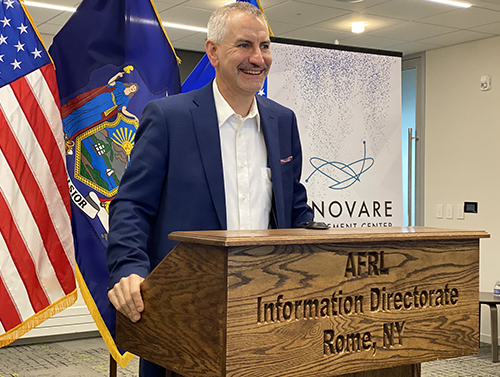

The Air Force Research Laboratory Information Directorate announced 23 awards to 15 small businesses, totaling $35 million in U.S. Air Force funding, during the Virtual Quantum Collider 2.0 held December 1-2, 2020 in Rome, N.Y.
These Phase II Small-Business Technology Transfer (STTR) awards were given for proposals covering any of four quantum topics: Timing, Sensing, Computing, or Communications. Companies were selected for awards based on evaluation and criteria set forth by researchers and scientists at the Information Directorate. Phase I awards were presented in June 2020.
The awarded companies include:
- Quantum Timing: (2) AOSense, Inc. (CA), (2) Stable Laser Systems (CO), and Vescent Photonics LLC (CO).
- Quantum Sensing: AOSense, Inc. (CA), Digital Optic Technologies, Inc. (IL), Freedom Photonics LLC (CA), Nexus Photonics LLC (CA), Physical Sciences (MA), Inc., and Sivananthan Laboratories, Inc. (IL).
- Quantum Computing: (2) AdvR, Inc. (MT), Azimuth Corporation (OH), Freedom Photonics LLC (CA), QuEra Computing, Inc. (MA), and SeeQC, Inc. (NY).
- Quantum Communications: AdvR, Inc. (MT), AOSense, Inc. (CA), Physical Sciences, Inc. (CA), Qubitekk, Inc. (CA), Qunnect LLC (NY), and Rigetti & Co., Inc. (CA).
Dr. Will Roper, U.S. Air Force and U.S. Space Force Acquisition Executive, was the honorable guest speaker for the event.

“We want to make quantum real,” Roper said. “We want to get dirt on it and get it out in the field. If you are an amazing scientist or engineer, or are supporting a company that’s pushing boundaries of research, you’re a rock star in our world, and forums like this really help us put that spotlight on building momentum for this important area of research.”
The virtual event featured astronaut-in-training and global TEDx speaker Alyssa Carson, along with her father Bert Carson, for a keynote session titled, “Walking on Mars with Alyssa & Bert Carson: A Fireside Chat That Is Out of This World.” They spoke about inspiring a future STEM-smart workforce and welcomed an open Q&A from the audience.

“Becoming an astronaut, really that is a very long-term goal,” said Ms. Carson when asked for advice for someone who is interested in becoming an astronaut. “What would you actually want to do in space? And then try to figure out what kind of career can match that and how does that career play out on Earth.”
Mr. Carson also discussed fostering his daughter’s passion for space at such a young age and offered advice for parents. “There’s so much available out there. It didn’t cost anything but hard work,” he said. “You have to be willing to put in the hard work. You can’t just have it be given to you, because then it’s not worth it.”
Other speakers at the event included:
- Prof. Dana Anderson, Co-Founder & CTO, Coldquanta.
- Mr. Terence J. Clas, Executive Business Development, NY State Science, Technology and Innovation Division, a Division of Empire State Development.
- Dr. Tomasz Durakiewicz, Program Director, National Science Foundation.
- Mr. J. Skyler Fernandes, Founder & General Partner, VU Venture Partners.
- Dr. Michael Hayduk, Deputy Director, Air Force Research Laboratory Information Directorate.
- Colonel Timothy Lawrence, Director, Air Force Research Laboratory Information Directorate; Commander, Detachment 4, Air Force Research Laboratory, Rome, New York.
- Ms. Denise Lee, SBIR/STTR Program Manager, Air Force Research Laboratory Information Directorate.
- Dr. Heather Lewandowski, Professor & Associate Chair of Physics, University of Colorado.
- Dr. Paul Lopata, Principal Director, Quantum Science, Office of the Under Secretary of Defense for Research & Engineering.
- Dr. Christopher Marki, CEO & Lead Designer, Marki Microwave.
- Dr. Celia Merzbacher, Deputy Director, Quantum Economic Development Consortium.
- Brigadier General Heather L. Pringle, Commander, Air Force Research Laboratory, Air Force Material Command, Dayton, Ohio.
- Ms. Karen Roth, Chief Engineer, Air Force Research Laboratory Information Directorate.
- Dr. Thomas Searles, Associate Professor of Physics, Howard University.
- Dr. Corey Stambaugh, Industrial Liaison, National Quantum Coordination Office, White House Office of Science and Technology Policy.
- Mr. Darryl Stimson, Chief Operations Officer, Air Force SBIR/STTR.
- Dr. Charles Tahan, Assistant Director for Quantum Information Science, Office of Science and Technology Policy; Director, National Quantum Coordination Office.
- Ms. Laura Wessing, Research Computer Scientist and Mathematician, Air Force Research Laboratory Information Directorate.
- Dr. Annie Xiang, Principal Investigator & Director of Product, Photodigm Inc.
- Dr. Scott Yano, Chief Technology Officer, Lake Shore Cryotronics.
The Phase II STTR awards are given based on evaluation and criteria set forth by researchers and scientists at the AFRL/RI.
This event was made possible through a partnership between the U.S. Air Force, the Air Force Research Laboratory Information Directorate (AFRL/RI), the U.S. Air Force Small Business Innovation Research (SBIR)/Small Business Technology Transfer (STTR) Office, and Innovare Advancement Center, with the support of New York State Technology Enterprise Corporation (NYSTEC) and Griffiss Institute (GI).
To watch the December 1-2, 2020 public event, or to learn more, go to the event website: usafquantumcollider.com.
For more market insights, check out our latest quantum computing news here.




![Nexus Photonics [Acquired by IonQ]](https://s3.us-east-2.amazonaws.com/tqd.s3.bucket/images/e9f7b9d9-ba40-441a-bc6c-9f99e0fbaf03.jpeg)