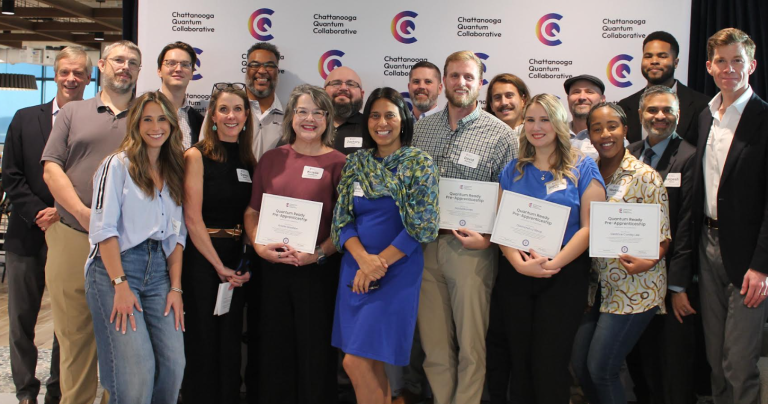
U.S. Launches National Quantum Education Partnership with Industry and Academic Leaders


The White House Office of Science and Technology Policy (OSTP), the National Science Foundation (NSF) and over a dozen top U.S. industry and academic leaders launched the National Q-12 Education Partnership, a new initiative to expand access to K-12 quantum information science (QIS) education.
As part of today’s announcement, NSF is awarding nearly $1 million to QIS education efforts, including the establishment of the Q2Work Program to support quantum education workforce development across the country. Private sector and academic leaders are committing to develop and provide educational programs, tools, training opportunities, and curricula that help introduce QIS themes at the middle school and high school levels.
“Quantum information science is a critical industry of the future where America must lead the world, and yet students don’t typically learn about QIS until college. Under President Trump’s leadership, the United States has prioritized quantum research and development, and now we will be among the first in the world to make QIS education tools and resources available to K-12 students and educators nationwide. Through strong public and private sector commitment, we look forward to advancing our Nation’s workforce and leadership in this key emerging technology,” said Michael Kratsios, U.S. Chief Technology Officer.
A quantum future will require a trained quantum workforce, according to NSF Director Sethuraman Panchanathan.

“In the coming decades, quantum systems are poised to drive our nation’s industrial base, economic strength and national security,” said Panchanathan. “Achieving that vision requires a workforce educated and trained in quantum information science and engineering. Through close collaboration with academia, industry, and partner agencies, the National Q-12 Education Partnership will increase the technical literacy of students, expanding inclusion and broadening participation for a future workforce that will bring benefits to all of us.”
Zapata Computing, developers of quantum software and algorithms for the enterprise, is one of the founding members of the National Q-12 Education Partnership program aimed at allowing the expansion of key quantum concepts for K-12 education, according to Christopher Savoie, CEO and founder, Zapata.
“Currently, the education necessary for developing qualified talent to help identify the next opportunities for applying and advancing quantum computing exist mainly at the collegiate level,” said Savoie. “This Q2Work Program is a much needed, progressive initiative because it’s aimed at sparking quantum passion much earlier in a child’s education through early exposure to all of the wonders and possibilities of quantum computing.”
The National Q-12 Education Partnership builds upon efforts spearheaded by OSTP and NSF to develop nine key QIS concepts that can be introduced to and adapted for computer science, mathematics, physics, and chemistry courses throughout middle and high schools.
Founding Members of the National Q-12 Education Partnership
- Amazon Web Services
- American Physical Society
- Boeing
- IBM
- IEEE-USA
- SPIE – The International Society for Optics and Photonics
- Lockheed Martin
- Microsoft
- Montana Instruments
- OSA—The Optical Society
- Rigetti
- University of Illinois Urbana-Champaign
- University of Chicago
- Zapata Computing
Visit q12education.org to learn more about the initiative.

Keep track of everything going on in the Quantum Technology Market. In one place.
Topics

Matt Swayne
With a several-decades long background in journalism and communications, Matt Swayne has worked as a science communicator for an R1 university for more than 12 years, specializing in translating high tech and deep tech for the general audience. He has served as a writer, editor and analyst at The Quantum Insider since its inception. In addition to his service as a science communicator, Matt also develops courses to improve the media and communications skills of scientists and has taught courses.
[email protected]

Stay Ahead of Quantum
Get the latest research, company news, and market intelligence every week.
MENTIONED IN THE ARTICLE

Zapata AI (operations ceased)
Zapata develops quantum software and algorithms for business. They offer a suite of generative AI solutions for enriching analytics and customizing large language models.
→

Amazon Web Services (AWS)
Amazon Braket – A fully managed service that allows scientists, researchers, and developers to begin experimenting with computers from multiple quantum hardware providers in a single place. Bra-ket notation is commonly used to denote quantum mechanical states, and inspired the name of the service.
→
IBM
IBM is an iconic technology pioneer founded in 1911 as the Computing-Tabulating-Recording Company and officially renamed International Business Machines Corporation in 1924. Beyond foundational computing, IBM possesses a deep legacy in aerospace and defense from building the guidance computers and Instrument Unit for NASA's historic Apollo missions to partnering with Airbus on CIMON, the first AI assistant on the ISS.
→

Lockheed Martin
The Lockheed Martin Corporation is a preeminent global aerospace and defense powerhouse, tracing its roots to late 1912 when pioneers Glenn Martin and brothers Allan and Malcolm Lockheed established independent aviation firms. Officially formed in 1995 through the merger of Lockheed Corporation and Martin Marietta, its Aeronautics division researches, designs, and manufactures advanced tactical aircraft, including the F-35 Lightning II, while its Space division builds critical launch vehicles and satellites.
→

Microsoft
Microsoft engages in the creation and licensing of software for both consumer and enterprise use. The company is renowned for its development of Windows operating systems and the Office suite designed for productivity. Microsoft's structure encompasses three major segments of roughly equal size: productivity and business processes, which encompasses legacy Microsoft Office, cloud-based Office 365, Exchange, SharePoint, Skype, LinkedIn, and Dynamics; the intelligence cloud, which includes offerings like Azure, Windows Server OS, and SQL Server; and more personal computing, which covers Windows Client, Xbox, Bing search, display advertising, and a range of Surface laptops, tablets, and desktops.
→

Rigetti Computing
Rigetti Computing develops integrated quantum computers and superconducting processors specialized for complex aerospace optimization and satellite communication tasks, including collaborations with the U.S. Air Force. Founded in 2013, the firm produces modular, multi-chip processors internally and provides cloud-based access for large-scale, complex simulations.
→

University of Chicago
The University of Chicago, located in Chicago, Illinois, USA, is a private research university with its primary campus situated in the Hyde Park neighborhood of Chicago.
→