

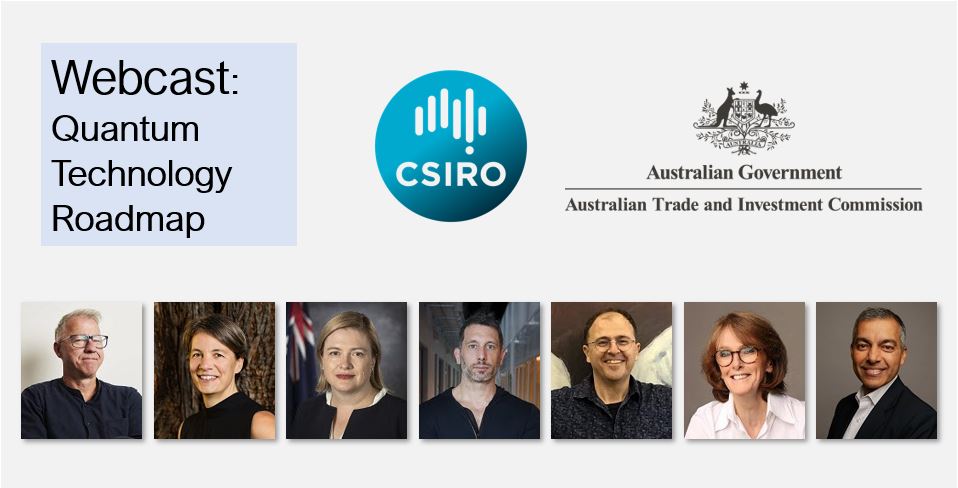
The Australian Government is proud to support the national science agency’s release of its quantum technologies roadmap to 2040.

The Growing Australia’s Quantum Technology Industry report identifies actions that will see Australia’s world class research and quantum start-ups support long-term economic growth in industries from mining and agriculture to defence, health and communications.

A new roadmap from Australia’s national science agency, CSIRO, outlines a vision to create a thriving quantum technology industry, generating $4 billion dollars annually and 16,000 jobs by 2040 in that country.
Find more about the Roadmap by joining a free webcast on the 21st of May at 5:30 PM PST (8:30 PM EST). You can find out additional details and RSVP here.
Facilitated by CSIRO‘s Chief Scientist, Dr Cathy Foley, this 1.5-hour event will kick-off a national discussion about how Australia can seize the opportunities of further developing its quantum industry.
This event is suited to those in government, industry and the research sector with an interest in industry development, trade and investment, and innovative technologies.
Following the webinar, we encourage you to talk with the Australian Trade and Investment Commission’s San Francisco-based Investment Director, Jessica Richman, at jessica.richman@austrade.gov.au for additional information and guidance on quantum opportunities in Australia.
Speaker biographies
Dr Cathy Foley
 Chief Scientist, CSIRO
Dr Cathy Foley is Chief Scientist of CSIRO, Australia’s national science agency and innovation catalyst. CSIRO solves the greatest challenges through innovative science and technology.
It is one of the world’s largest mission-driven multidisciplinary science and research organisations, collaborating with industry, government, academia and the community to unlock a better future for everyone.
Dr Foley has made significant contributions to the understanding of superconducting materials and to the development of devices using superconductors to detect magnetic fields and locate valuable deposits of minerals.
She was awarded Agenda Setter of the Year in the Women’s Agenda Leadership Awards in 2019, the Australian Institute of Physics Medal for Outstanding Service to Physics in 2016, and the Clunies Ross Medal of the Australian Academy of Technological Science and Engineering in 2015. In 2014, she was awarded the International IEEE Award for Continuing and Significant Contributions to Applied Superconductivity, and in 2013 she was named `Woman of the Year’ by the NSW Government.
Dr Foley has a passion for advancing scientific research and has held various roles, including member of the Prime Minister’s Science, Engineering and Innovation Council, President of the National Executive for Australian Institute of Physics, President of Science and Technology Australia, Editor-in-Chief of Superconductor Science and Technology journal, and Council Member for Questacon. Dr Foley is a strong advocate for women in STEM and is committed to tackling gender equality. As a leader in CSIRO, she is working to enhance collaboration across the sector and turn more world-class research into benefits for the nation.
Our panellists for the discussion include:
Professor Andrew White
 Director, ARC Centre of Excellence for Engineered Quantum Systems
Professor Andrew White was raised in a sub-tropical dairy town in Queensland, before heading south to the big smoke of Brisbane to study chemistry, maths, physics and – during World Expo 88 – the effects of alcohol on university students from around the world. Deciding he wanted to know what the cold felt like, he first moved to Canberra, then Germany – completing his PhD in quantum physics – before moving on to Los Alamos National Labs in New Mexico where he quickly discovered that there is more than enough snow to hide a cactus, but not nearly enough to prevent amusing your friends when you sit down.
Returning to Australia over 20 years ago, he has conducted research on various topics including shrimp eyes, nuclear physics, optical vortices, and quantum computers. He likes quantum weirdness for its own sake, and his current research aims to explore and exploit the full range of quantum behaviours – notably entanglement – with an eye to engineering new technologies and scientific applications. He is currently Director of the Centre for Engineered Quantum Systems, a collaboration between five Australian universities and eighteen industrial and institutional partners to build sophisticated machines that harness the quantum world for practical applications.
Michael Biercuk
 CEO and Founder, Q-CTRL
Michael J. Biercuk is CEO and Founder of Q-CTRL, Australia’s first venture-capital-backed quantum technology company, and Professor of Quantum Physics and Quantum Technology at the University of Sydney where he is also a Chief Investigator in the ARC Centre of Excellence for Engineered Quantum Systems. In both Q-CTRL and his academic work he is focused on enabling a new generation of quantum technologies through the development of control engineering in quantum-coherent systems. Michael earned his undergraduate degree from the University of Pennsylvania and his Masters and PhD from Harvard University. He held a research fellowship in the Ion Storage Group at NIST Boulder and has served as a full-time technical consultant to the Defense Advanced Research Projects Agency, helping to steer government investments in quantum information & advanced computer architectures. Michael is a TEDx and SXSW speaking alumnus and winner of the 2015 Australian Museum Eureka Prize for Outstanding Early Career Researcher.
Professor Michelle Simmons
 Director, Silicon Quantum Computing and ARC Centre of Excellence for Quantum Computation and Communication Technology
Professor Michelle Simmons is Director of the Centre of Excellence for Quantum Computation and Communication Technology, at the University of New South Wales. She is also the founder of Silicon Quantum Computing Pty Ltd, Australia’s first quantum computing company and has developed unique technologies world-wide to build electronic devices in silicon at the atomic scale. She is internationally renowned for creating the field of atomic electronics and her team is leading the global race to develop a quantum computer in silicon. In 2017 she was recognised by the American Computer Museum as a pioneer in quantum computing, awarded the Feynman Prize in Nanotechnology and was named the 2017 L’ORÉAL-UNESCO Asia-Pacific Laureate in the Physical Sciences. In 2018 Professor Simmons was admitted as a Fellow to the Royal Society of London and named Australian of the Year. She is currently Editor-in-Chief of Nature Quantum Information.
Phil Morle
 Partner, Main Sequence Ventures
Phil Morle is a Partner at Main Sequence Ventures in Australia. The fund specialises in backing deep tech, science-driven founders and was founded by Australia’s national science agency, CSIRO. In this work he specialises in the transformation of valuable inventions discovered in a lab into high growth companies. He is a director of Q-CTRL which he helped bring to life in 2018. He is well known as the CEO of Australia’s first tech start-up incubator, Pollenizer through which he co-created many of Asia Pacific’s start-up programs.
Professor Tanya Monro
 Chief Defence Scientist, Department of Defence
Professor Tanya Monro began her role as Chief Defence Scientist in March 2019. She was previously Deputy Vice Chancellor Research and Innovation and an ARC Georgina Sweet Laureate Fellow at the University of South Australia. Professor Monro was the inaugural Director of the Institute for Photonics and Advanced Sensing from 2008 to 2014 and was also the inaugural Director for the ARC Centre of Excellence for Nanoscale BioPhotonics at the University of Adelaide. Her research is in the field of photonics, with a focus on sensing, lasers and new classes of optical fibres.
Professor Monro obtained her PhD in physics in 1998 from The University of Sydney, for which she was awarded the Bragg Gold Medal for the best Physics PhD in Australia. In 2000, she received a Royal Society University Research Fellowship at the Optoelectronics Research Centre at the University of Southampton in the UK and is also an inaugural Bragg Fellow of the Royal Institution of Australia.
Professor Monro is a Fellow of the Australian Academy of Science, the Australian Academy of Technological Sciences and Engineering, the Optical Society of America and the Australian Institute of Physics. She is a member of the Prime Minister’s Commonwealth Science Council, and a Board Member of the CSIRO, the South Australian Defence Advisory Board, and the South Australian Economic Development Board.
Her awards include the Prime Minister’s Malcolm McIntosh Prize for Physical Scientist of the Year (2008), South Australian Scientist of the Year (2010), South Australia’s Australian of the Year (2011), and the Eureka Prize for Excellence in Interdisciplinary Scientific Research (2015).
Dr Vikram Sharma
 Founder and CEO, QuintessenceLabs
Recognising the potential of quantum cybersecurity, Dr Vikram Sharma conducted award-winning research to mature this science at the Australian National University (ANU). He founded and leads the Canberra-headquartered company QuintessenceLabs, which is at the forefront of quantum cybersecurity delivering quantum random numbers, crypto-agile key management and second-generation quantum key distribution. Among many recognitions, QuintessenceLabs was selected as a World Economic Forum Technology Pioneer.
Dr Sharma holds a Master of Science in computer science from the ANU, a Master of Science in management from Stanford University, and a doctorate in quantum physics from the ANU. Prior to QuintessenceLabs, Vikram successfully built several technology companies, providing IT services to the Australian Government, and one of the first private ISPs in India.





.png)