

Gartner’s Belief
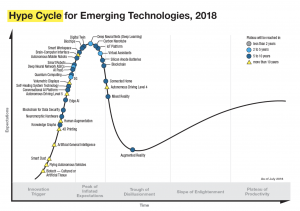
There’s a phenomenon in technology called the hype cycle. Formulated by Gartner, Inc., a global research and advisory firm. The premise is that either the technology is no longer relevant or, unfortunately, has entered what we call a ‘plateau of productivity’ regarding the said technology. Gartner also talks about the market clock, which follows the trends and movements of technology from its inception to the time it has become obsolete.
Unfortunately, every kind of new technology at some time or another finds itself in the hype cycle — it is a normal course of business. At the moment, we can see it with 5G technology. All the shouts, promises and lies about how it will change our lives immeasurably even before the mass rollout of the technology is, for some at least, annoying.

False Promises
Hype, so the old adage goes, gives people unrealistic expectations of the future, creates in them a positive idealism that what the industry is doing will be revolutionary.
And sometimes it is. But mostly — and this is no grinch talking now — a falsehood.
Often the customer, the end-user of the technology, gives out a deep sigh in disappointment, angry at the lies they’ve been fed to boost the CEOs’, engineers’ and marketing experts’ egos.
This situation is and has occurred within the quantum computing space, too, with its enterprise technology focussed on making what seemed only a dream a decade or two ago a watertight reality.
‘I think it’s definitely significant that quantum computers are becoming more accessible, to the point that you can buy your own integrated system that will let you explore the possibilities of quantum computers. Ultimately though, I think figuring out how to make a lot of low-noise qubits is a lot more important than figuring out how to put them in a beautiful package.’
– Andrew Childs, co-director of the Joint Center for Quantum Information and Computer Science at the University of Maryland, 2019
Investments
This appears all the more poignant with the recent investment pouring into the space.
However, there are many within the industry who see the potential of quantum computers very differently. Ray Beausoleil, who leads the Large-Scale Integrated Photonics research group at Hewlett Packard Labs, said:
‘Quantum computers are not very good at the three Rs — reading, writing and arithmetic. They don’t like to read big databases, they can’t give you very big complicated readouts, and they don’t do regular arithmetic as well as a regular old classical computer.’
This means, in Beausoleil’s opinion anyway, that quantum computers, and all the assurances of their guaranteed efficacy in the face of current technological innovations, are a falsehood. That the hype cycle, in this case at least, is in full swing and working effectively.
Big Hitters and Small Players
IBM, Google, Intel and Microsoft are proof that this is, in fact, the trend. Mass adoption in R&D by the big hitters in the industry — and the research groups at CalTech, MIT and Berkeley — strengthens the belief for some that the hype cycle and market clock have tricked them into action.
The smaller players, too — Rigetti, D-Wave Systems and all the other startups spread out across the globe are testament to the gold-rush mentality that has excited so many people.
Yet there are others who take a completely different view of quantum computers and what they will be able to do in the future.
Advocates
Physics professor at Harvard University, Mikhail Lukin, staunchly believes that quantum computers — like their classical models in the past — will go from ‘scientific lab experiments’ to the mainstream within the next thirty years.
‘I think we need to have big enough computers to start really figuring out what they can be used for. We don’t know yet what quantum computers are capable of doing, so we don’t know their full potential. I think the next challenge is to do that.’– Professor Mikhail Lukin
Lukin, who spoke in an interview to Futurism.com early in 2018, went on to talk about research in the space needs to be targeted to specialized applications, developing, what he calls, ‘smallscale devices which could be used for diagnosing patients in medical situations’. He also believes quantum communication is an area which has the potential for universal adoption across the planet. Another paradigm-shifting technology could be the quantum internet, an architecture of safe, quantum encrypted networks.
Battle Ready
As you can see, the lines are drawn, Opponents on both sides of the scientific spectrum have their swords at the ready.
The war is on.
But let us hope — by way of mutual understanding, common goals and deep-lying altruism for our species — that when push comes to shove, the technology developed will be for the common good.
Because we have to believe that innovators like Elon Musk in AI, driverless cars and space exploration, Mark Zuckerberg and Jack Dorsey in social media, the babyfaced, geekish Vitalik Buterin in the cryptocurrency sphere, and all those other great minds already out there or yet to be born, do have our best interests above everything else.

Let’s hope Canadian-Russian programmer and Ethereum founder Vitalik Buterin has our interests as part of his ultimate plan. Source: Wikipedia
Sometimes, though, it doesn’t seem so. The Cambridge Analytica scandal involving Facebook or Uber’s hush money to hackers over data breaches give credence to that.
‘I can certainly imagine many directions in which quantum computers can enter everyday life, even though you don’t carry it in your own pocket.’– Professor Mikhail Lukin
Let us hope, with the biggest potential technology of them all in quantum computing, none of this besets the industry and the hype cycle and the market clock don’t do any damage.





.png)