
Insider Brief
- Researchers developed a theoretical framework showing that many proposed signatures of quantum gravity can instead be interpreted as quantum particles moving through an ordinary classical gravitational field.
- The framework, described as the “Relativity of Spacetime Superpositions,” demonstrates that some scenarios viewed as quantum superpositions of gravity have an equivalent description using classical spacetime and gravity without requiring observable quantum gravity effects.
- The researchers say the results do not rule out quantum gravity but provide guidance for designing future experiments by identifying which observations would genuinely require a quantum description of gravity rather than conventional physics.
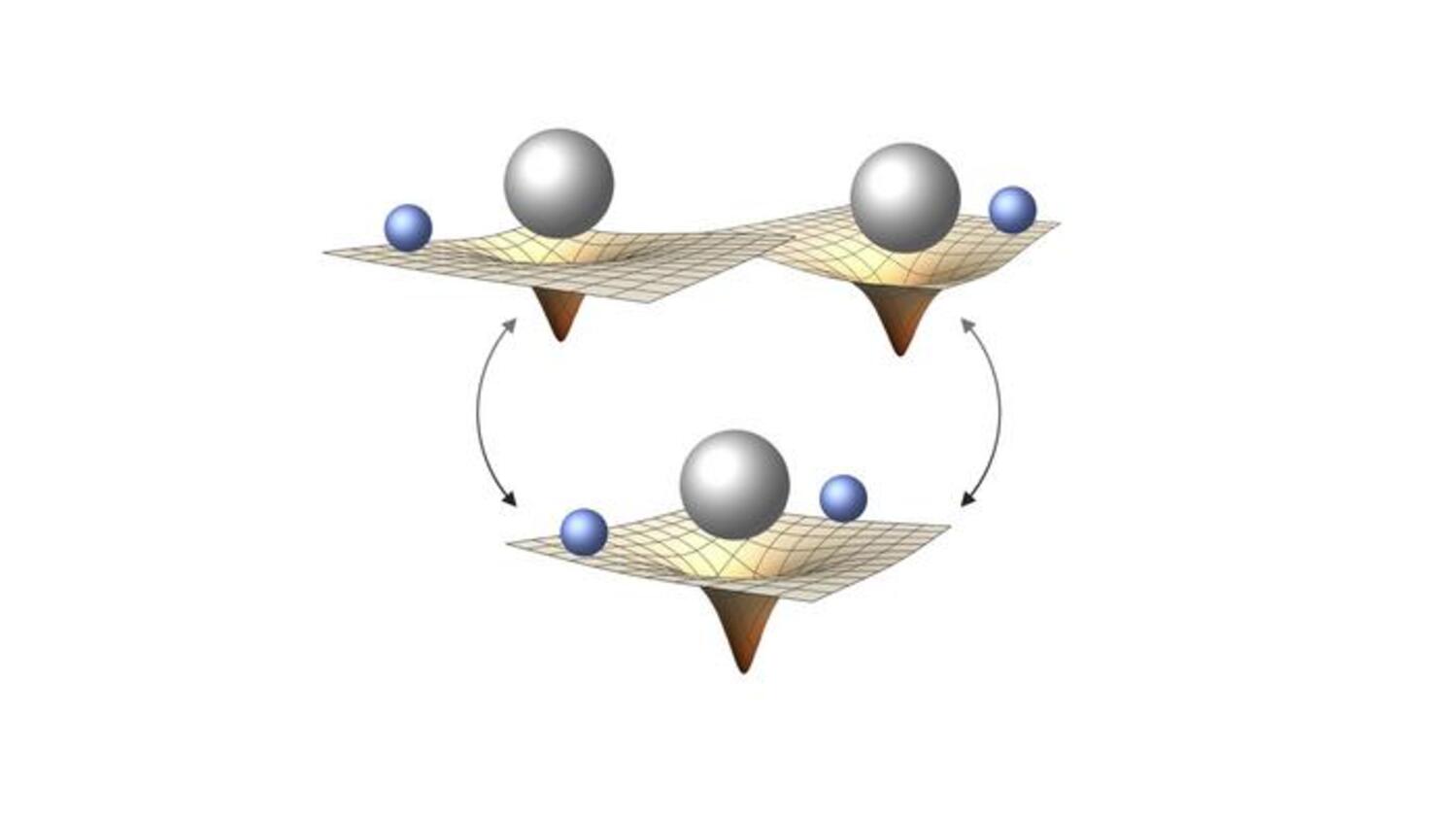
- Image: A quantum superposition of gravitational fields or spacetimes (top) and a “test” particle in a quantum superposition of locations in an ordinary gravitational field (bottom). (Joshua Foo/Kyushu University)
PRESS RELEASE — Everything around us, from atoms and molecules to planets and galaxies, is governed by two extraordinarily successful theories of physics: Quantum mechanics and gravity. Quantum mechanics explains the behavior of the microscopic world, while Einstein’s theory of gravity describes the motion of stars, black holes, and the expansion of the Universe. Yet despite their successes, physicists are still searching for a theory of “quantum gravity” that would unite them into a single description of nature.
One of the most widely expected features of such a theory is that gravity should obey the laws of quantum mechanics. And this where it gets difficult: quantum mechanics predicts that any object can be delocalized over multiple places at once, which is routinely tested in experiments with atoms and even small clumps of metal. Gravity, according to Einstein’s theory, is the space and time itself—it can be curved, flat or even have waves propagating through it, as confirmed by gravitational wave detectors. And so many physicists believe that spacetime around a quantum object would also exist in multiple “states” simultaneously.
But what would such a situation actually look like?

Publishing in npj Quantum Information, researchers from Kyushu University, the University of Waterloo, and Stockholm University have shown that despite the lack of a universal framework we may sometimes know the answer.
The team developed a new theoretical framework demonstrating that many scenarios described as a “quantum superposition of gravity” are equivalent to a situation where quantum particles are in quantum superpositions but feel ordinary gravity and spacetime, with no quantum gravity signatures.
“Many researchers have proposed experiments that could potentially reveal the quantum nature of gravity,” explains Associate Professor Joshua Foo of Kyushu University’s Institute for Advanced Study and lead author of the study. “What we found is that some of these scenarios can be viewed from two equally valid perspectives. One interpretation describes gravity as being in a quantum superposition, while the other describes quantum particles moving in an ordinary gravitational field.”
The researchers refer to this idea as the “Relativity of Spacetime Superpositions.” Much like two maps can describe the same landscape using different projections, the researchers found that what looks like quantum gravity can in many cases be described using classical gravity and spacetime while mapping the motion of any particle within it to an appropriate quantum state.
This does not mean that gravity is classical, nor does it rule out the existence of quantum gravity. Instead, it reveals an important ambiguity in how experiments testing gravity’s quantum side can be interpreted.
“Our work does not tell us that such experiments rule out quantum gravity,” says Magdalena Zych of Stockholm University and a co-author on the paper. “Rather, it helps us identify which experimental signatures would genuinely require a quantum description of gravity and which ones could arise from more familiar physics. That distinction is crucial for designing future experiments.”
While the research addresses highly fundamental questions, history shows that studying the deepest laws of nature often leads to unexpected advances. Technologies such as GPS navigation, lasers, and modern electronics all grew from discoveries in theoretical quantum physics and Einstein’s theory of gravity.
More immediately, the work provides researchers a roadmap for designing experiments. By identifying which observations can truly distinguish between classical and quantum descriptions of gravity, the framework narrows the search for evidence of one of the most sought-after theories in modern science.
“Understanding how gravity and quantum mechanics fit together is one of the greatest challenges in physics,” concludes Foo. “Before we can test gravity’s quantum nature, we first need to know what evidence would prove that we’ve found it. Our work helps clarify that question.”