



Insider Brief
- A new report from the Special Competitive Studies Project finds that the United States maintains a slight overall lead over China in quantum technologies, but warns that China’s coordinated national strategy is steadily narrowing the gap.
- The report concludes that the United States retains advantages in areas such as quantum software, error correction, private investment and parts of the supply chain, while China leads in quantum networking deployment and is gaining ground in materials, manufacturing and talent development.
- According to the analysis, the eventual leader in quantum technologies will be the nation that can most effectively translate research breakthroughs into scalable, operational systems across computing, sensing and communications.
The United States still holds a narrow lead over China in the race to develop quantum technologies, but that advantage is shrinking as Beijing deploys a coordinated national strategy that increasingly challenges American strengths in research, manufacturing and commercialization.
A new SCSP Tech Competition Scorecard report from the Special Competitive Studies Project (SCSP) concludes that the United States remains ahead overall in quantum information science, engineering and technology, or QISET. Yet the analysts warn that China’s sustained investments across research, industrial policy, workforce development and infrastructure could erase that lead within years if current trends continue.
The report offers one of the most comprehensive attempts to measure the state of the quantum competition between the world’s two largest economies. Rather than focusing solely on quantum computing, it assesses four interrelated areas: quantum computing, quantum sensing, quantum networking, and the materials and equipment needed to support them.

Its central finding is that there may never be a single defining moment that determines who wins the quantum race. Instead, leadership is likely to emerge gradually as countries gain advantages in specific technologies and demonstrate an ability to translate scientific discoveries into practical systems deployed at scale.
America’s Lead is Real, but Narrowing
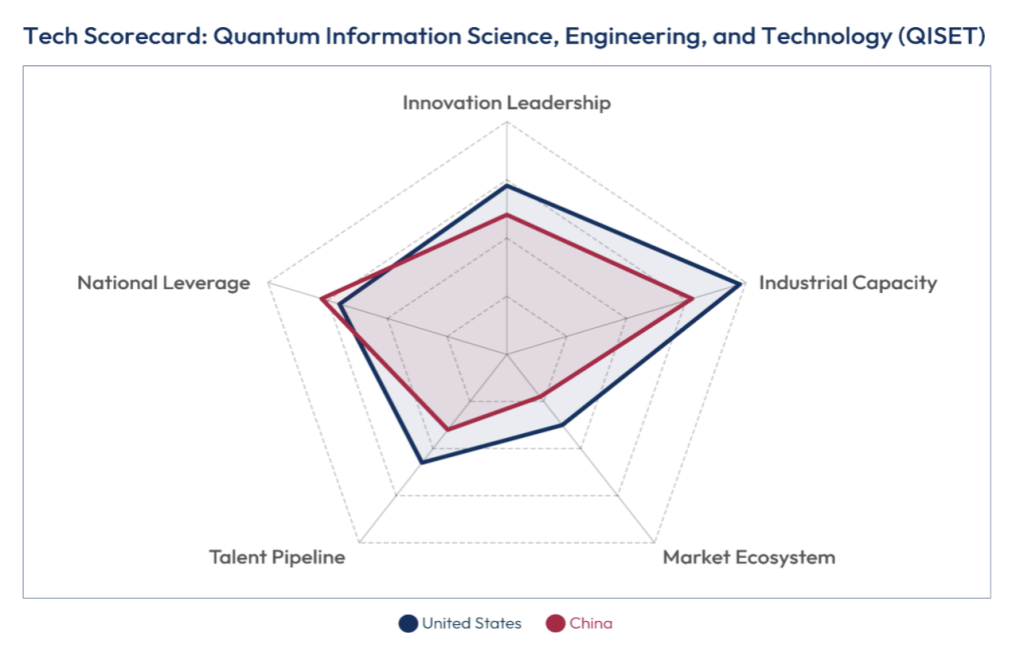
As a whole, the United States currently maintains a slight lead in QISET, the report indicates, citing advantages in innovation, software ecosystems, private investment and portions of the supply chain. At the same time, it concludes that China’s state-backed approach is steadily closing the gap.
The analysts report that the real contest extends beyond scientific prestige because quantum technologies have the potential to reshape sectors ranging from defense and communications to pharmaceuticals, logistics and finance. Nations that deploy useful systems first could gain enduring economic and strategic advantages.
The United States and China have adopted fundamentally different models for pursuing that goal, according to the report.
America’s quantum ecosystem is decentralized with universities, national laboratories, startups and large technology companies operating within a competitive market structure spread across multiple regional hubs. Boston, Chicago, Colorado, New Mexico, Maryland and Silicon Valley are all playing prominent roles in the U.S. landscape.
China’s model is more concentrated and centrally directed. Hefei, Beijing and Shanghai account for the majority of the country’s quantum activity. Government funding, industrial planning and talent initiatives are aligned around national priorities, enabling coordinated action on a scale that market forces alone might not produce.
According to SCSP, neither model has proven inherently superior. The determining factor will be which system can solve difficult engineering problems and convert laboratory advances into reliable products and infrastructure.
Where Each Country Holds the Advantage
The report finds that the United States still leads in innovation, although it suggests that China’s progress has been substantial.
Researchers affiliated with American institutions accounted for 35% of the top 10% most-cited quantum papers referenced in 2025 publications. Chinese researchers represented 23%, a share that has doubled over the past decade.
The United States also maintains advantages in certain areas critical to fault-tolerant quantum computing. In quantum error correction — the techniques needed to detect and correct mistakes in fragile quantum systems — American researchers and companies dominate both highly cited publications and influential patents.
SCSP identified error correction as one of the most strategically important areas in the field. The United States’ early lead in this domain could provide lasting advantages as companies pursue large-scale, commercially useful quantum computers.
However, China is demonstrating fast gains throughout the quantum technology spectrum. For example, in advanced quantum materials, Chinese researchers now account for roughly half of the highest-performing publications, compared with about one-fifth for American researchers. The report attributes that rise to a decade-long strategy involving universities, national laboratories and state-supported research institutions working in concert.
China is also gaining ground in quantum algorithms and protocols, with its share of top publications increasing steadily while American dominance narrows.
The report singles out quantum networking as one area where China already enjoys a substantial operational advantage.
China has prioritized quantum key distribution, or QKD, a communications approach that uses quantum principles to secure information exchange. Beijing has supported the deployment of national-scale networks linking cities across thousands of miles, supplemented by satellite experiments.
China has demonstrated quantum communication networks spanning more than 6,000 miles, according to the report.
By contrast, the United States has focused less aggressively on QKD, partly because U.S. security agencies have expressed reservations about the technology’s implementation challenges. American efforts remain concentrated in regional testbeds and pilot programs.
As a result, SCSP concludes that China currently leads in turning quantum networking research into deployed infrastructure.
Manufacturing, Software and Talent Define the Contest
Competition in the industrial competition is a little more difficult to quantify and requires a more nuanced comparison.
The United States benefits from mature manufacturing capabilities, established supply chains and strong positions in several critical bottlenecks. These include helium-3 supplies used in dilution refrigerators, advanced cryogenic systems and specialized laser technologies required for many quantum platforms.
Yet China’s manufacturing strengths are beginning to reshape the economics of the field. The report points to dramatic differences in cleanroom construction costs. Advanced cleanrooms used in quantum manufacturing can cost between $800 and $1,000 per square foot in the United States. Comparable facilities in China may cost a fraction of that amount, aided by domestic supply chains and government subsidies.
This cost advantage could lower barriers to scaling production and accelerate China’s industrial expansion.
The software ecosystem remains one of America’s clearest advantages.
Quantum developers around the world rely heavily on U.S.-affiliated programming tools, cloud platforms and software frameworks. IBM’s Qiskit, Google’s Cirq and other Western-developed platforms dominate research workflows and developer communities.
Metrics cited in the report suggest that American quantum software tools enjoy dramatically greater adoption than their Chinese counterparts. The analysts write that these ecosystems create powerful lock-in effects. Once researchers and companies standardize around particular tools, replacing them becomes increasingly difficult.
China is working to build domestic alternatives, particularly after foreign access restrictions exposed vulnerabilities in its reliance on overseas platforms. However, SCSP concludes that the United States and its allies still control the dominant software architectures underpinning quantum development.
The investment landscape reflects broader differences between the two countries.
The United States has relied heavily on private capital, with approximately $5.3 billion in announced private investment through 2024.
China’s private investment totals are smaller, but they exist alongside extensive state support. The report estimates that Chinese government commitments to quantum technologies reached approximately $15 billion by 2024, although there is considerable debate around that figure.
When public and private funding are combined, China’s total investment footprint exceeds that of the United States, according to the report’s estimates.
Talent may prove to be one of the most important long-term variables.
The United States retains strengths in higher education, international collaboration and its ability to attract foreign researchers. American universities offer a broad range of quantum programs and continue to serve as training grounds for scientists from around the world.
China, however, is producing STEM doctoral graduates at a faster rate and on a larger scale. Since 2020, it has awarded substantially more STEM Ph.D.s annually than the United States.
SCSP characterizes America’s talent advantage as real but increasingly uncertain.
The Next Phase Will Be Defined by Deployment
The report ultimately concludes that leadership in quantum technologies will depend less on isolated scientific breakthroughs than on the ability to sustain progress across an entire ecosystem.
Quantum sensing may deliver meaningful capabilities first, including improvements in navigation, timing and detection systems. Quantum computing and networking remain less predictable, with development timelines extending over years or decades.
For policymakers and industry leaders, the report’s main theme is that, just as quantum tech has moved from the lab to the marketplace, competition between the nations is no longer theoretical.
The United States continues to lead in several of the areas most associated with commercial quantum computing, including software, error correction and private-sector innovation. China, meanwhile, has demonstrated an ability to mobilize resources rapidly, reduce production costs and deploy infrastructure at national scale.
According to SCSP’s assessment, the outcome of the quantum race will not be determined by which country publishes the most papers or announces the most ambitious prototypes. Instead, it will depend on which nation can consistently transform scientific advances into operational systems that reshape economies, strengthen national security and establish the standards that define the next technological era.