

Insider Brief
- Q-Factor raised $24 million in seed funding to develop a neutral atom quantum computing architecture designed to scale from thousands to potentially millions of qubits.
- The company aims to address a central industry limitation—scaling beyond a few thousand qubits—by introducing a new system architecture rather than relying on incremental improvements.
- Founded by leading physicists from the Weizmann Institute of Science and the Technion – Israel Institute of Technology, the company seeks to commercialize decades of atomic physics research into a scalable quantum platform.
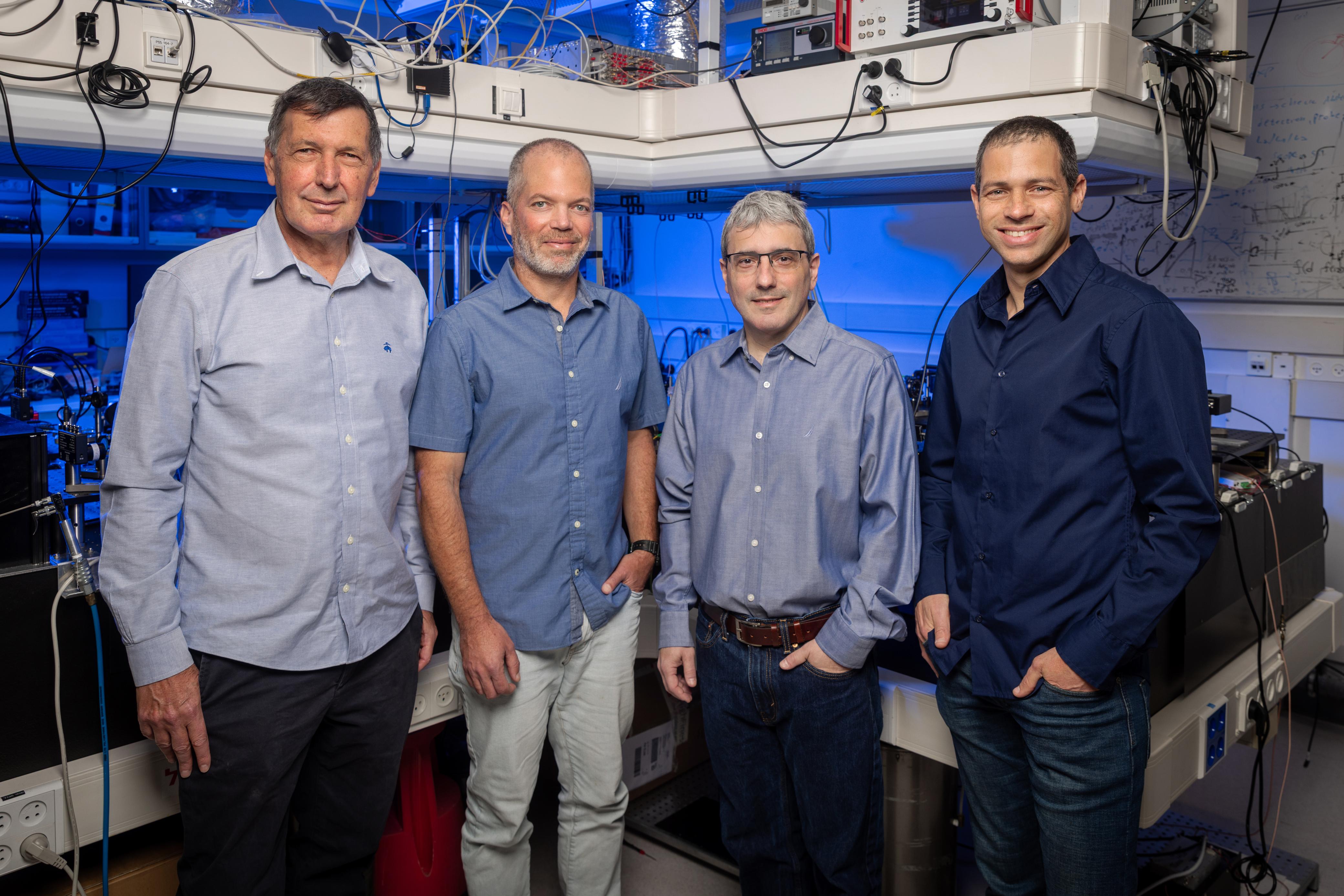
- Image: Q-Factor team (Provided)
PRESS RELEASE — Q-Factor, a neutral atom quantum computing company, today announced $24 million in seed funding. The round was led by NFX and TPY Capital, with participation from Intel Capital, Korea Investment Partners, Deep33, and the Matias family, along with a grant from the Israel Innovation Authority. The Technion – Israel Institute of Technology and the Weizmann Institute of Science (through Yeda, its technology transfer arm) are also shareholders in the company, which was founded to commercialize decades of foundational research in atomic physics conducted in their labs.
Neutral atoms have rapidly emerged as one of the most promising approaches to quantum computing. They are naturally inert, capable of holding quantum information for extended periods, yet precisely controllable using light alone, without the need for extreme cooling or complex wiring. However, current quantum computers across all modalities remain too small by orders of magnitude to deliver real commercial value. Breaking past a few thousand qubits to the hundreds of thousands or millions required for useful computation demands not incremental improvement, but a fundamental architectural leap.
Q-Factor was founded to tackle this challenge. The company brings together four physicists whose research spans decades at the forefront of neutral atom science. Three lead labs at the Weizmann Institute and the Technion have pioneered the building blocks of neutral atom systems, including ultracold atoms, controlled atomic interactions (Rydberg physics), atom transport, and advanced laser techniques; the fourth founder brings extensive technical leadership building and scaling deep tech ventures The founders closely analyzed the limitations of current neutral atom quantum computing systems, and have identified the architectural bottlenecks that prevent current platforms from scaling beyond a few thousand qubits. Q-Factor has developed an approach to overcome these limitations and scale to over one million qubits.

“The quantum computing industry needs a revolution, not an evolution,” said Prof. Ofer Firstenberg, co-founder and chief scientist of Q-Factor. “Current systems are too small to deliver on the promise of quantum computing, and incremental improvements alone aren’t going to close that gap. We’ve developed an architecture designed for continuous scalability, a Moore’s Law-like trajectory that can take neutral atom systems from thousands of qubits to millions and beyond.”
Q-Factor was founded by Prof. Nir Davidson, a world-renowned authority in ultracold atoms with 280 published papers and former dean of physics at the Weizmann Institute of Science; Prof. Ofer Firstenberg of the Weizmann Institute, an expert in quantum optics and Rydberg atoms, formerly of Harvard and MIT; Prof. Yoav Sagi of the Technion, a leading authority in neutral-atom manipulation, formerly of JILA and the University of Colorado; and Dr. Guy Raz, a physicist with 20 years of technical leadership experience across multiple deep tech startups.
“It’s rare to find a team with this combination of scientific authority and commercial instinct,” said Gigi Levy-Weiss, partner at NFX. “Four Talpiot graduates with hundreds of published papers in the fields directly underlying this technology, and real experience bringing deep science to market. They are uniquely positioned to execute one of the most ambitious goals in quantum computing.”
“Neutral atoms are emerging as the leading modality for scalable quantum computing, and Q-Factor is entering the race with a distinct architectural advantage,” said Dekel Persi, partner at TPY Capital. “TPY has been investing in quantum computing for seven years and has evaluated dozens of companies across modalities and geographies. What the Q-Factor team achieved stood out immediately. Their architectural approach to scale made this a clear must-do for us.”
“Q-Factor’s founding team combines world-class scientific depth with a clear-eyed understanding of what it will take to build a commercially viable quantum computer,” said Lisa Cohen, Investment Director at Intel Capital. “They’ve watched the field evolve, learned from the challenges others have encountered, and assembled the right expertise to tackle the hardest remaining problem in quantum computing: scale.”