

Insider Brief
- Researchers at RIKEN have built a new amplifier that reads superconducting quantum bits more clearly, cutting background noise close to the fundamental physical limit and supporting progress toward 100-qubit quantum computers.
- The team reduced unwanted noise by redesigning the device to remove energy-absorbing materials and instead using a new spiral-shaped structure that improves signal clarity.
- The amplifier delivers strong, low-noise signal boosts using fabrication methods already common in many quantum labs, making it easier to scale up quantum computing systems.
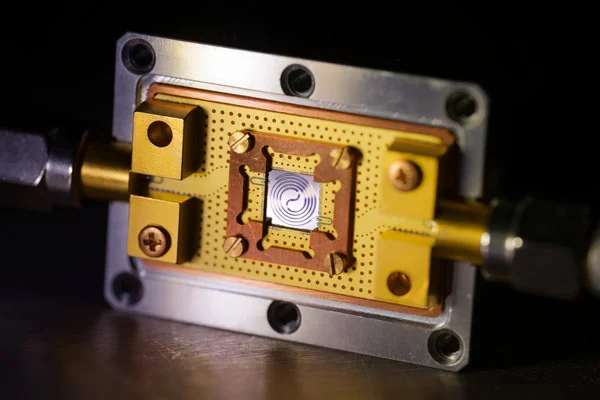
- Image: A long, spiral-wound waveguide with a fine-tapered, fishbone-like structure can amplify photon signals from quantum computing qubits with very low noise. (RIKEN Center for Quantum Computing)
PRESS RELEASE — The low-noise, high-gain properties needed for high-performance quantum computing can be realized in a microwave photonic circuit device called a Josephson traveling-wave parametric amplifier (JTWPA), RIKEN researchers have shown experimentally. This advance stands to speed up development of superconducting quantum computer systems at the 100-qubit scale.
Quantum computers are extraordinary feats of research and engineering, combining highly advanced quantum physics with state-of-the-art fabrication techniques designed to physically manipulate light near the limits of quantum dynamics.
While the elemental quantum bits—qubits—are where the magic of quantum computing happens, they need to be ‘read’ in order for their computations to be useful. Unfortunately, the very act of reading the state of a qubit can introduce noise and interference that obscures the data.
The readout operation needs to meet several criteria: it needs to be fast enough with very high signal-to-noise ratio to be able to measure the qubit in a single shot, while operating with just a few quanta in energy (where a quantum is the energy of one microwave photon). Ideally, it should also comb multiple frequencies so it can read multiple qubits at once using the same circuit.
“So far, amplifiers based on an array of Josephson junctions fulfill all of these qualities except for noise, which is what we focused on in this study,” says Sandbo Chang of the RIKEN Center for Quantum Computing (RQC).
Chang, Yasunobu Nakamura, also of RQC, and co-workers have resolved a long-standing noise issue with JTWPAs. This advance promises to strengthen this highly accessible scheme for qubit signal processing.
Noise is inevitably added to a readout signal when it is amplified. Quantum mechanics requires any phase-preserving amplifier with high gain to add at least half a quantum of noise. The best previous noise level achieved by a Josephson traveling-wave parametric amplifier is often one photon or more, which has limited the usefulness of this technology.
“This is mostly because previous approaches use lossy dielectric material in their design,” says Chang.
By dropping the use of lossy dielectric material and instead creating a spiraled fishbone-like tapered waveguide structure (Fig. 1), the team was able to reduce the noise to 0.68 quanta, only 0.18 quanta above the quantum limit. They demonstrated this through performing simulations and creating an experimental device.
“Our goal was also to keep the fabrication recipe as accessible as possible,” says Nakamura. “The hope is that most labs that can already fabricate superconducting qubits will already have the techniques and equipment they need to reproduce our results.”