


Insider Brief
- Stanford researchers have demonstrated a nanoscale optical device that operates at room temperature to entangle photons and electrons, offering a potential pathway to low-cost, low-energy quantum communication.
- The device combines molybdenum diselenide with silicon nanostructures to generate “twisted light” that transfers spin to electrons, creating qubits without the need for cryogenic cooling.
- The team is refining the platform, exploring new materials, and developing components needed for larger quantum networks with the long-term goal of enabling quantum systems small enough for everyday devices.
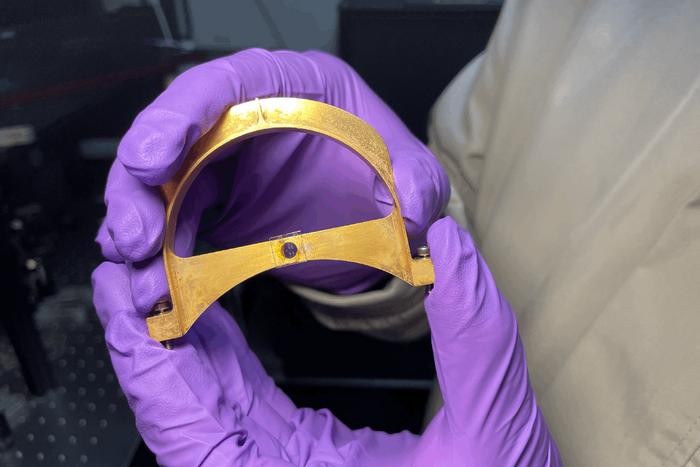
- Image: The nanoscale optical device works at room temperature to entangle the spin of photons and electrons to achieve quantum communication. (Antony Georgiadis)
PRESS RELEASE — Present-day quantum computers are big, expensive, and impractical, operating at temperatures near -459 degrees Fahrenheit, or “absolute zero.” In a new paper, however, materials scientists at Stanford University introduce a new nanoscale optical device that works at room temperature to entangle the spin of photons (particles of light) and electrons to achieve quantum communication – an approach that uses the laws of quantum physics to transmit and process data. The technology could usher in a new era of low-cost, low-energy quantum components able to communicate over great distances.
“The material in question is not really new, but the way we use it is,” says Jennifer Dionne, a professor of materials science and engineering and senior author of the paper just published in Nature Communications describing the novel device. “It provides a very versatile, stable spin connection between electrons and photons that is the theoretical basis of quantum communication. Typically, however, the electrons lose their spin too quickly to be useful.”
The device is made of a thin, patterned layer of molybdenum diselenide (MoSe2) atop a solid, nanopatterned substrate of silicon. Molybdenum diselenide is one of a class of materials known as transition metal dichalcogenides (TMDCs) that have favorable optical properties.

“The Silicon nanostructures enable what we call ‘twisted light,’” explains Feng Pan, a postdoctoral scholar in Dionne’s lab and first author of this paper and a series of others exploring room-temperature quantum devices. “The photons spin in a corkscrew fashion, but more importantly, we can use these spinning photons to impart spin on electrons that are the heart of quantum computing.”
Smaller, simpler, cheaper
“The patterned nanostructures are imperceptible to the human eye, about the size of the wavelength of visible light,” Dionne adds. “But they help us manipulate photons very precisely to make them spin – to twist them – in a specific direction, for example, up or down.”
In turn, Pan explains, this twisted light can be “entangled” with the spin of electrons to create qubits, the foundational unit of quantum communication and computation. The spin of a qubit is to quantum computing what the 1 and the 0 are to traditional binary computation.
Material matters
Dionne and Pan targeted TMDCs for their distinctive quantum properties, teaming up with Stanford TMDC experts, professors Fang Liu and Tony Heinz. “It all comes down to this material and our Silicon chip,” Pan says. “Together, they efficiently confine and enhance the twisting of light to create a strong coupling of spin between photons and electrons. This stabilizes the quantum state that makes quantum communication possible.”
Dionne and Pan are now working to refine their device and exploring other TMDCs and material combinations to achieve even greater quantum performance or, potentially, to reveal additional quantum functionalities currently not possible at room temperature.
More promising still, the researchers are looking at ways to integrate their device into larger quantum networks. To do this, the field will need new and better light sources, modulators, detectors, interconnects, Dionne says. The ultimate vision is to miniaturize quantum systems to the point where they can be embedded in everyday devices, at which point they might become a ubiquitous part of the modern technological landscape – a day that is still years away.
“If we can do that, maybe someday we could do quantum computing in a cell phone,” Pan says with a smile. “But that’s a 10-plus-year plan.”
For more information
Contributing Stanford authors include graduate students Amalya C. Johnson, Chih-Yi Chen, Sahil Dagli, and Ashley Saunders; Fang Liu, assistant professor of chemistry in the School of Humanities and Sciences (H&S); research intern Rajas Apte; former graduate research assistant Jefferson P. Dixon; graduate research assistant Sze-Cheung Lau; Tony Heinz, professor of applied physics in H&S and of photon science of Stanford and SLAC National Accelerator Laboratory. Additional authors are from Guangdong Provincial Key Laboratory, Tingting Weng of Marvell Technology, Inc., and Lawrence Berkeley National Laboratory.
Dionne is also a senior fellow at the Precourt Institute for Energy, a member of Stanford Bio-X, the Cardiovascular Institute, and the Wu Tsai Neurosciences Institute. Heinz is also a principal investigator at the Stanford Institute for Materials and Energy Sciences and Stanford PULSE Institute. Liu is also a principal investigator at Stanford PULSE Institute.
Funding was provided by the U.S. Department of Energy, Office of Basic Energy Sciences; Office of Naval Research, Multi-University Research Initiative (MURI); U.S. Department of Energy, Office of Science; National Quantum Information Science Research Centers; U.S. Department of Defense National Defense Science and Engineering. Work was performed in part at the Stanford Nanofabrication Facility (SNF) and the Stanford Nano Shared Facilities (SNSF) with support from the National Science Foundation; National Natural Science Foundation of China, Guangdong Basic and Applied Basic Research Foundation, Guangdong Provincial Quantum Science Strategic Initiative, and Guangzhou Science and Technology Program, and the Defense Advanced Research Projects Agency (DARPA).