Guest Post: Why Critical Infrastructure Must Prepare for Cryptographic Uncertainty
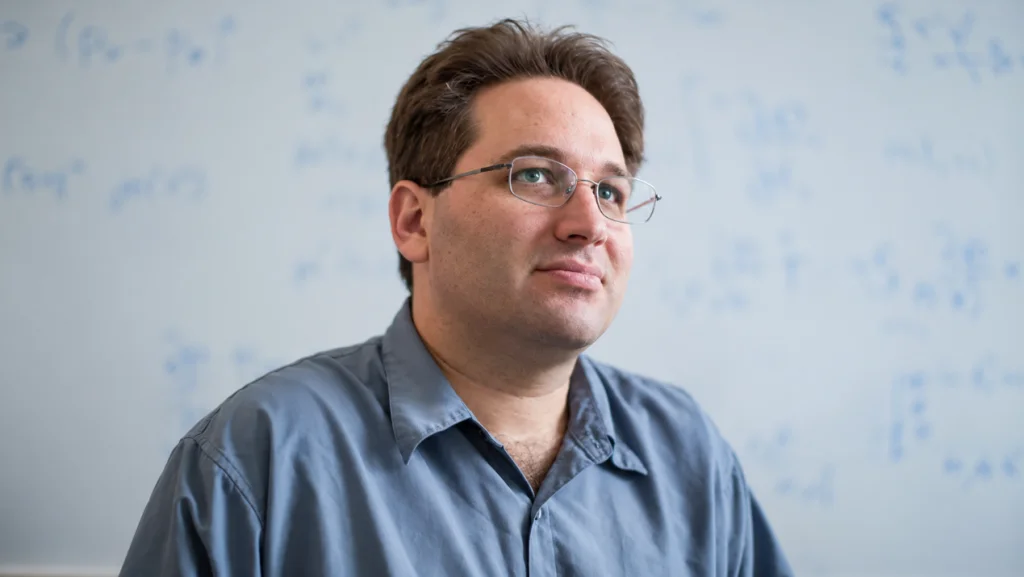

Guest Post By Scott Aaronson, a computer scientist at the University of Texas at Austin.
Companies preparing for quantum computers may have to confront a threat that requires no quantum computer at all. For the operators of critical infrastructure, from electric utilities and water systems to hospitals and telecom networks, the lesson is simple: keep the move to quantum-resistant cryptography on schedule, but buy systems that can change their security methods again when a new weakness emerges. The next upgrade should not be the last one any device can take.
The rumors behind this did not come from nowhere. On October 26, OpenAI announced that one of its models had refuted the Exponential Time Hypothesis, a central conjecture in complexity theory, and Anthropic published an independent refutation hours later. Then, on November 24, Scott Aaronson, a computer scientist at the University of Texas at Austin, wrote on his blog that he had heard many rumors that OpenAI or Anthropic might have found a way to factor large numbers in polynomial time on ordinary computers. That means the computing time grows no faster than a fixed power of the number of digits. The following day, Aaronson said he was virtually certain the labs were holding cryptography “bombshells,” while emphasizing that he had neither seen the details nor heard directly from either lab.
Why would factoring matter so much? A digital signature helps a device verify that a software update came from a supplier it trusts. In the widely used RSA method, finding the two secret prime numbers that make up a large public number would allow an attacker to recover the signing key. An affordable attack could undermine trust in software updates for grid controllers, medical devices and network equipment, although other safeguards could still prevent their installation. A supplier that can move its fleet to a different signature method without sending technicians to every site turns that scenario from a crisis into a maintenance window.
The public evidence does not yet settle the question. A November 5 Google DeepMind paper studied ways to reduce the cost of factoring many numbers. Separate Google manuscripts released November 25 claim a rigorous bound long expected in factoring research, along with other mathematical advances. None demonstrates an affordable attack on RSA-2048, a widely used key size, or on common elliptic-curve methods that secure internet connections. The rumors about OpenAI and Anthropic remain unresolved, and that is exactly the kind of uncertainty an adaptable system is built to absorb: a company should not need proof of a break before it can respond to one.
The replacements are not beyond question either. On November 20, cryptographer Anthony Leverrier raised the possibility of an attack on a problem called Ring-LWE, suggesting two days later that it might require a quantum computer. Imagine trying to recover a secret from equations whose answers have been deliberately distorted by small errors. This is the kind of puzzle behind the new standard for establishing shared keys (ML-KEM), while the new signature standard (ML-DSA) uses related mathematics. Both rely on lattices, regular patterns of points that can extend into hundreds of dimensions. Published attacks on selected versions of Ring-LWE have not established that either standard can be defeated. But a company that hard-wires ML-KEM into every device would be as exposed to a lattice surprise as one hard-wired to RSA is today.
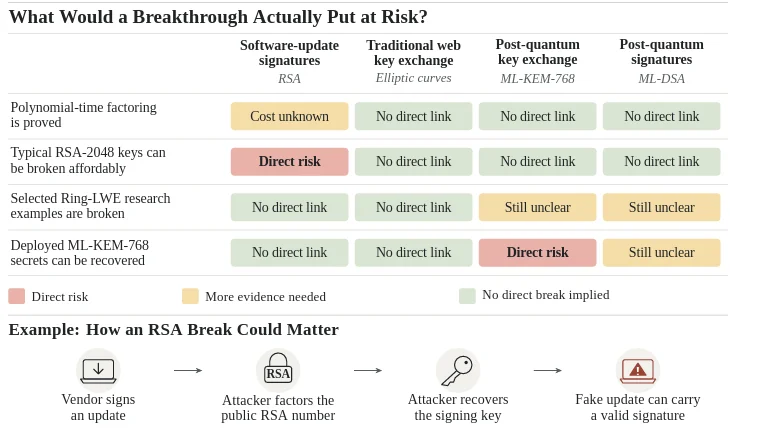
Figure 1 shows why a mathematical shortcut does not necessarily compromise every kind of security. The second row illustrates what would happen if an attacker could afford to recover an RSA signing key. The same result would not directly break the newer methods for sharing keys or signing software.
The reports also revive P versus NP, the question of whether problems whose solutions are easy to check are also easy to solve. Multiplying two primes is easy; recovering them from their product can be extremely hard, which is why a signature is easy to verify yet hard to forge. OpenAI and Anthropic released research on a separate mathematical problem on November 23, and Aaronson speculated two days later that a proof of P not equaling NP might be close. Even that would not prove RSA or its replacements secure, while a proof that P equals NP would in principle threaten quantum-resistant signatures too. No single mathematical assumption is a safe place to stand forever.
So businesses should keep the post-quantum transition on schedule while avoiding permanent dependence on any one mathematical approach. America’s National Institute of Standards and Technology has already standardized signatures based on digital fingerprints and selected another method for establishing keys for standardization. Companies should write that flexibility into procurement: require suppliers to demonstrate how installed equipment can switch to alternatives securely without interrupting essential operations.
Agility has one limit. A utility can change its signing method next year, but it cannot change the protection on traffic someone has already recorded. Combining traditional and post-quantum methods for establishing keys correctly can keep recorded communications private if either method holds and the rest of the system remains secure.
For an operator connecting two data centers over fiber, quantum key distribution is another option worth evaluating. It uses the quantum properties of light to establish shared keys without relying on the presumed difficulty of those mathematical puzzles. The sites must still verify each other’s identity, and both the equipment and subsequent encryption must be secure. It cannot replace digital signatures, and the National Security Agency advises against its use in national security systems unless practical limitations are overcome.
The next upgrade should be judged not only by how well it handles the threat we expect, but also by how readily it can adapt to the one we did not anticipate.
Guest posts reflect the views and opinions of their authors and do not necessarily represent those of The Quantum Insider, its staff or its affiliated organizations. Publication does not constitute an endorsement of any company, product, service or claim discussed.

Keep track of everything going on in the Quantum Technology Market. In one place.
Topics

Resonance
The Quantum Insider is the leading online resource dedicated exclusively to Quantum Computing. You can contact us at [email protected].
Stay Ahead of Quantum
Get the latest research, company news, and market intelligence every week.