Canadian Researchers Piece Together a Million-Qubit Quantum Chip


Insider Brief
- Researchers at Canada’s National Research Council and the University of Warwick developed a germanium-silicon chip design aimed at scaling quantum computers to 1 million qubits on a single chip.
- In peer-reviewed research, the team showed that engineered layers of germanium and silicon could serve as a foundation for future chips that use nanoscale structures called quantum dots to form qubits.
- The collaboration received support from the NRC’s Quantum Sensors Challenge program, and the researchers are developing follow-on projects and seeking academic and industry partners.
PRESS RELEASE — Researchers at the National Research Council (NRC) and the University of Warwick are taking an important step toward building practical quantum computers powerful enough to solve problems beyond the reach of today’s technology. The team has developed a new approach using the elements germanium and silicon to address one of quantum computing’s biggest challenges: how to scale from a handful of qubits to one million qubits on a single chip.
For over 2 decades, NRC scientists have been at the forefront of quantum research and development of quantum dots—nanoscale semiconductor structures that can be used to build types of qubits. Qubits run quantum sensors, computers and other systems.
Dr. Sergei Studenikin met his future collaborator Associate Professor Myronov from the University of Warwick at a conference over a decade ago. These 2 experts came together to search for the “perfect” quantum material needed to build qubits for extremely powerful quantum computers.
Key to helping their collaboration grow was support from the NRC’s Internet of Things: Quantum Sensors Challenge program at a critical time.
“When you have that many nanoscale qubits on a chip, everything has to be made from very high-quality materials, perfectly manufactured and precisely aligned.”Dr. Sergei Studenikin, Principal Investigator, Quantum and Nanotechnologies Research Centre
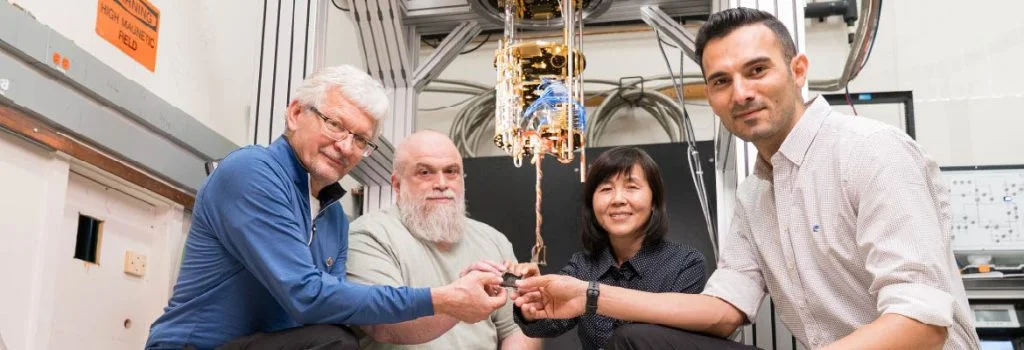
Inside the quantum physics lab where Drs. Sergei Studenikin, Yousef Karimi Yonjali and Khaled Mnaymneh do their research, the golden cryostat with its open cover immediately catches your eye. This essential piece of equipment is capable of freezing qubits at the extremely low temperature of about −273 °C, also known as near absolute zero. This extreme cold is needed for the researchers to test the extremely fragile qubits, crucial tests the team believes allowed them to unlock another piece of the quantum computing puzzle.
Down the hall in another lab, Dr. Weihong Jiang peers into the electron scanning microscope to verify the fabrication of a germanium and silicon chip. “Our research showed that specially engineered layers of silicon and germanium could provide a promising foundation for future quantum computer chips,” she said.
The team’s peer-reviewed research demonstrated that germanium silicon engineered chips could provide a promising foundation for a future practical computer.
“This creates an exciting opportunity for germanium and silicon to become a key material platform for the next generation of quantum electronics, sensing and information technologies,” adds Professor Myronov.
Results achieved so far are just the beginning, according to Professor Myronov. With several other projects already in development, they see great potential, both in terms of scientific impact and future commercialization. “We’re grateful to the NRC for its vision and support, and we look forward to strengthening this long-term collaboration and translating our joint research into technologies with real-world impact,” he said.
“We hope that our research will attract the interest of other academic collaborators and small and medium-sized enterprises to make quantum computers a reality for more people,” said Dr. Studenikin.
Director of the Internet of Things Quantum Sensors Challenge program Dr. Marina Gertsvolf emphasizes that this research success illustrates “how important it was to support ongoing fruitful collaboration between scientists from the NRC and the University of Warwick. It exemplifies how Canadian researchers are at the forefront of developing new solutions that will grow and strengthen our quantum ecosystem.”

Keep track of everything going on in the Quantum Technology Market. In one place.
Matt Swayne
With a several-decades long background in journalism and communications, Matt Swayne has worked as a science communicator for an R1 university for more than 12 years, specializing in translating high tech and deep tech for the general audience. He has served as a writer, editor and analyst at The Quantum Insider since its inception. In addition to his service as a science communicator, Matt also develops courses to improve the media and communications skills of scientists and has taught courses.
[email protected]

Stay Ahead of Quantum
Get the latest research, company news, and market intelligence every week.
MENTIONED IN THE ARTICLE

National Research Council of Canada
National Research Council Canada is the primary national agency of the Government of Canada dedicated to science and technology research and development. It is the largest federal R&D organization in Canada, supporting innovation through research centres, collaboration programs, and funding initiatives. NRC's work spans aerospace, construction, digital technologies, health, metrology, quantum and nanotechnologies, and more, aiming to accelerate scientific breakthroughs and address national priorities. It partners with industry, academia, and government to deliver impactful solutions and foster Canadian competitiveness.
→

University of Warwick
The University of Warwickis a public research university on the outskirts of Coventry between the West Midlands and Warwickshire, England.The university was founded in 1965 as part of a government initiative to expand higher education. The Warwick Business School was established in 1967, the Warwick Law School in 1968, Warwick Manufacturing Group (WMG) in 1980, and Warwick Medical School in 2000. Warwick incorporated Coventry College of Education in 1979 and Horticulture Research International in 2004.
→

National Research Council Canada
National Research Council Canada is the primary national agency of the Government of Canada dedicated to science and technology research and development. It is the largest federal R&D organization in Canada, supporting innovation through research centres, collaboration programs, and funding initiatives. NRC's work spans aerospace, construction, digital technologies, health, metrology, quantum and nanotechnologies, and more, aiming to accelerate scientific breakthroughs and address national priorities. It partners with industry, academia, and government to deliver impactful solutions and foster Canadian competitiveness.
→