Telia, Nokia And QMill Demonstrate Quantum-Powered Encryption in a 5G Network


Insider Brief
- Telia Finland, Nokia and QMill demonstrated quantum-powered encryption integrated into Nokia’s 5G base station software using commercial equipment in Telia’s innovation environment.
- The solution combines standard ML-KEM post-quantum cryptography with QMill’s quantum-powered key exchange and user-verifiable quantum randomness to secure connections between a base station and a network security gateway.
- The partners completed the concept-to-demonstration process in less than 90 days and are exploring security-sensitive use cases for commercialization.
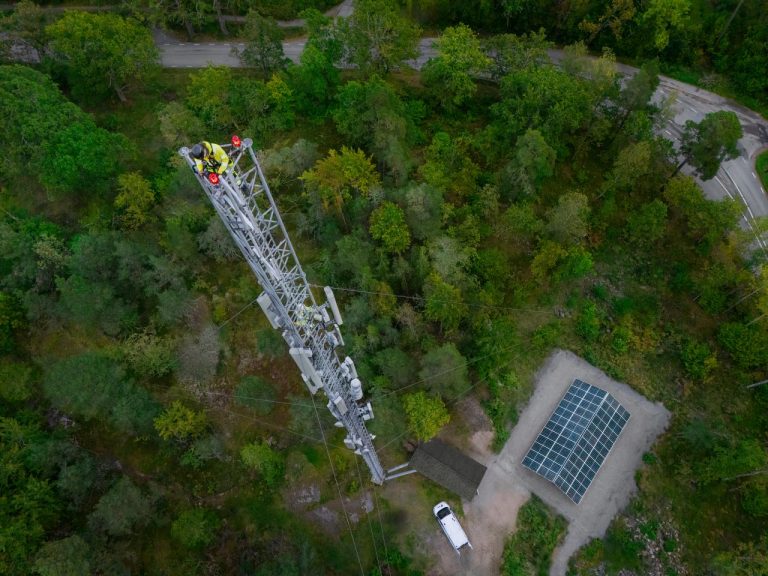
PRESS RELEASE — Telia Finland, Nokia and QMill have demonstrated the world’s first quantum-powered encryption in a 5G network using commercial equipment. In the proof of concept (PoC), QMill’s solution was integrated into Nokia’s 5G base station software and successfully demonstrated in Telia’s 5G innovation environment.
Two firsts in one solution
The method brings together two firsts, both part of QMill‘s solution: a new quantum-powered key exchange working in tandem with standard, state-of-the-art post-quantum cryptography (PQC), and user-verifiable quantum random numbers used to seed the key exchange.
During the PoC, a quantum computer was used to establish a secure connection between a 5G base station and the network’s security gateway function, which protects traffic to the operator’s core network. The solution in essence consists of two functions:

- Quantum-powered key exchange: The base station establishes a shared encryption key with the IPsec peer by combining standard ML-KEM, the post-quantum key exchange algorithm standardized by NIST, with QMill‘s new key exchange algorithm powered by quantum computation.
- Verified quantum randomness: QMill‘s method feeds its key exchange with fresh, user-verifiable random numbers drawn from a quantum computer. These are fetched through the QMill Cloud service, which orchestrates the quantum computations.
An extra component on top of the PQC foundation
Standards-defined post-quantum cryptography will be the foundation for critical networks. QMill‘s solution adds an extra component for security on top of it, powered by a quantum computer. The PoC showed it working in a real 5G network, on standard network equipment, without requiring costly dedicated infrastructure.
From whiteboard to base station in less than 90 days
In less than 90 days, the new cryptographic primitive went from a concept on a whiteboard to a successful PoC product implementation, including integration with the 5G base station functionality and an end-to-end demonstration in a 5G network consisting of commercial equipment. This demonstrates the rapid development capabilities necessary to keep our most critical infrastructure secure.
The approach is likely to become increasingly relevant as networks evolve toward 6G and security requirements continue to develop in response to emerging threats.
Next: concrete use cases in security-sensitive sectors
The PoC builds on earlier work. In May 2026, Telia Finland and QMill announced that they had developed a quantum-enhanced message-encryption method for mobile networks, enabled by local or cloud-based quantum computers.
With the PoC completed, Telia, Nokia and QMill see potential for the solution, particularly in security-sensitive sectors, and are looking into concrete use cases on the path to commercialization.

Keep track of everything going on in the Quantum Technology Market. In one place.
Topics

Matt Swayne
With a several-decades long background in journalism and communications, Matt Swayne has worked as a science communicator for an R1 university for more than 12 years, specializing in translating high tech and deep tech for the general audience. He has served as a writer, editor and analyst at The Quantum Insider since its inception. In addition to his service as a science communicator, Matt also develops courses to improve the media and communications skills of scientists and has taught courses.
[email protected]

Stay Ahead of Quantum
Get the latest research, company news, and market intelligence every week.
MENTIONED IN THE ARTICLE

Telia
Telia is a Swedish multinational telecommunications company operating across the Nordic and Baltic regions. It provides mobile telephony, internet access, fixed-line communications, and IT hosting services. Telia is the largest fixed-voice, broadband, and mobile operator by revenue and customer base in these regions, and also owns TV-media operations including TV4 in Sweden and MTV in Finland. The company has a history of pioneering mobile and broadband technologies and continues to expand its 5G network and digital services.
→

Nokia
Nokia is a global technology leader specializing in advanced connectivity solutions across fixed, mobile, and cloud networks. The company develops and deploys AI-powered network infrastructure, cybersecurity, and mission-critical communications for enterprises, telecommunication providers, and defense sectors. Through its innovation arm, Nokia Bell Labs, the company drives research in next-generation networking, automation, and quantum-safe technologies. Nokia's solutions enable secure, high-performance connectivity, supporting digital transformation and the integration of AI in network operations worldwide.
→

QMill
QMill specializes in quantum computing, focusing on the development of quantum-advantage algorithms and software for the noisy intermediate-scale quantum (NISQ) era. Its core innovation is AI-powered quantum circuit compression, enabling more efficient execution of quantum algorithms on current and near-term quantum hardware. QMill collaborates with industry and academic partners to benchmark and test its solutions, aiming to deliver practical quantum advantage for industrial applications. The company is based in Espoo, Finland, and is supported by venture capital and government grants.
→