From Cat Pictures to DNA, Moth Quantum Reports Progress on Getting Everyday Data Into Quantum Computers


Insider Brief
- Moth Quantum reported a method that loaded and recovered 1,568 numerical values across an entire IBM quantum processor, more than 12 times the largest previous comparable experiment.
- The method, called Tessa, works with existing chip connections to encode data in parallel without extra operations to move information or additional helper qubits.
- Tests included images, audio and biological sequences, though encoding more values per data qubit requires more repeated measurements to recover them accurately.
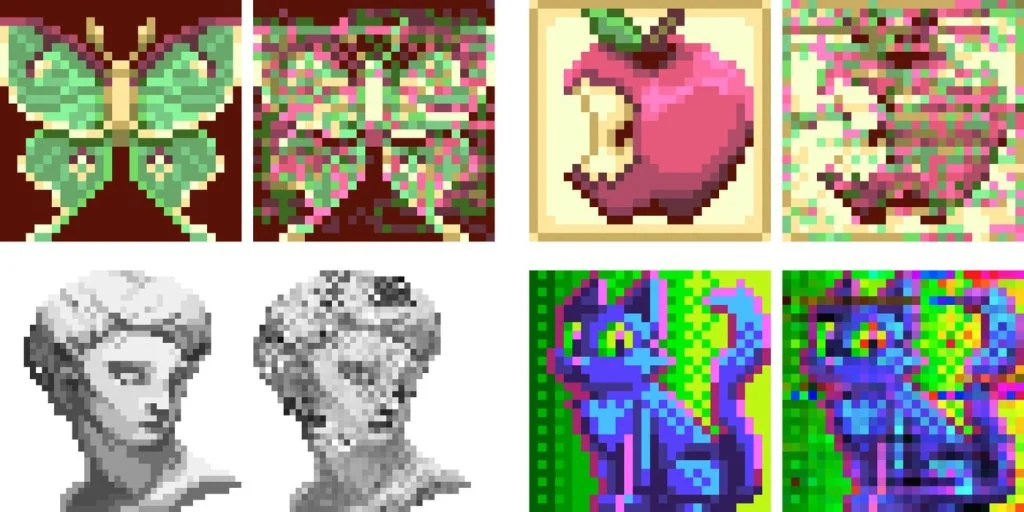
- Image: Four pixel-art images, each shown before (left) and after (right) being encoded across all 120 qubits of an IBM Quantum Nighthawk r2 processor with Tessa and read back from the chip. Top: Moth and Apple by M. Fish, held in the same qubits. Bottom: Statue by M.A. Kozhikkal (SalvaPixel) and City-pop cat by M. Fish. Contrast correction only, no error mitigation.
Moth Quantum says it has used an entire IBM quantum processor to load and recover data equivalent to two small grayscale images.
That may not sound like much, but the company says the method, called Tessa, addresses getting conventional data onto the machines without adding excessive errors, a basic obstacle to quantum computing, according to a company blog post.
The experiment encoded 1,568 individual numbers, enough to represent two 28-by-28-pixel images, across the processor’s 120 qubits. Each number could describe a pixel’s brightness or another element of a dataset, such as a sample in an audio recording. The total was more than 12 times the number recovered in the largest previous experiment of its kind, according to the company.

Developed by Moth researcher Daniel Bultrini, it arranges the encoding process around a chip’s existing wiring and writes data across the processor at the same time. .
Moth reported the result using a IBM Quantum Nighthawk r2 processor. The largest previous comparable experiment recovered 128 values, the company said. Separate tests used all 156 qubits of an IBM Quantum Heron r3 processor.
The work could help researchers studying quantum machine learning, where the time and operations needed to load conventional data can erode a proposed computational benefit. Bultrini writes in the post that Tessa reduces that burden on current hardware, while leaving a trade-off between how much information is encoded and how many measurements are needed to recover it.
The experiments tested whether information survived the loading process by reading it back. In a working application, the data would undergo further processing on the quantum chip, the company said.
Working With the Wiring
Before a quantum computer can analyze an image, sound recording or other conventional data, those inputs must be translated into the states of its qubits, the basic units of quantum information. That preparation requires operations on the processor, and each operation creates another opportunity for errors.
The arrangement of connections between qubits adds another constraint. According to the post, earlier methods of this kind assume that every qubit holding data connects directly to every qubit used to identify where that data belongs.
IBM’s superconducting processors have a more restricted layout. Each qubit connects only to nearby qubits, so operations involving more distant parts of the chip can require information to move through intermediate connections. Those extra steps lengthen a calculation and expose it to more noise.
Other types of quantum hardware face different constraints, according to the post. Trapped-ion and neutral-atom processors can connect distant qubits, but those operations can be slower or require moving the qubits.
Tessa divides the chip into two groups in a pattern the company says resembles a checkerboard. One group consists of data qubits, which carry the information. The other consists of neighboring address qubits, which distinguish the different values associated with each data qubit.
Each additional address neighbor doubles the number of values a data qubit can represent. A data qubit connected to four address qubits can therefore carry 16 numerical values, according to Moth.
Neighboring data qubits share some address qubits, allowing the arrangement to extend across the processor. The company said the accompanying paper proves that this sharing does not prevent the values associated with each data qubit from being read independently of those on neighboring data qubits.
The arrangement avoids SWAP gates, operations that exchange the states of qubits to move information around a chip. It also requires no additional helper qubits, commonly called ancillas. By avoiding extra steps to move information and the need for additional helper qubits, Tessa limits opportunities for errors and makes more efficient use of the chip.
By assigning some qubits to hold data and others to help locate it, Tessa uses the entire processor.
Testing Images and Other Data
Moth used a pixel-art cat to test the method on both IBM processors. On the Heron r3 chip, Tessa encoded and decoded 441 numbers across 156 qubits. On the Nighthawk r2, it encoded 784 values across 120 qubits.
The recovered cat remained recognizable on both machines without error mitigation, the company said. Error mitigation refers to techniques used to reduce the effect of hardware noise on reported results.
Moth reported a correlation — which means measures how closely the values vary together — of at least 0.95 between the original and recovered data. Correlation
The Nighthawk experiment encoding 784 values required 19 layers of two-qubit gates, operations involving pairs of qubits. This measure, known as circuit depth, describes the number of sequential layers needed, rather than the total number of operations across the chip.
Because Tessa writes the data qubits in parallel, Moth said its circuit depth can stay the same as the number of qubits increases. The company described the encoding circuit as having the same depth on 16 qubits as on 400.
Moth doubled the Nighthawk result to 1,568 values by also encoding information in the phase of the qubits, another aspect of their quantum state. That experiment also required no SWAP gates, according to the company.
Showing that the demonstrations could extend beyond images, Moth said it encoded an audio waveform on the Heron processor, read it back and used the recovered waveform as a repeating sound source in a synthesizer. It also tested musical scores represented as lists of note pitches and durations.
And Tessa isn’t restricted to entertainment. Tests on the Nighthawk processor included DNA and protein sequences. A 784-letter segment of mitochondrial DNA was recovered with 92% of its letters correct, the company said.
These examples draw on the same basic approach of translating different kinds of information into lists of numbers that Tessa can encode.
More Data, More Measurements
Tessa’s capacity comes with a measurement cost. As a data qubit gains more address neighbors and carries more values, recovering those values to the same accuracy requires more repeated measurements, known as shots, according to the post.
A shallow encoding circuit therefore does not eliminate the work needed to read the information. The company said values stored in one measurement basis can be recovered from a single set of measurements across the processor. A measurement basis is the choice of how qubit states are examined, and that set still involves repeated runs.
Moth illustrated the use of different measurement directions by encoding two images in the same qubits, one associated with the Z axis and another with the X axis. These axes describe different ways to prepare and measure a qubit’s state.
As the measurement angle changed from zero to 90 degrees, the recovered image gradually changed from one picture to the other. Demonstrations included a cat changing into a second cat image and an apple changing into a moth.
The company also showed several pixel-art images alongside their recovered versions. Raw output appeared somewhat washed out because of noise, according to Moth. A separate set of images applied a simple contrast correction to that output.
Tessa is available to use now on Moth’s Atlas platform: mql.ink/d.

Keep track of everything going on in the Quantum Technology Market. In one place.
Topics

Matt Swayne
With a several-decades long background in journalism and communications, Matt Swayne has worked as a science communicator for an R1 university for more than 12 years, specializing in translating high tech and deep tech for the general audience. He has served as a writer, editor and analyst at The Quantum Insider since its inception. In addition to his service as a science communicator, Matt also develops courses to improve the media and communications skills of scientists and has taught courses.
[email protected]

Stay Ahead of Quantum
Get the latest research, company news, and market intelligence every week.
MENTIONED IN THE ARTICLE

Moth Quantum
Moth’s mission is to enable the next era of music, gaming and the arts with quantum computing technology.
→

IBM
IBM is an iconic technology pioneer founded in 1911 as the Computing-Tabulating-Recording Company and officially renamed International Business Machines Corporation in 1924. Beyond foundational computing, IBM possesses a deep legacy in aerospace and defense from building the guidance computers and Instrument Unit for NASA's historic Apollo missions to partnering with Airbus on CIMON, the first AI assistant on the ISS.
→
Related Articles