Altera, OQC and NVIDIA Link Quantum Processor to GPU Computing


Insider Brief
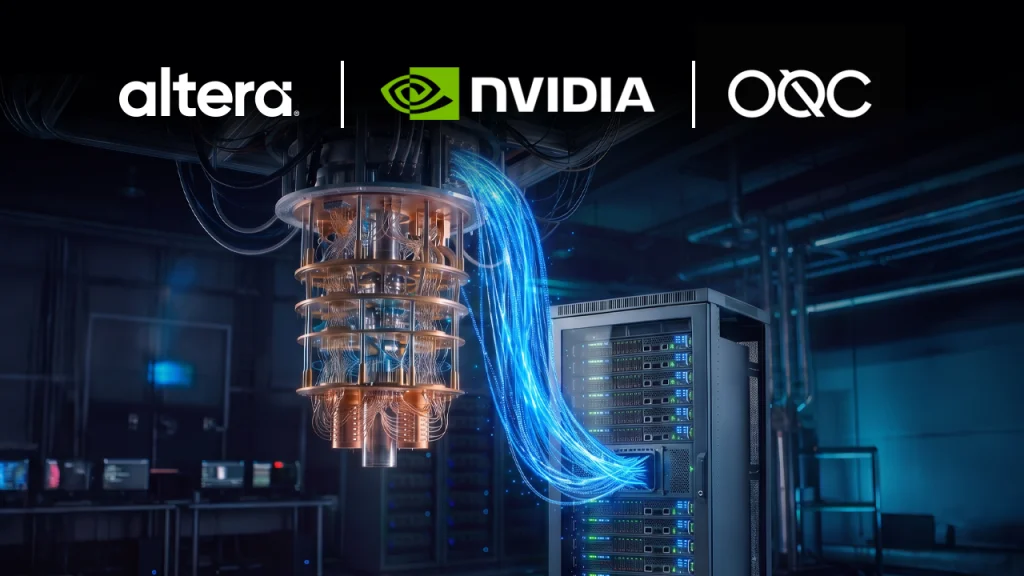
- Altera, Oxford Quantum Circuits and NVIDIA developed an FPGA-based quantum controller reference design that connects an OQC quantum processor with NVIDIA GPUs.
- The design integrates qubit control and readout functions to reduce control hardware requirements, while GPUs handle tasks such as calibration and machine learning-based readout classification.
- The companies will demonstrate the system at Supercomputing 2026 in Chicago, with the reference design expected to be released in January 2027.
PRESS RELEASE — Altera Corporation, the largest pure-play FPGA provider with a full-spectrum portfolio, today announced the development of an end-to-end FPGA-based quantum system controller reference design in collaboration with Oxford Quantum Circuits (OQC) and NVIDIA. Built on an Agilex® 9 Direct RF FPGA, the design runs real-time system control in the FPGA, which controls a new generation OQC quantum processing unit (QPU) through RF conditioning electronics developed in OQC, and connects to NVIDIA accelerated computing over NVIDIA NVQLink, helping developers build smaller, lower-power, lower-latency quantum computing controllers.
The companies will demonstrate the full-system reference design in Altera’s booth #2854 at Supercomputing 2026 (SC26) in Chicago.
Qubit counts in quantum computing systems are growing much faster than the space available for the classical control equipment around them, so control hardware has to become denser. FPGAs provide that density by integrating functions that otherwise take racks of discrete RF chains, converters, and interconnects. Agilex 9 Direct RF FPGAs do this with integrated analog-to-digital and digital-to-analog converters, so control and readout run without external RF up-conversion or down-conversion. Frequency multiplexing then lets multiple readout channels share a single RF port, which is designed to reduce the need for additional RF hardware as systems scale.

“Our work with Oxford Quantum Circuits and NVIDIA uses FPGAs to demonstrate a full system reference design in a real-world setting, from the quantum processor through the FPGA to the GPU,” said Farhad Shafai, Head of Business Solutions & Marketing at Altera. “This demonstration shows how Altera’s Direct RF technology can anchor the control layer of quantum systems, and it gives developers a clear path to build on.”
The reference design runs real-time qubit control and resonator readout and spectroscopy in the FPGA, with synchronized scheduling across functions. NVIDIA NVQLink connects the FPGA to GPUs, which take on processing-heavy tasks such as calibration and ML-based readout classification, and CUDA functions drive the FPGA logic for QPU system functions.
With Altera’s quantum system controller reference design, developers get a validated set of functions and a software stack for the basic building blocks of a quantum system controller, including qubit and resonator spectroscopy, qubit initialization, and resonator readout and classification, plus a GPU-based machine learning (ML) readout classifier and example GPU-based initialization functions for the QPU. A built-in emulation path lets developers bring up the controller and test algorithms before physical qubit hardware is available, so they reach results sooner.
“Advances in AI are opening new ways to build and operate quantum computers,” said Sam Stanwyck, Director of Quantum Product at NVIDIA. “NVIDIA NVQLink gives quantum builders an open architecture to put those advances to work. Together with Altera and OQC, we’re giving developers a working reference design to explore AI-driven calibration and readout and accelerate the development of their own quantum systems.”
“Precise control and fast feedback are essential to unlocking the capabilities of our quantum processors,” said Simon Phillips, CPO at OQC. “Altera’s FPGA technology provides a programmable, low-latency connection to our QPU, bringing control and readout together while allowing us to refine calibration and feedback as our systems evolve. This integration helps simplify system development and provides a path to supporting more qubits.”
The Agilex 9 Direct RF quantum system controller reference design with NVIDIA NVQLink is expected to be released in January 2027. Attendees at Supercomputing 2026 (SC26) can see the demonstration live in Altera’s booth #2854. To learn more, visit Altera Quantum Computing.

Keep track of everything going on in the Quantum Technology Market. In one place.
Topics

Matt Swayne
With a several-decades long background in journalism and communications, Matt Swayne has worked as a science communicator for an R1 university for more than 12 years, specializing in translating high tech and deep tech for the general audience. He has served as a writer, editor and analyst at The Quantum Insider since its inception. In addition to his service as a science communicator, Matt also develops courses to improve the media and communications skills of scientists and has taught courses.
[email protected]

Stay Ahead of Quantum
Get the latest research, company news, and market intelligence every week.
MENTIONED IN THE ARTICLE