Classical Light Dynamics Could Help Simulate Quantum Interactions


Insider Brief
- Researchers from Saint Louis University and two German institutions used numerical simulations to show that classical nonlinear light dynamics can induce effective photon interactions and thermalize quantum light.
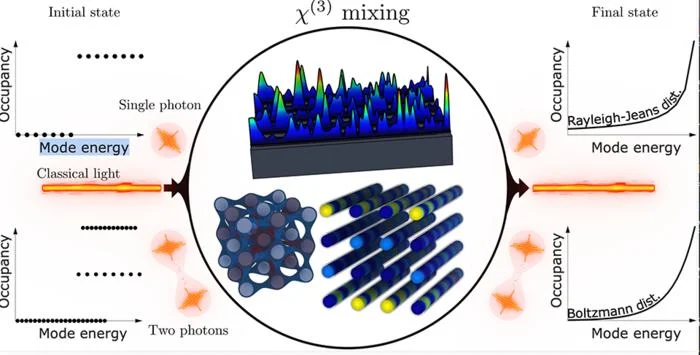
- Single- and two-photon states propagating alongside intense classical light developed statistical distributions consistent with Rayleigh-Jeans and Boltzmann distributions.
- The approach could provide a platform for studying quantum thermodynamics and open quantum systems without requiring materials with strong single-photon nonlinearities.
PRESS RELEASE — An international research team of scientist from Saint Louis University (SLU) and two institutions in Germany has shown that multimode nonlinear optical platforms can be harnessed to induce effective quantum interactions between photons, subsequently thermalizing them.
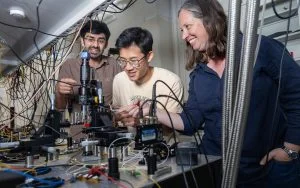
In a study published in Sciences Advances, a research team from SLU’s School of Science and Engineering (SSE), the Max Born Institute, and Humboldt-Universität zu Berlin has demonstrated that the nonlinear dynamics of classical light can influence single and two-photon quantum states.
The SLU team includes Şahin K. Özdemir, Ph.D., professor and chair of electrical and computer engineering; Ramy El-Ganainy, Ph.D., professor of electrical and computer engineering; and Armando Perez-Leija, research scientist. Other authors include Fouad Chahrour, of the Max Born Institute and Humboldt University of Berlin, and Kurt Busch, professor of theoretical physics at the Institute of Physics in the Humboldt University of Berlin and the Max Born Institute.

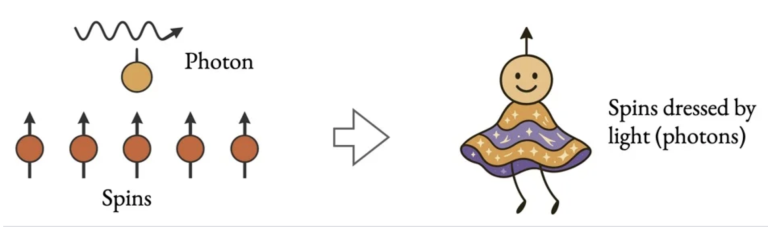
Photons stand out as the ultimate information carriers in quantum physics and optical sciences. Possessing exceptional coherence and traveling at the upper physical speed limit, they form the backbone of high-speed data transmission and quantum-enhanced optical technologies. Yet, these advantages are coupled with a fundamental physical limitation – the absence of direct photon-photon interactions.
In “Thermalization of quantum light induced by classical nonlinear wave dynamics,” the research team investigated scenarios where quantum light propagates alongside relatively intense classical light fields within multimode nonlinear optical systems. Through rigorous numerical experiments, the team revealed that single- and two-photon states embedded in these configurations do not merely maintain their initial states or suffer unmitigated decoherence; instead, they thermalize.
This thermalization process is confirmed by the emergence of characteristic statistical distributions, specifically matching Rayleigh-Jeans and Boltzmann distributions, Perez-Leija said. “By leveraging the intense classical wave dynamics to mediate effective interactions, the system successfully bridges the gap between macroscopic nonlinear optics and microscopic quantum mechanics.”
This approach provides a powerful framework for simulating quantum behaviors that were previously considered practically inaccessible in optical setups. Rather than requiring exotic, ultra-strong single-photon nonlinear materials—which are notoriously difficult to fabricate and scale — the method achieves effective quantum thermalization using standard, readily available classical optical structures.
“The implications of this work extend far beyond foundational optics, reaching deep into statistical mechanics and condensed matter physics,” said El-Ganainy. “By establishing that classical nonlinearities can effectively thermalize quantum states, the framework offers researchers a powerful, highly controllable testbed for investigating open quantum systems and many-body thermodynamics.”
Furthermore, this platform paves the way for exploring a richer, broader spectrum of complex quantum phenomena — including aspects of quantum phase transitions — within standard laboratory optical settings.
“By lowering the experimental barriers required to study complex quantum photon interactions, the research opens fresh avenues for light dynamics and deepens our fundamental understanding of how statistical equilibrium emerges in quantum systems,” Ozdemir said.
This research was supported by the US Air Force Office of Scientific Research (AFOSR) and the Army Research Office (ARO).

Keep track of everything going on in the Quantum Technology Market. In one place.
Topics

Matt Swayne
With a several-decades long background in journalism and communications, Matt Swayne has worked as a science communicator for an R1 university for more than 12 years, specializing in translating high tech and deep tech for the general audience. He has served as a writer, editor and analyst at The Quantum Insider since its inception. In addition to his service as a science communicator, Matt also develops courses to improve the media and communications skills of scientists and has taught courses.
[email protected]

Stay Ahead of Quantum
Get the latest research, company news, and market intelligence every week.
MENTIONED IN THE ARTICLE

Saint Louis University
Saint Louis University is a private Jesuit research university in St. Louis, Missouri, specializing in a broad range of disciplines including health sciences, engineering, science, and liberal arts. It develops interdisciplinary research initiatives, including work in quantum-related materials, quantum electronics (microwave resonators, amplifiers, etc.), environmental modelling, and computational science. It emphasizes a mission combining rigorous academics, research, and community engagement, drawing on both local and global partnerships to deliver impact.
→

Humboldt University Berlin
Humboldt University Berlin is a public research university. The university is recognized as one of Europe’s pioneering higher education institutions, and Wilhelm von Humboldt is credited with developing a model for universities that saw a closer relationship between research and teaching.
→

United States Air Force
The United States Air Force is the air service branch of the United States Armed Forces, and is one of the eight US uniformed services.
→
US Army Research Office
ARL’s Army Research Office, founded in 1951 as the Army Research Office and based in Research Triangle Park, N.C., has more than 100 scientists, engineers and support staff, who manage the Army’s extramural research program. The research they fund is conducted at 250 universities across the country and around the world with more than 1,100 individual researchers.
→