

Insider Brief
- Researchers at Nanjing University demonstrated an asynchronous measurement-device-independent quantum cryptographic conferencing system that enables three users to establish a shared secure key without trusting the central measurement station.
- By pairing single-photon detections recorded at different times, the protocol avoids the increasingly rare multiphoton coincidence events that limit conventional multiuser quantum conferencing as network loss and user numbers rise.
- The experiment generated secure keys at up to about 59.6 dB of total system loss and used post-processing to compensate for independent-laser frequency differences and fiber-phase drift without phase locking.
- Image: https://arxiv.org/pdf/2602.20927
PRESS RELEASE — Quantum key distribution allows two users to establish secret keys whose security is grounded in the laws of quantum mechanics. Extending this capability to multiple users is an essential step toward quantum networks that support secure communication among many participants. Quantum cryptographic conferencing addresses this need by enabling multiple users to share the same secure key, which they can then use to protect group communications.
Writing in Physical Review Letters, a team led by Professor Xiao-Song Ma at Nanjing University reports the experimental realization of asynchronous measurement-device-independent quantum cryptographic conferencing, or AMDI QCC. The demonstration addresses two major challenges in developing practical quantum networks: maintaining useful key-generation rates as networks grow and reducing the complexity of controlling optical phases.
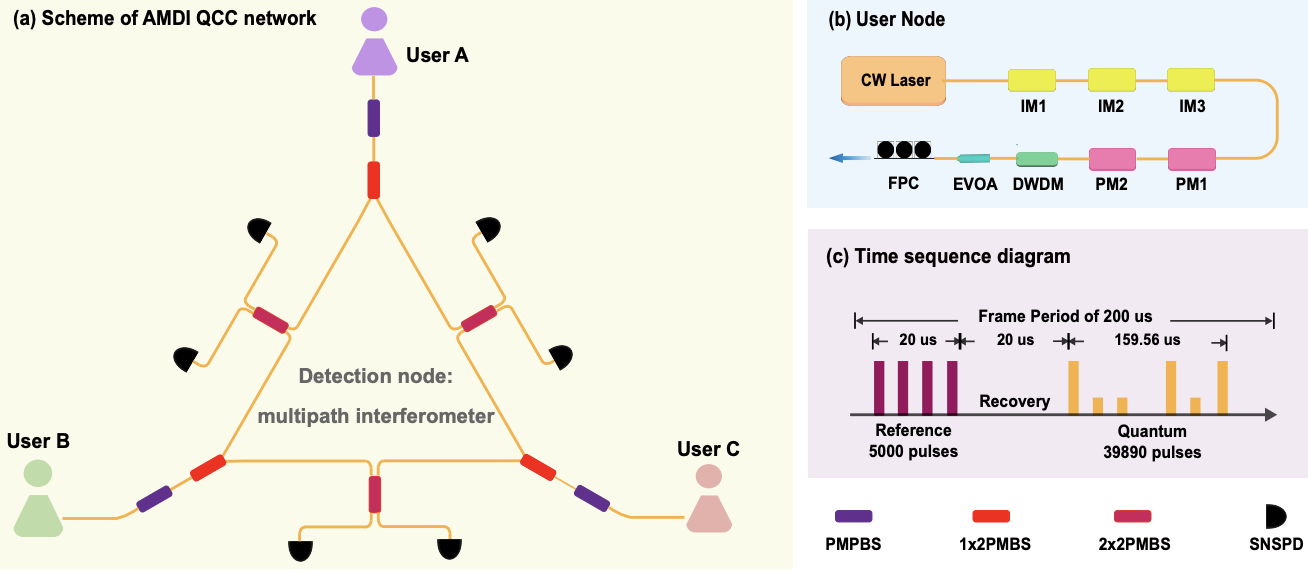
As illustrated in the image above, three users independently send optical pulses to a shared GHZ measurement station, where a fiber-based multipath interferometer enables interference between signals from different users and single-photon detection. Based on the detection results publicly announced by the measurement node and their own encoding information, the users finally obtain a shared secure conference key through processes such as single-photon detection event pairing, key mapping, and classical post-processing. The measurement-device-independent design protects against attacks targeting the detection equipment, removing the need to trust the shared measurement station.

Higher rates for scalable quantum networks
Conventional measurement-device-independent quantum conferencing protocols rely on multiphoton coincidence events to generate secure keys. These events become increasingly rare as transmission losses increase and more users join the network, sharply limiting communication performance and scalability.
The asynchronous protocol, theoretically proposed by Professor Zeng-Bing Chen and Hua-Lei Yin’s group and collaborators, overcomes this bottleneck by assembling key-generation events from single-photon detections recorded at different times (Y.-S. Lu et al., Reports on Progress in Physics 88, 067901 (2025)). Rather than requiring the relevant detections to occur simultaneously, it pairs suitable events during data processing, making more efficient use of the detected signals.
This change brings a fundamental improvement in how the key rate scales with transmission loss. In an ideal N-user network, the rate changes from a dependence proportional to in conventional MDI conferencing to proportional to η, where η denotes single-user channel transmittance. The loss-scaling exponent therefore no longer grows with the number of users. Although practical rates still depend on system parameters and finite data, this improvement offers a promising route to higher-rate, larger-scale quantum conferencing.
The research team generated secure keys under a maximum total system loss of approximately 59.6 dB, compared with approximately 21.5 dB achieved in the same group’s earlier polarization-encoded MDI quantum conferencing experiment (Y. Du et al., Physical Review Letters 134, 040802 (2025)). At this highest tested loss, the team obtained a secure key rate of approximately 4.470 × 10⁻⁹ bits per pulse. This substantial improvement in loss tolerance builds on the earlier demonstration and strengthens the prospects for extending secure quantum conferencing to longer distances.
A simpler route to practical implementation
For communication networks that employ independent, free-running lasers without frequency locking, frequency differences among the lasers and phase drift in the fiber interferometers can both affect the interference results and key generation.
In this experimental work, the research team used reference optical pulses encoded via time-division multiplexing, combined with a fast Fourier transform, to estimate the frequency differences between the independent lasers and further estimate the phase drift in the multipath interferometer, thereby performing the corresponding phase compensation during data post-processing.
This approach realizes the protocol’s ability to operate without phase locking while retaining the phase estimation and compensation needed for secure key generation. It reduces the dependence of multiuser networks on complex phase control techniques and provides a simpler technical path toward the practical application of multiuser quantum communication.
Together, efficient asynchronous key generation and simplified phase control make AMDI QCC a promising cornerstone for future quantum networks. The present laboratory demonstration establishes a foundation for developing secure, long-distance, multi-party communication over optical fiber. Further advances in integrated light sources, modulators, and detectors could help translate this capability into practical intercity networks.