


Insider Brief
- SK Telecom and KISTI developed a digital twin technology to simulate and verify quantum cryptographic communication network conditions before deploying physical QKD equipment.
- The system links SKT’s Kubernetes-based quantum key management system with KISTI’s QKD simulator through an ETSI standard-compatible interface.
- The companies said the setup can simulate factors such as communication distance, optical loss and equipment characteristics while supporting interoperability with QKD systems from other organizations.
PRESS RELEASE — SK Telecom (CEO Jeong Jae-heon, CEO) news.sktelecom.com 22, said that in collaboration with the Korea Institute of Science and Technology Information (KISTI), the company has developed digital twin technology to verify performance and operability before actually establishing a quantum cryptographic communication network.
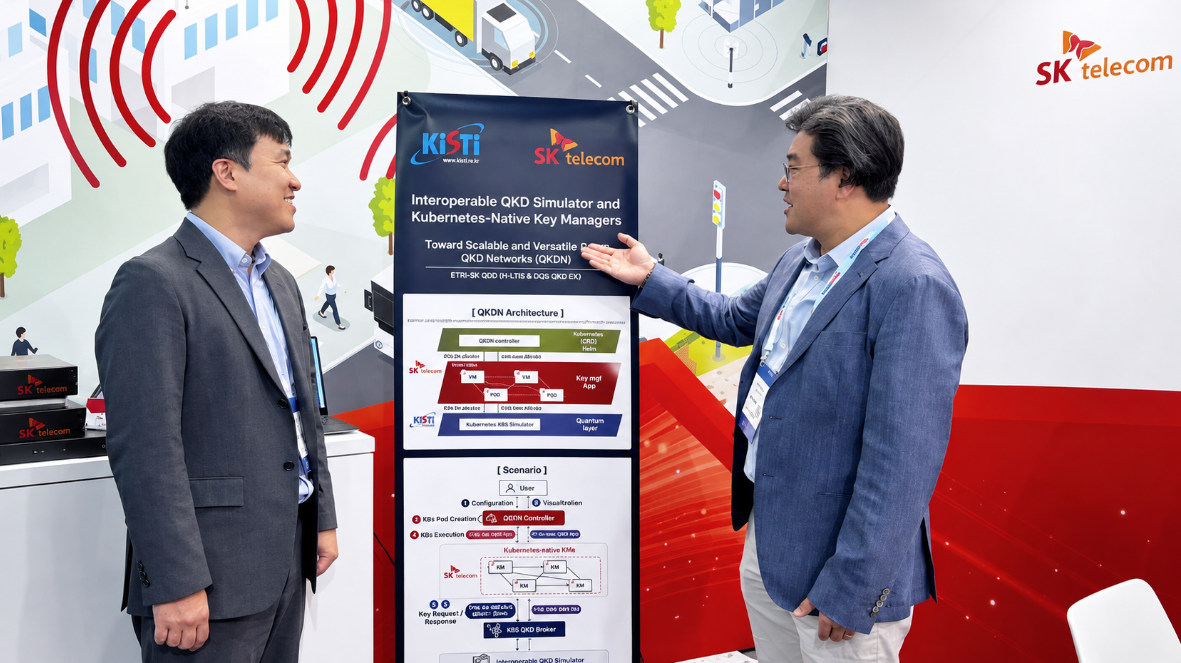
The technology was unveiled at the European Conference on Optical Communication (ECOC) 2026, Europe’s largest international optical communication event, which has been taking place in Malaga, Spain since September 21.
Once a quantum cryptographic communication network is installed, it is difficult to change conditions such as optical cable length or optical loss. The equipment is expensive, so it is not easy to actually test various conditions. SKT and KISTI have virtually moved this entire testing process.

Quantum key distribution (QKD, Quantum Key Distribution) is a technology that uses the principles of quantum mechanics to securely generate and transmit cryptographic keys. The core of this technology is the real-time interworking of SKT’s quantum key management system (Key Manager) and KISTI’s quantum key distribution simulator with an international standard-compliant interface established by the European Telecommunications Standards Institute (ETSI).
When the key management system requests a quantum key, KISTI’s simulator implements various quantum key distribution communication environments, and delivers the performance and status information of the quantum key and quantum key distribution system generated in the environment in real time. This creates a virtual environment that can be verified by linking the entire process from quantum key creation to management and supply.
In particular, this virtual environment can reflect not only the operation of the quantum key distribution equipment, but also the surrounding communication environment such as communication distance and light loss to which the actual equipment is connected, and equipment characteristics such as reception efficiency and post-processing algorithms. The configuration and settings verified within it, that is, which equipment to place at what distance and at what value, can be applied to the actual operating environment, acting as a digital twin in itself.
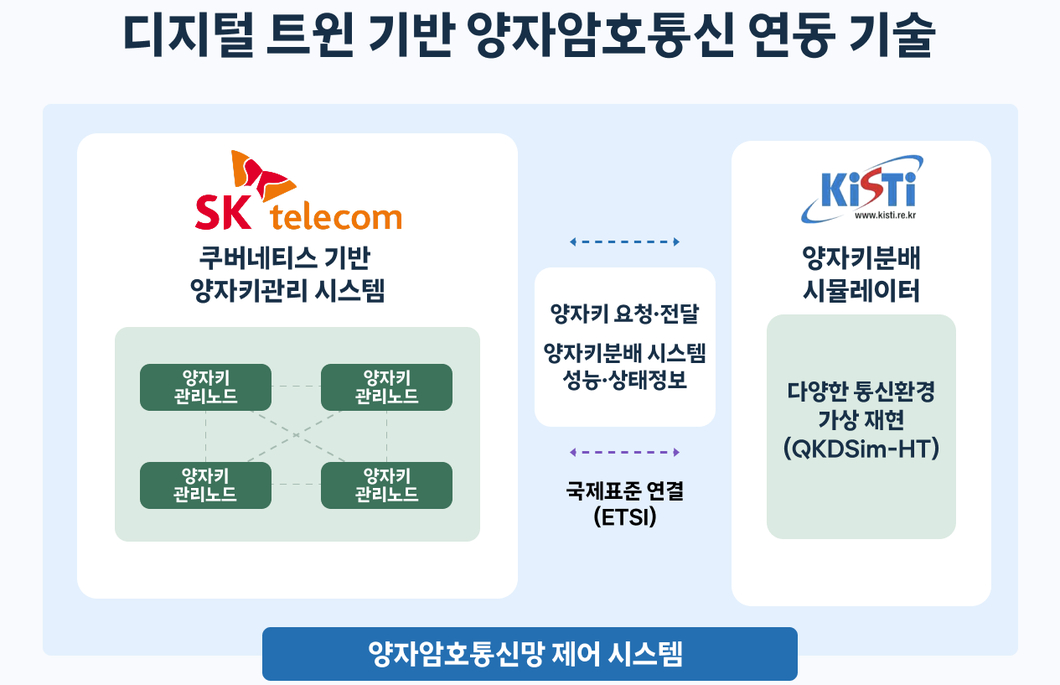
This achievement is the result of industry-research cooperation between the two organizations, combining their strengths. SKT implements the quantum key management system based on containers that are not fixed to specific hardware or virtual machines and distributes and operates it as Kubernetes*.
Thanks to this structure, the key management system can flexibly expand and verify in real time according to the various network environments and key management scenarios created by the simulator.
KISTI developed a quantum key distribution simulator and virtually implemented various conditions such as communication distance and light loss.
The quantum cryptographic communication network control system serves to interlock and control the key management system and the simulator. If this structure is moved as is, it is possible to implement a quantum cryptographic communication network that links actual quantum key distribution equipment with an interface compatible with international standards.
This is the first time that a quantum key management system and a quantum key distribution simulator developed independently by different organizations have been linked and publicly confirmed.
It is also characterized by the fact that by applying an international standard-compatible interface, it is not dependent on a specific equipment or a dedicated interface, but has secured scalability that can be linked to quantum cryptography equipment developed by other organizations or companies in the future. This is expected to increase interoperability between different quantum cryptography systems and contribute to the expansion of quantum cryptography communication services.
This technology was developed as a task for the Ministry of Science and ICT ‘’ element technology for expanding the efficiency of QKD networks and optimizing resources‘and ’ development of quantum cryptographic communication network technology based on national research infrastructure. The exhibition took place at the SK Broadband booth, which received project support ‘demand-based quantum technology demonstration and consulting’.
SKT Network Technology Manager Ryu Tak-gi said, “By linking the Kubernetes-based key management system and the quantum key distribution simulator, it has become possible to flexibly verify various network environments and key management functions”. “Based on this, we will create a highly scalable quantum cryptographic communication network operation environment.” He said.
Song Jung-seok, head of KISTI Network Future Technology Research Division, said “This technology is significant in that it has laid the foundation for implementing various quantum cryptography communication environments and verifying them by linking with actual key management systems”. “In the future, it will be developed into a core technology that increases interoperability and scalability of quantum cryptography networks. said.
Readers looking to learn more about Quantum Key Distribution (QKD) should definitely give Understanding Quantum Networking and Its Industrial Potential a read.