Princeton to Lead $27.9M NSF Institute for Quantum Processor Manufacturing


Insider Brief
- Princeton University will lead MARQUIS, a new NSF Quantum Leap Challenge Institute receiving $27.9 million over five years to address manufacturing challenges in superconducting quantum processors.
- The institute will bring together researchers in materials science, quantum devices and semiconductor processing from nine institutions to develop new fabrication methods for superconducting qubit components.
- MARQUIS will also develop testing and validation methods for mid-scale quantum processors while building education and workforce programs in quantum science and engineering.
Press release – The U.S. National Science Foundation announced today that Princeton University will lead one of eight major initiatives to accelerate the development of quantum computing.
The Princeton-led Quantum Leap Challenge Institute will devise techniques for fabricating hardware and develop education and workforce training programs that deepen U.S. leadership in quantum science and engineering. The research institute will gather experts from wide-ranging fields to break a single, critical bottleneck — the manufacture of core components for quantum processors.
“The whole community has been using essentially the same materials technology for about a quarter century,” said Nathalie de Leon, a professor of electrical and computer engineering at Princeton and co-director of the Princeton Quantum Initiative, who will direct the new institute. That technology has worked well for experimental prototypes and small-scale systems. But to build quantum computers at a scientifically useful scale, she said, the most basic elements must be reinvented.

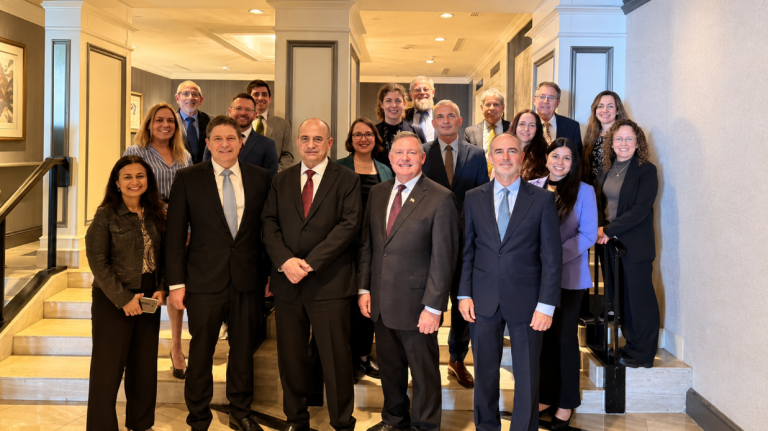
The Princeton-led institute will receive $27.9 million in NSF funding over five years, according to the agency. The research team harnesses expertise from three broad disciplines — materials science, quantum devices and semiconductor processing — spanning two dozen laboratories across nine research institutions.
“There’s a huge barrier to solving the problem,” said Valla Fatemi, a physicist at Cornell University and the institute’s deputy director. “That’s why we need an institute like this, with all this multi-interdisciplinary expertise to solve it.”
Participating institutions include Princeton, Cornell, the Massachusetts Institute of Technology, University of California at Santa Barbara, Stanford University, Dartmouth College, NY Creates, Michigan State University and the University of Iowa. The organizations represented on the advisory board include Google Quantum AI, NVIDIA, Applied Materials, Oxford Instruments, Bluefors, KU Leuven/Imec and MIT Lincoln Laboratory. The new institute will be titled MARQUIS: Manufacturable and Resilient superconducting Quantum Information Systems. It is one of eight announced Aug. 25 in a $290 million round of funding in the NSF’s Quantum Leap Challenge Institutes program.
“For more than four decades, NSF has been laying the foundational groundwork of research and discovery that is powering today’s modern quantum computing, sensing and communication,” said Brian Stone, performing the duties of the NSF director. “It’s time for focused activities to leverage that base of knowledge to drive us even farther forward to the benefit of all Americans. The NSF Quantum Leap Challenge Institutes are a next step for us in understanding the quantum world we live in.”
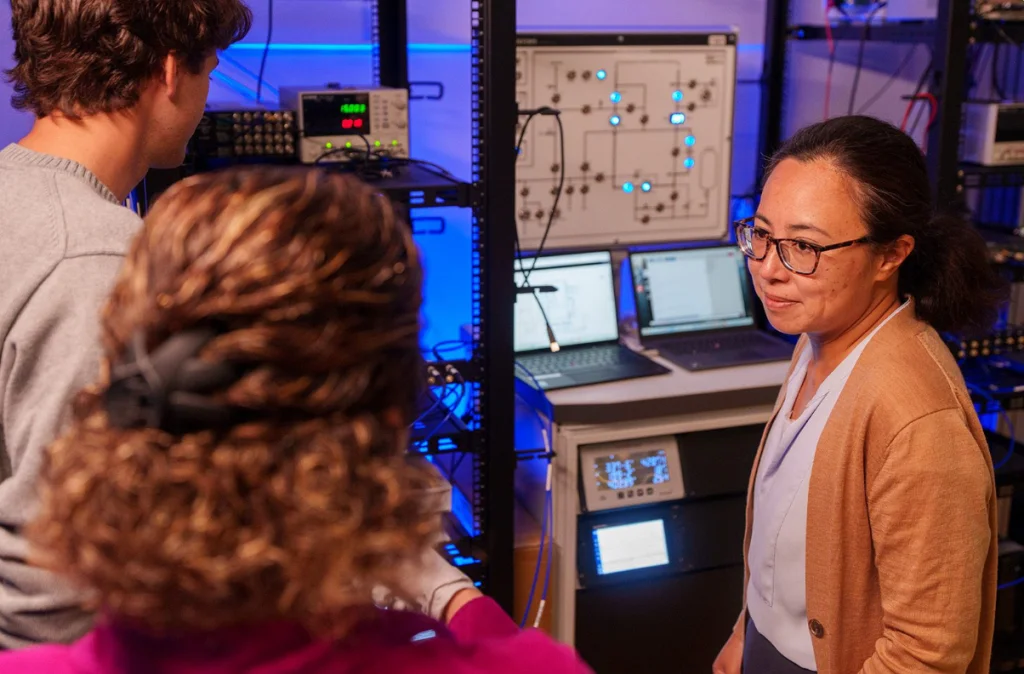
In addition to reinventing the materials systems, the MARQUIS team will also develop methods to validate and compare the performance of various designs and to test them in mid-scale quantum processors — a step between the small systems typically developed in academic labs and the large processors that will one day run useful quantum algorithms.
These test beds will help standardize research efforts across disparate labs and allow experts from other fields to contribute meaningfully to the core challenge, according to the institute leaders. For example, semiconductor fabrication techniques that could prove valuable for quantum computing often involve highly specialized expertise that quantum researchers don’t have.
“In the semiconductor industry especially,” de Leon said, “a lot of the best knowledge is behind a curtain. And the literature is so vast, it’s hard for us to make sense of. So having a few key experts in the field who know what the right waypoints are and how to think about it is really crucial.”
David Graves, a Princeton professor of chemical and biological engineering and expert in the use of plasmas for semiconductor processing, serves as a co-principal investigator of the new institute.
De Leon’s own research has helped revolutionize component technologies for superconducting quantum devices through a collaboration with Andrew Houck, Princeton’s dean of engineering, and Robert Cava, a renowned solid-state chemist, as well as junior researchers from all three labs. Last year, that team published the largest advance in the field in more than a decade. The advance was based on re-imagining the materials used to build superconducting qubits, which store and process quantum information. Their qubits worked 15 times better than leading industry chips, and they have since made even more progress.
Those qubits are all based on a single circuit element called a Josephson junction. This junction consists of three metallic layers stacked like a sandwich, with a layer of oxidized metal in the middle that is only a few atoms thick. Pairs of linked electrons travel through the thin middle layer to create a system that can manipulate information using quantum mechanical rules. Virtually all of today’s qubits use junctions with aluminum and aluminum oxide, the same approach used in the first superconducting qubits more than twenty-five years ago. The new institute’s work will focus entirely on finding new approaches to fabricating the Josephson junction.
Nobel laureate Michel Devoret, who first demonstrated how these devices work, has called the decades-long effort to make better superconducting qubits a “graveyard” of ideas for aspiring physicists and engineers. He has also praised de Leon for taking on such a risky endeavor and making real progress. Devoret, a professor at UC Santa Barbara and chief scientist at Google Quantum AI, is one of the new institute’s senior investigators.
“We can see that the materials limitations are going to be one of the next big bottlenecks,” de Leon said. A large research institute creates mechanisms to coordinate the activities of lots of different people, she said. Her idea: Gather that firepower and aim it at one of the oldest obstacles in quantum computing.
“Let’s make a dream team,” de Leon said, “to try to unblock this.”

Keep track of everything going on in the Quantum Technology Market. In one place.
Topics

Mohib Ur Rehman
Covering quantum and emerging technologies, Mohib explores the intersection of technology, security, and society. His work also frequently examines surveillance infrastructure and the institutions shaping the digital world. In addition to his work at The Quantum Insider, he co-runs SK NEXUS, an independent technology publication that helps readers understand the technologies shaping their lives.

Stay Ahead of Quantum
Get the latest research, company news, and market intelligence every week.
MENTIONED IN THE ARTICLE

Princeton University
Princeton University is a private Ivy League research institution located in Princeton, New Jersey. It traces its roots back to 1746 when it was established as the College of New Jersey in Elizabeth. Being one of the United States' oldest higher education institutions, it's now recognized as the fourth-oldest. The university transitioned through various locations, finally settling in its current site. It achieved university status in 1896 and was later renamed Princeton University.
→
National Science Foundation
The National Science Foundation, situated in Alexandria, Virginia, is a governmental entity. This organization administers the America's Seed Fund SBIR/STTR Program, which aids startups and small businesses by providing grants and seed funding. In Aug, 2022, NSF organized a workshop on Quantum Advantage and Next Steps at the University of Chicago. In Oct, 2022, NSF hosted a virtual workshop on Software-Hardware Co-Design for Quantum Computing, aiming to foster collaboration and build a shared technological ecosystem for both quantum and classical technologies. In Mar, 2023, An NSF Research Coordination Network award facilitated weekly collaboration among scientists from various countries, leading to the inclusion of Quantum Biology as a topic in the Gordon Research Conferences. In Jun, 2023, NSF announced new awards for MRSECs, with several focusing on quantum control of materials and materials for quantum information processing. In Jul, 2023, NSF released the solicitation (NSF 23-604) for the first phase of the NQVL, marking a significant step in advancing quantum research and development.
→