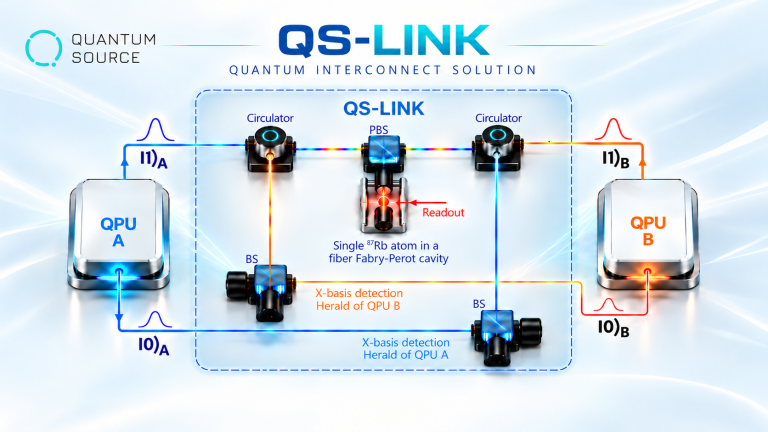
Israeli Quantum Startups Eye Wall Street as SPAC Interest Accelerates



Insider Brief
- Israeli quantum computing companies Quantum Art and Classiq are reportedly in advanced talks to go public on Wall Street through SPAC mergers that could value each company between $2 billion and $5 billion.
- Quantum Art is developing trapped-ion quantum hardware, while Classiq builds quantum software and has partnerships and customers that include Nvidia, Microsoft, Amazon Web Services, BMW, Rolls-Royce and Citi.
- The reported deals reflect growing investor interest in quantum computing as companies seek access to larger pools of capital despite the industry’s limited current revenue and high development costs.
- Photo by engin akyurt on Unsplash
PRESS RELEASE — Two of Israel’s best-funded quantum computing companies are in advanced discussions to go public on Wall Street through mergers with special purpose acquisition companies, underscoring growing investor demand for a sector that remains largely pre-revenue but is attracting multibillion-dollar valuations.
According to YNet News, citing information first obtained by Calcalist, hardware developer Quantum Art and quantum software company Classiq are negotiating potential SPAC mergers that could value each company between $2 billion and $5 billion. The companies declined to comment on the reported discussions.
If completed, the transactions would add to a wave of quantum companies entering public markets through SPAC mergers as investors seek exposure to a technology that many expect could begin delivering — potentially — more commercially significant capabilities later this decade.

Industry sources cited by YNet News estimate that roughly 30 SPACs are currently searching for quantum computing acquisition targets. Among them is an Israeli SPAC led by entrepreneurs Tom Livne and Eyal Waldman that recently raised $172 million.
Quantum Art is reportedly further along in the process and could become the first Israeli quantum computing company listed on Wall Street, potentially before the end of 2026. Classiq is also weighing another private fundraising round before pursuing a public listing in an effort to secure a higher valuation, according to the report.
According to sources close to Classiq, the company is also considering a pre-IPO round to be followed by a standard IPO, which is a longer process than a SPAC, but which might lead to a higher valuation.
Two Different Paths Into Quantum Computing
Although both companies operate in quantum computing, they target different parts of the technology stack.
Founded in 2022, Quantum Art is developing a full quantum computer based on trapped-ion technology. Trapped-ion systems store quantum information in electrically charged atoms suspended by electromagnetic fields. Researchers generally view the approach as offering high-quality quantum operations, although building large-scale systems remains technically challenging.
According to YNet News, Quantum Art employs about 60 people and recently raised $140 million, bringing its total funding to approximately $200 million. The company was founded by Dr. Tal David, former head of Israel’s national quantum computing program; Prof. Roee Ozeri of the Weizmann Institute of Science; and Dr. Amit Ben-Kish, who completed his doctorate under Nobel Prize-winning physicist Prof. David Wineland.
The company is seeking to capitalize on investor enthusiasm surrounding trapped-ion quantum computing. Public companies using similar technology, including IonQ and Quantinuum, have reached valuations of roughly $20 billion, although Quantum Art is reportedly seeking a lower valuation because it has yet to establish significant revenue.
Classiq, founded in 2020, focuses instead on software. Rather than building quantum hardware, the company develops software tools designed to help organizations create applications that can run across different quantum computers.
YNet News described the platform as a potential operating layer for quantum computing, comparable to the role traditional operating systems played in making conventional computers easier to use. If quantum hardware becomes widely deployed, software that works across multiple machines could become an important part of the ecosystem.
The company has raised about $200 million to date and counts AMD, Qualcomm, IonQ and SoftBank among its investors. According to YNet News, Classiq already works with Nvidia, Microsoft and Amazon Web Services, while its customers include Comcast, BMW, Rolls-Royce, Citi, Toshiba and SoftBank. Industry estimates place its annual revenue in the tens of millions of dollars, considerably higher than many quantum startups at a similar stage.
Public Markets Fuel Capital Race
According to YNet News, five quantum startups have already gone public through SPAC mergers since the beginning of 2026, while another five are in advanced merger discussions. Together, the publicly listed companies carry a combined valuation of roughly $70 billion.
Quantum computing companies require unusually large amounts of capital because developing practical quantum systems demands years of research, specialized equipment and highly trained scientists before substantial commercial revenue emerges.
Traditional venture capital has financed much of that work so far. However, many investors believe additional funding will be needed as companies move toward larger quantum processors and commercial deployment.
A SPAC merger can provide several hundred million dollars in relatively short order, allowing companies to expand engineering teams, increase research efforts and accelerate product development without waiting for traditional initial public offerings, the article suggests.
Opportunity and Risk
Israel has emerged as a leading quantum technology hubs despite its relatively small size.
According to YNet News, the country is home to roughly 20 quantum companies out of about 270 worldwide. Many originated from research conducted at institutions including the Weizmann Institute and the Technion.
About $800 million has been invested in Israeli quantum companies to date, with Quantum Art, Quantum Source and Classiq alone raising approximately $500 million during 2025, according to the report. Israel ranks fifth globally in total investment in quantum companies and seventh in overall ecosystem strength.
Despite growing investor enthusiasm, the sector continues to face important limitations.
Most quantum computing companies generate limited revenue, meaning valuations depend largely on expectations that the technology will eventually deliver transformative commercial applications. Those expectations remain difficult to validate because practical, fault-tolerant quantum computers capable of solving large real-world problems have not yet been achieved.
According to YNet News, publicly traded quantum companies often command revenue multiples exceeding 100 times annual sales. Rigetti, one of the earliest quantum companies to reach public markets through a SPAC merger, reportedly carries a valuation of about $7 billion despite annual revenue of roughly $7 million.

Keep track of everything going on in the Quantum Technology Market. In one place.

Matt Swayne
With a several-decades long background in journalism and communications, Matt Swayne has worked as a science communicator for an R1 university for more than 12 years, specializing in translating high tech and deep tech for the general audience. He has served as a writer, editor and analyst at The Quantum Insider since its inception. In addition to his service as a science communicator, Matt also develops courses to improve the media and communications skills of scientists and has taught courses.
[email protected]

Stay Ahead of Quantum
Get the latest research, company news, and market intelligence every week.
MENTIONED IN THE ARTICLE

Quantum Art
Quantum Art is an Israeli full-stack ion trap quantum computing company, spun out of the Weizmann Institute in mid-2022.
→
Classiq
Classiq Technologies specializes in quantum computing software, focusing on enabling the design, optimization, analysis, and deployment of quantum algorithms. It develops a high-level quantum algorithm design platform (IDE, compiler, “OS”) that transforms functional models into optimized, hardware-aware quantum circuits to address the challenge of gate-level complexity. It emphasizes abstraction, circuit synthesis, and resource optimization, working with enterprises, researchers, and hardware/cloud providers to deliver scalable quantum software.
→
NVIDIA
NVIDIA Corporation is an American multinational technology company and a global player in accelerated computing and Artificial Intelligence (AI). Founded in 1993, the company pushes the aerospace frontier with the Space-1 Vera Rubin Module, a platform for orbital data centers that delivers massive AI-compute Space Computing. This NVIDIA technology enables satellites and autonomous spacecraft to process and fuse sensor data rapidly Space Computing.
→

Microsoft
Microsoft engages in the creation and licensing of software for both consumer and enterprise use. The company is renowned for its development of Windows operating systems and the Office suite designed for productivity. Microsoft's structure encompasses three major segments of roughly equal size: productivity and business processes, which encompasses legacy Microsoft Office, cloud-based Office 365, Exchange, SharePoint, Skype, LinkedIn, and Dynamics; the intelligence cloud, which includes offerings like Azure, Windows Server OS, and SQL Server; and more personal computing, which covers Windows Client, Xbox, Bing search, display advertising, and a range of Surface laptops, tablets, and desktops.
→

Amazon Web Services (AWS)
Amazon Braket – A fully managed service that allows scientists, researchers, and developers to begin experimenting with computers from multiple quantum hardware providers in a single place. Bra-ket notation is commonly used to denote quantum mechanical states, and inspired the name of the service.
→

BMW
BMW, which stands for Bayerische Motoren Werke AG, is a prominent German multinational corporation known for manufacturing luxury vehicles and motorcycles. The company has its headquarters in Munich, Bavaria, Germany. BMW is renowned for producing high-quality automobiles and motorcycles, often associated with innovative engineering and a premium driving experience.
→

Rolls-Royce
Rolls-Royce Holdings plc is a British multinational aerospace and defence company incorporated in February 2011. The company owns Rolls-Royce, a business established in 1904 which today designs, manufactures and distributes power systems for aviation and other industries.
→

Citigroup
Citigroup Inc. or Citi is an American multinational investment bank and financial services corporation headquartered in New York City.
→

IonQ
IonQ is a developer in trapped ion quantum computing founded in 2015 that actively applies its technology to the aerospace and defense sectors. The company empowers satellite-based quantum networks and quantum enabled drones to improve positioning, navigation, and timing resilience in GPS denied environments, and collaborates with industry leaders like Airbus to optimize aircraft loading.
→

Quantinuum
Quantinuum builds full-stack quantum computing solutions for practical deployment. Leveraging proprietary enhancements to trapped-ion QCCD architecture, the company has launched multiple commercial hardware generations that deliver leading two-qubit gate fidelity and industry-topping accuracy.
→

AMD
Advanced Micro Devices (AMD) is a U.S.-based multinational technology company that designs and develops CPUs, GPUs, FPGAs, system-on-chip (SoC) solutions, and high-performance computing products. AMD serves markets including gaming, data centers, artificial intelligence, and embedded systems. Its key products include Ryzen CPUs, Radeon GPUs, and EPYC server processors.
→
QUALCOMM Inc.
Qualcomm engages in the design, production, and promotion of digital wireless communication solutions. The company's single-chip radio technology empowers individuals to personalize, manage, and engage with their surroundings. This innovation facilitates novel and captivating interactions through compact and energy-efficient platforms.
→
SoftBank
SoftBank delivers a range of offerings including fixed-line services, mobile telephony, internet connectivity, telecommunications solutions, and digital television products. This multinational corporation specializes in telecommunications and internet services, concentrating on diverse areas such as broadband, fixed-line telecommunication services, e-commerce, technology services, finance, media and marketing, and various other business ventures.
→

Comcast Ventures
Comcast Ventures is the venture capital arm of Comcast Corporation, focusing on investments in technology-driven companies that align with Comcast's strategic interests. The firm invests in early to growth-stage companies across various sectors, including energy and sustainability.
→
Toshiba
Toshiba Corporation is a multinational conglomerate formed in 1939 through the merger of Shibaura Seisakusho and Tokyo Denki. It operates across a wide array of industries including consumer electronics, home appliances, semiconductors, storage products, medical equipment, power systems, elevators, escalators, air conditioners, lighting, and batteries. Toshiba is renowned for its technological innovations and global presence in various sectors.
→
Quantum Source
Quantum Source is working towards scaling quantum computers to millions of qubits through developments in photonic technology. The company was founded by three serial entrepreneurs and a Professor from the Weizmann Institute of Science.
→

Rigetti Computing
Rigetti Computing develops integrated quantum computers and superconducting processors specialized for complex aerospace optimization and satellite communication tasks, including collaborations with the U.S. Air Force. Founded in 2013, the firm produces modular, multi-chip processors internally and provides cloud-based access for large-scale, complex simulations.
→