

Insider Brief
- The University of Texas at Austin is expanding its quantum ecosystem through new facilities, historic research strengths and state-backed infrastructure.
- UT’s quantum legacy includes John A. Wheeler, David Deutsch, Wojciech Zurek, Benjamin Schumacher, Allan MacDonald and Scott Aaronson.
- Recent efforts include new Welch Hall facilities, the Texas Quantum Institute, Infleqtion’s qNexus collaboration and a $4.8 million state grant for Qlab.
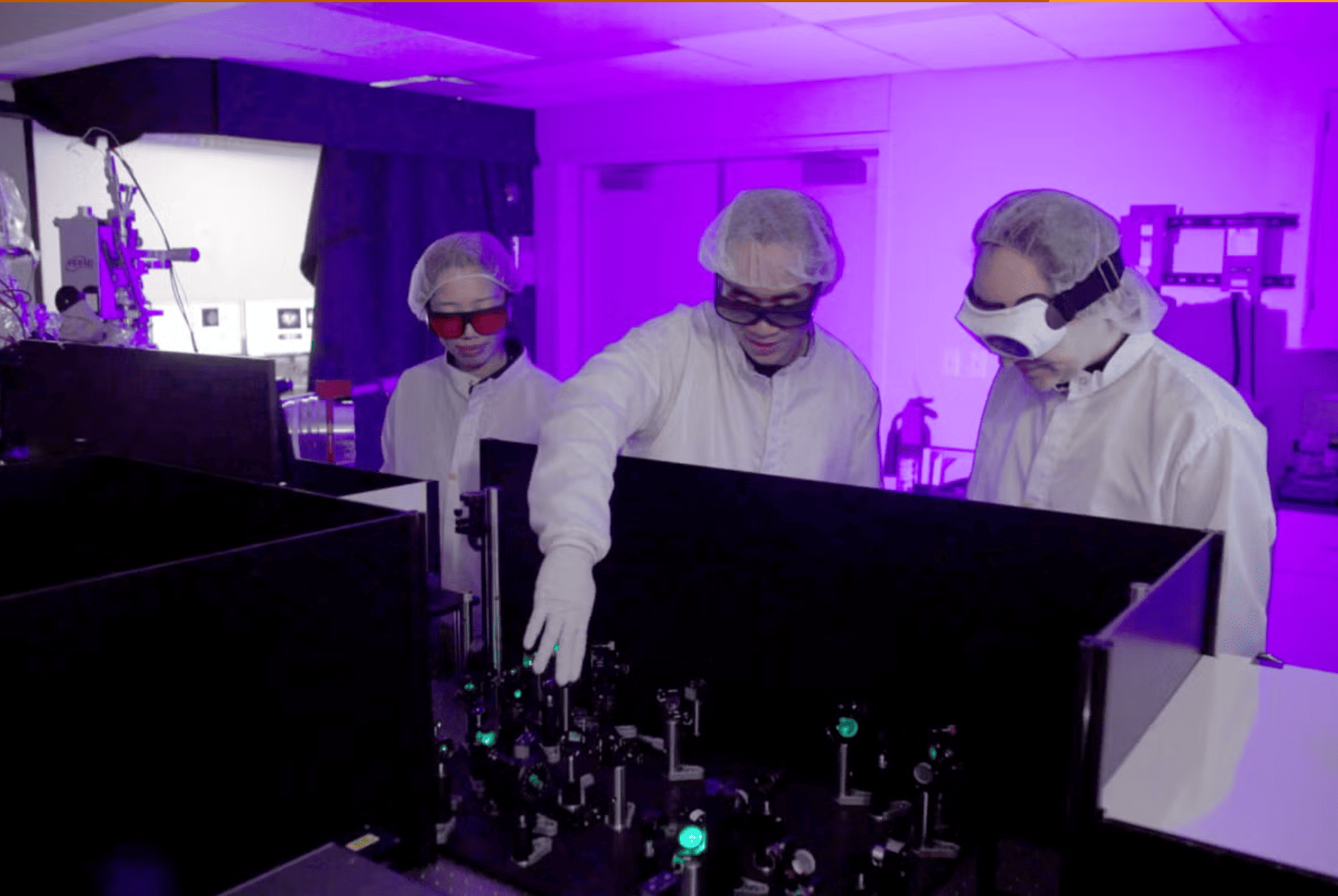
- Image: Physicist Edoardo Baldini and his team advance quantum discoveries in the Love, Tito’s Quantum Materials Characterization Lab in Welch Hall. (UT News)
The University of Texas at Austin is expanding its quantum research capabilities with new laboratories, state-backed infrastructure and a roster of scientists whose work has helped shape modern quantum science, positioning the university as one of the nation’s most established quantum research hubs.
According to an article in UT News, the latest additions include a quantum materials characterization laboratory that opened in 2024 in Welch Hall and a new underground quantum research facility now under construction. Together with new state investments and longstanding strengths in physics, computer science and engineering, the facilities reflect a broader effort to expand research spanning quantum materials, quantum computing, quantum sensing and semiconductor technologies.
Although quantum mechanics that gave rise to those quantum technologies often seems abstract, its impact already extending into everyday uses. Earlier discoveries in quantum physics enabled the development of semiconductors, which underpin modern computing, while quantum principles also support technologies including MRI scanners and GPS systems. Researchers now believe another generation of technologies built on quantum science could influence computing, medicine, communications and energy.

The underground research facility under construction is expected to help scientists identify new quantum phases of matter, continuing a research tradition at the university that stretches back more than five decades, according to UT News.
A Legacy That Helped Define Quantum Computing
UT’s modern quantum story traces much of its foundation to theoretical physicist John A. Wheeler, who joined the university in the 1970s and trained a generation of researchers who later became influential figures in quantum science.
Wheeler advanced the understanding of quantum demolition, a form of quantum measurement that extracts information from a system while ultimately disturbing or destroying the quantum state being measured. His students and postdoctoral researchers expanded that work into fields that today form the backbone of quantum computing.
Among them was theoretical physicist David Deutsch, who established mathematical principles describing a universal quantum computer. His work laid the theoretical groundwork for quantum computing decades before practical quantum computers emerged, earning him recognition as one of the field’s founders.
Another Wheeler student, Wojciech Zurek, developed the theory of quantum decoherence, which describes how fragile quantum states lose their quantum properties when interacting with their environment. Decoherence remains one of the central obstacles facing practical quantum computing because it introduces errors that can overwhelm calculations.
Zurek also helped establish the field of quantum error correction, which develops methods for detecting and correcting those errors so quantum information can survive long enough to perform useful computations. He continues conducting quantum research as a laboratory fellow at Los Alamos National Laboratory.
Wheeler’s influence extended even to the language used throughout the industry.
Benjamin Schumacher, who earned his doctorate at UT in 1990, introduced the concept of the “qubit,” now the standard term for the basic unit of quantum information. Unlike classical computer bits, which are read as either zero or one, qubits are described mathematically in ways that can involve both possibilities before measurement, allowing quantum computers to approach certain problems differently from conventional machines.
According to UT News, Schumacher first presented the concept during the early 1990s, and the term has since become fundamental across quantum computing research and industry.
Twistronics Opens a New Research Field
UT’s influence extends beyond quantum computing theory into quantum materials, where physics professor Allan MacDonald helped launch an entirely new area of research, UT News reports.
In 2011, MacDonald and postdoctoral researcher Rafi Bistritzer investigated what happens when two atom-thin sheets of graphene are stacked with a slight rotational offset. Using supercomputers at the Texas Advanced Computing Center, they calculated that electrons behave in unexpected ways when the sheets are rotated by precisely 1.1 degrees.
That prediction became known as the graphene “magic angle” and launched the field of twistronics, which studies how twisting two-dimensional materials changes their electronic properties.
Seven years later, researchers at the Massachusetts Institute of Technology experimentally confirmed that graphene arranged at the predicted angle could become superconducting under conditions less extreme than many conventional superconductors. Superconductors conduct electricity without electrical resistance, making them attractive for future quantum computers, advanced electronics and more efficient energy technologies.
MacDonald shared the 2020 Wolf Prize in Physics with Bistritzer, now at Tel Aviv University, and MIT physicist Pablo Jarillo-Herrero for the work. Earlier this year, MacDonald and Jarillo-Herrero also received the Frontiers of Knowledge Award.
According to UT News, MacDonald said one of the most significant developments since the original discovery has been researchers’ growing ability to precisely control twist angles across a wide range of materials rather than focusing only on the 1.1-degree configuration.
That capability offers new opportunities to tailor how electrons move through materials and interact with light, potentially benefiting applications ranging from fiber-optic communications to quantum computing.
Exploring What Quantum Computers Can—and Cannot—Do
While some researchers concentrate on building quantum hardware, computer scientist Scott Aaronson focuses on understanding the theoretical capabilities and limits of quantum computers.
Aaronson, the David J. Bruton Jr. Centennial Professor of Computer Science, is widely recognized for helping establish the theoretical framework behind quantum supremacy, the point at which a quantum computer performs a calculation that would be impractical for a classical computer within a reasonable amount of time.
His work helped define how such demonstrations should be understood and interpreted while applying computational complexity theory to questions in quantum physics.
Aaronson received the 2020 ACM Prize in Computing for those contributions and was recently elected to the National Academy of Sciences.
Rather than developing physical quantum processors, Aaronson’s research group studies the mathematical foundations of quantum computation.
According to UT News, the group’s central question is: “What can we do and what can we not do with a quantum computer?”
That work helps distinguish realistic applications from problems that may remain beyond quantum computers, even as hardware continues improving.
New Facilities Expand UT’s Quantum Infrastructure
Alongside its research programs, UT is investing in facilities intended to support both scientific discovery and future manufacturing.
The Texas Quantum Institute serves as the university’s umbrella organization for quantum research and is co-directed by physicists Elaine Li and Xiuling Li.
Elaine Li, who holds the Jack S. Josey-Welch Foundation Chair in Science, said the institute aims to strengthen quantum research across campus while coordinating with broader initiatives throughout Texas.
Recent investments illustrate that strategy.
In 2023, quantum technology company Infleqtion signed a memorandum of understanding with the Texas Institute for Electronics to develop qNexus, a center of excellence focused on quantum manufacturing.
Then, in late 2025, Texas Gov. Greg Abbott announced a $4.8 million grant from the Texas Semiconductor Innovation Fund for the Texas Quantum Institute to establish Qlab, a quantum-enhanced semiconductor metrology facility in Austin.
Metrology refers to the science of measurement. In semiconductor manufacturing, increasingly precise measurements are needed to verify the dimensions and performance of ever-smaller chips. According to UT News, the facility will be managed by the Texas Quantum Institute in collaboration with the university’s Materials Research Science and Engineering Center, the Microelectronics Research Center and the Texas Materials Institute.
Li said the U.S. Department of Commerce has identified metrology as a key enabling technology for the semiconductor industry.
From theoretical advances that introduced concepts such as qubits and quantum error correction to discoveries that launched twistronics and current investments in quantum manufacturing and semiconductor measurement, the university’s quantum ecosystem now spans fundamental physics, computer science, materials research and engineering.
As researchers continue exploring quantum algorithms, quantum materials and precision measurement, UT is seeking to translate decades of foundational research into technologies that could influence the next generation of computing and advanced electronics.
“We like to say we’re at the onset of the second quantum revolution,” Li said, as reported by UT News. “The first quantum revolution happened last century, and that’s made a lot of technology possible. The second quantum revolution may do even more.”





.png)