Lockheed Martin Sees GPS And Quantum Navigation Working Together


Insider Brief
- Lockheed Martin is investing in quantum navigation sensors that could work with GPS to provide more precise and resilient positioning when satellite signals are blocked, jammed or spoofed.
- The company says quantum sensors can operate independently of satellite signals and may help reduce drift in inertial navigation systems used on defense platforms.
- Lockheed Martin is working with Q-CTRL and AOSense and participating in Defense Department-funded programs to move quantum navigation technology from laboratory research toward field-ready hardware.
- Image: Lockheed Martin
Lockheed Martin is positioning quantum navigation as a backup and companion to GPS, aiming to give military users more precise location data when satellite signals are blocked, jammed or spoofed.
The company said in a news story that the future of positioning, navigation and timing, or PNT, will depend on a mix of technologies rather than satellites alone. GPS remains the foundation, but Lockheed Martin is investing in quantum sensors that could help aircraft, ships, vehicles and other defense platforms keep track of their position when satellite signals are unreliable or unavailable.
The effort reflects a growing concern across defense and aerospace: GPS is essential, but it is also vulnerable. Satellite navigation signals can be weakened by buildings, terrain or weather. In military settings, they can also be targeted by electronic warfare systems designed to jam or mislead receivers.

According to Lockheed Martin, quantum navigation could strengthen that system by adding sensors that do not depend on satellite signals. These devices use quantum effects — the behavior of atoms and particles at extremely small scales — to measure motion, acceleration and changes in direction with high precision. When paired with GPS or other navigation tools, they could help correct drift and maintain a more accurate position over time.
Lockheed Martin said the technology is still in beta stages, but the company is working with firms including Q-CTRL and AOSense to develop quantum navigation sensors for advanced defense platforms. The company is also participating in Defense Department-funded programs, including a Defense Innovation Unit effort to prototype a quantum-enabled inertial navigation system.
An inertial navigation system, or INS, tracks movement from a known starting point. It can help a vehicle estimate where it is without relying on outside signals. Traditional inertial systems can drift over time as small measurement errors build up. Quantum sensors are being developed to reduce that drift by making more precise measurements.
The goal is not to replace GPS, according to Lockheed Martin, but to build a layered navigation system. In that model, GPS provides the broad global position, while quantum sensors refine and sustain that position when signals are degraded or contested.
Lockheed Martin compared the concept to driving through a multilevel parking garage, where concrete and steel can interfere with satellite signals. In this scenario, a GPS-based location marker on a phone may drift by several meters. A quantum sensor, working alongside GPS, could help correct that position and keep the marker closer to the vehicle’s true location.
For military users, the stakes are higher when warfighters operating in urban areas, underground facilities, dense terrain or contested airspace may not be able to rely on clear satellite access. In those conditions, Lockheed Martin said quantum sensing could improve accuracy and continuity for all-domain operations, including missions that span land, sea, air, space and cyber environments.
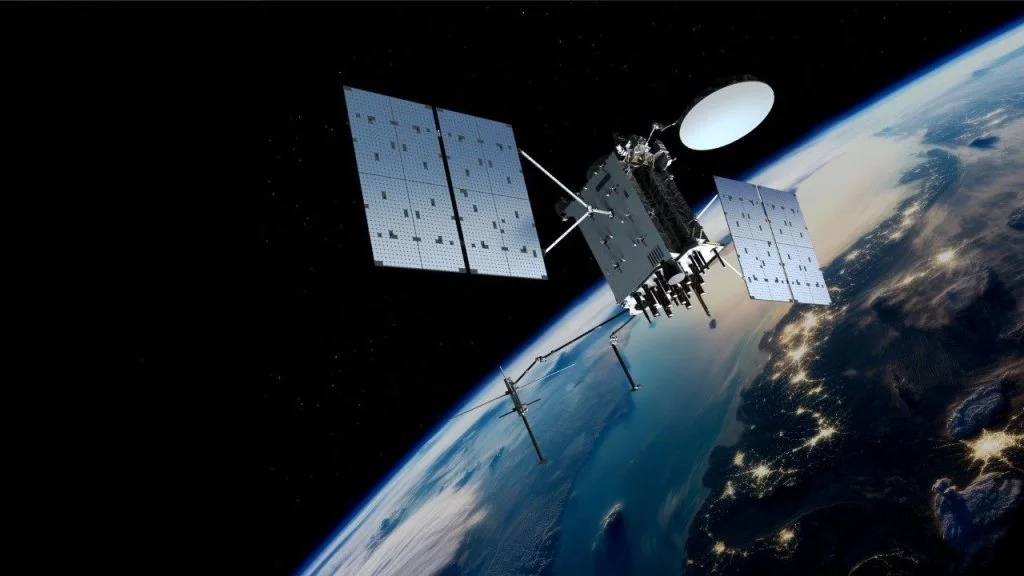
The company’s quantum navigation push builds on its existing GPS work. Lockheed Martin built the GPS III satellites and is developing the next-generation GPS IIIF satellites. The company said those spacecraft were designed for environmental, operational and signal resilience.
GPS III satellites deliver up to eight times the antijamming power of legacy spacecraft, according to Lockheed Martin. The coming GPS IIIF satellites are expected to add Regional Military Protection, a capability that uses beam focusing techniques to provide up to 63 times greater antijamming performance for military users.
Lockheed Martin said the satellites also include features beyond navigation, including GPS spacecraft supporting civilian search and rescue by processing emergency signals from users in distress. They also carry nuclear detection systems that help monitor unsanctioned nuclear detonations and support global treaty compliance.
The company said its GPS III and IIIF satellites use a modular architecture, allowing new technologies and capabilities to be added as threats change. That approach is intended to make the constellation more adaptable as adversaries develop new ways to disrupt navigation and timing services.
Quantum navigation would extend that resilience from orbit to the platform level. Instead of relying only on stronger satellite signals, defense systems could also carry onboard sensors that help maintain position when those signals are compromised.
The approach reflects a broader shift in military navigation strategy. Rather than treating GPS as a single source of truth, defense planners are seeking backup and complementary systems that can work together. These may include inertial navigation, celestial navigation, signals of opportunity and emerging quantum sensors.
Lockheed Martin said the combination of GPS and quantum navigation could create a more robust PNT framework. In that system, GPS would establish the reliable baseline, while quantum sensors would continuously enhance it.
The technology is not yet fielded at scale because, while quantum devices that work well in laboratories, they must still be made smaller, tougher and easier to operate in real-world defense environments. Systems will need to withstand vibration, temperature swings and the demands of deployment on aircraft, ships and ground vehicles.
However, Lockheed Martin’s investment suggests that quantum sensing is moving from research into defense engineering. If the technology matures, it could give military users a way to navigate with greater confidence when GPS is degraded, denied or under attack.
Learn more about Lockheed Martin‘s quantum technology here.

Keep track of everything going on in the Quantum Technology Market. In one place.
Topics

Matt Swayne
With a several-decades long background in journalism and communications, Matt Swayne has worked as a science communicator for an R1 university for more than 12 years, specializing in translating high tech and deep tech for the general audience. He has served as a writer, editor and analyst at The Quantum Insider since its inception. In addition to his service as a science communicator, Matt also develops courses to improve the media and communications skills of scientists and has taught courses.
[email protected]

Stay Ahead of Quantum
Get the latest research, company news, and market intelligence every week.
MENTIONED IN THE ARTICLE

Lockheed Martin
The Lockheed Martin Corporation is a preeminent global aerospace and defense powerhouse, tracing its roots to late 1912 when pioneers Glenn Martin and brothers Allan and Malcolm Lockheed established independent aviation firms. Officially formed in 1995 through the merger of Lockheed Corporation and Martin Marietta, its Aeronautics division researches, designs, and manufactures advanced tactical aircraft, including the F-35 Lightning II, while its Space division builds critical launch vehicles and satellites.
→

Q-CTRL
Q-CTRL is a company that specializes in quantum technology, particularly through the development of quantum control infrastructure software. The company's software is designed to improve the performance of quantum hardware by reducing and controlling errors in qubits, which are the basic units of quantum information.
→

AOSense
AOSense, Inc., founded in 2004, develops quantum sensors and navigation tools for aerospace and defense applications. Their miniaturized atom optic sensors, including inertial measurement units, gyroscopes, and atomic clocks, allow aircraft and spacecraft to achieve precision navigation and orbit positioning without relying on vulnerable satellite signals.
→

Defense Innovation Unit
The Defense Innovation Unit (DIU) is a United States Department of Defense (DoD) organization founded to help the U.S. military make faster use of emerging commercial technologies. Launched in 2015, the organization has been called "the Pentagon's Innovation Experiment". The DIU's role in the field of quantum science and technology is to identify promising quantum technology companies, facilitate partnerships, and support the development and deployment of quantum-based solutions for defense purposes. By leveraging the expertise and capabilities of the private sector, the DIU aims to accelerate the adoption of quantum technologies within the military.
→