Quantum-Inspired AI Finds Cancer Signals in Small, Noisy Data Sets

Insider Brief
- A University of Utah-led research team reported a quantum mechanics-based AI framework that found and validated new neuroblastoma predictors from small, noisy and complex multiomic data sets.
- The method analyzed linked patterns across tumor DNA, blood DNA and tumor RNA, using quantum-inspired mathematics to identify signals that appeared consistently across different biological measurements.
- The study found that the combined predictors outperformed MYCN amplification in several tests, though further validation would be needed before clinical use.
A new quantum mechanics-based form of AI may help researchers find medical predictors in data sets that are too small, noisy and complex for many standard machine-learning methods.
The study, published in APL Quantum, reports a mathematical framework designed to analyze several layers of biological data at once, including tumor genomes, blood genomes and tumor RNA profiles. The researchers tested the method on neuroblastoma, a rare childhood cancer whose outcomes can range from spontaneous regression to relapse and death.
The University of Utah-led research team reports that the approach found and validated two new predictors of neuroblastoma survival and treatment response. Each predictor appeared in three linked forms across tumor DNA, blood DNA and tumor RNA. The researchers suggest that these linked forms behave in a way that is mathematically similar to quantum entanglement, meaning that a measurement in one data layer can help determine what should be seen in the others.

The practical implication is that the method could give researchers a new way to extract useful medical signals from data sets that look unfavorable for AI. Many medical studies include far more measured features than patients. A genome can contain millions of data points, while a clinical cohort may include only dozens or hundreds of people. That imbalance makes it hard for conventional AI systems to find patterns that are reliable, explainable and useful for doctors.
The study does not show that the method is ready for routine clinical use. The findings would still need further validation, including prospective testing and clinical assessment, before they could be used to guide care. But the work suggests a possible route for medical AI in areas where large training data sets are scarce.
A Different Kind of Medical AI
The researchers frame the study around a persistent problem in precision medicine. Doctors and scientists can now measure whole genomes, RNA activity and other layers of patient biology. But turning those measurements into accurate predictions remains difficult.
The study reports that most AI and machine-learning systems struggle with what the researchers call “skinny” biomedical data. That means data with many more features than samples. A tumor study may include 20 to 100 patients but millions of genomic measurements. The problem is made harder by noise from lab procedures, batch effects, normal variation among patients and incomplete clinical labels.
Large AI systems often rely on vast data sets, which is not always possible in medicine, especially for rare cancers. The researchers write that clinical trials often enroll small cohorts, while some data layers, such as whole-genome sequencing, contain orders of magnitude more variables than samples.
The framework introduced in the paper is built from a family of mathematical tools known as spectral decompositions. To put it simply, these tools break a large data set into patterns and weights. The researchers describe the method as exact and structure-preserving. That means it is designed to retain the structure of the original data rather than compressing it in a way that loses information.
The study generalizes earlier work by the team on comparative spectral decompositions. The new framework can handle multiple tensors, or multiway arrays of data. A tensor can be thought of as a table extended into more dimensions. In this case, each tensor layer can represent a different kind of biological measurement from the same patients.
The researchers report that the framework always converges to a model under the conditions they define and that the model is almost always unique. That matters because many AI systems can produce models that are hard to interpret or unstable across repeated runs. A unique model is easier to connect to biological mechanisms.
The Quantum Link
The quantum element in the study is not a claim that the analysis ran on a quantum computer, rather quantum refers to the mathematical structure of the method.
The researchers connect the framework to two core ideas from quantum mechanics, superposition and entanglement. Superposition means a system can be described as a combination of possible states. Entanglement means the state of one part of a system is linked to the state of another part.
In the study’s framework, a patient’s tumor genome, blood genome and tumor transcriptome can be rewritten as a combination of disease-related states. Each state is represented by linked patterns across the different data layers. The researchers report that, in the neuroblastoma case, measuring one representation of a predictor approximately determined the other representations.
That could be important for medicine because a useful disease predictor should not be a statistical accident in one data layer. It should ideally show up in related biological measurements and make sense in light of known or plausible disease mechanisms.
Neuroblastoma Test Case
The researchers applied the framework to neuroblastoma data from the Therapeutically Applicable Research to Generate Effective Treatments project, known as TARGET, and other validation data.
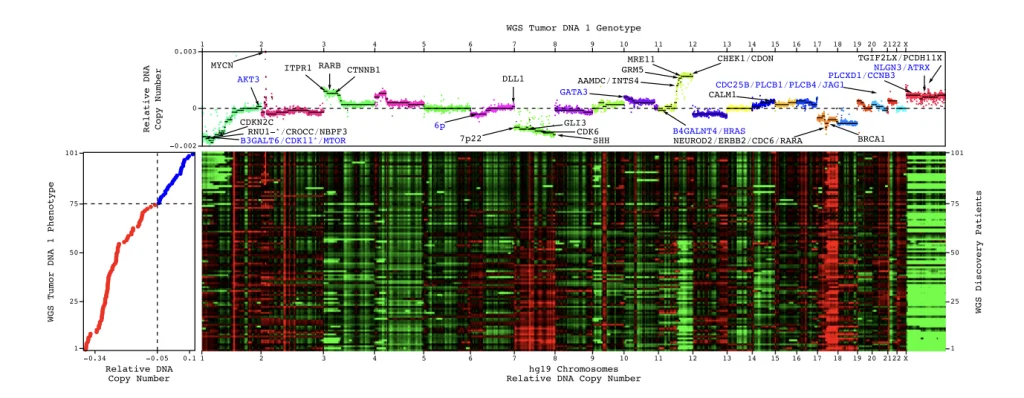
In one analysis, the team used patient-matched tumor and blood whole-genome sequencing profiles from 101 neuroblastoma patients. The tumor and blood data layers each included more than 2.8 million genomic features. The researchers also used tumor RNA sequencing data from 71 patients, with more than 15,000 transcriptomic features.
The method separated the tumor and blood data into 101 sets of patterns. The researchers report that two tumor DNA-derived predictors were correlated with overall survival among 90 patients who had all labels available.
The two predictors separated patients into groups with sharply different outcomes, according to the study. In both cases, patients flagged as higher risk had much shorter survival times than those classified as lower risk. The gap was large enough that the researchers concluded the signals were not just statistical noise.
The researchers then tested the two predictors together. Used in combination, the tumor DNA signals did a better job of sorting patients by risk than several measures now used in neuroblastoma care, including age, disease stage and MYCN amplification, the study reports.
MYCN amplification is one of the best-known biomarkers in neuroblastoma. It measures extra copies of a gene linked to aggressive disease. The study reports that the new predictors were more accurate than MYCN amplification when tested in tumor DNA, blood DNA and tumor RNA, suggesting the signals were not confined to one type of biological data.
The team also tested whether the signals held across data types. The researchers report that the predictors discovered in tumor DNA were represented in blood DNA and tumor RNA. In the validation analysis, the team projected data from 419 patient-matched tumor and blood profiles onto the discovery model. Among 398 validation patients, the study reports that the predictors remained associated with survival.
The work suggests a possible role for quantum-inspired mathematics in biomedical AI. If confirmed, the value may come from better handling of complex data rather than from running calculations on a quantum processor.
Limitations and Next Steps
The findings remain early, the researchers suggest, adding that the study uses existing data sets and computational validation. It does not report a prospective clinical trial in neuroblastoma, nor does it show that treatment decisions improved when guided by the predictors.
The method is also mathematically demanding, which would require careful implementation, independent replication and comparison with other approaches in order to be used in clinical research. Researchers would need to show that the framework performs well across institutions, sequencing platforms, patient populations and cancer types.
Another limitation is that survival prediction is not the same as clinical actionability. A model can identify high-risk patients without proving which therapy they should receive. The study reports links to disease mechanisms and possible drug targets, but those links would need experimental and clinical testing.
In the future, the method may need broader validation in independent cohorts and prospective settings. Researchers will also need to test whether the same framework can help predict treatment response, identify drug targets and guide trial design in other cancers or diseases.
In a broader sense, the study suggests that quantum mechanics-based mathematics may offer one way to make AI more useful when the data are rich in features but poor in sample size. That is a common situation in modern medicine. If the findings hold up, the approach could help move multiomic analysis from pattern detection toward interpretable prediction.
The research team included Orly Alter, of the University of Utah, as well as Prism AI Therapeutics; Elizabeth Newman, of Tufts University; Sri Priya Ponnapalli, of Scale AI; and Jessica W. Tsai, of the University of Southern California.

Keep track of everything going on in the Quantum Technology Market. In one place.
Matt Swayne
With a several-decades long background in journalism and communications, Matt Swayne has worked as a science communicator for an R1 university for more than 12 years, specializing in translating high tech and deep tech for the general audience. He has served as a writer, editor and analyst at The Quantum Insider since its inception. In addition to his service as a science communicator, Matt also develops courses to improve the media and communications skills of scientists and has taught courses.
[email protected]

Stay Ahead of Quantum
Get the latest research, company news, and market intelligence every week.