
Guest Post by Yoon Auh, Founder of BOLTS Technologies
IBM’s recent announcement that it plans to invest more than $10 billion over the next five years to fund its quantum roadmap, including its stated goal of delivering a large-scale fault-tolerant quantum computer by 2029 has generated exactly the kind of headlines you would expect.
Quantum computing is one of those technologies that naturally attracts grand predictions, dramatic warnings, and more than a little science fiction. But whenever quantum appears in the news, I find it useful to start with a more precise question: What part of the quantum stack is actually moving?
Too often, the public conversation treats quantum computing as a single technology progressing along a single timeline. In reality, quantum development consists of several different tracks moving at different speeds. Some advances affect hardware, others affect algorithms, others affect cybersecurity, communications, sensing, or manufacturing. Let’s not forget that some of these paths will be dead ends.

Viewed through that lens, IBM’s announcement is significant, but perhaps not for the reasons many people assume.
The Hardware Race Just Got More Serious
I generally organize quantum developments into six buckets: hardware, software that compensates for hardware limitations, quantum algorithms, optimization of those algorithms, quantum-resilient cryptography, and network-scale quantum technologies. IBM’s announcement is overwhelmingly a Bucket 1 story.
This announcement goes far beyond investing in research, it is investing in manufacturing, ecosystem development, infrastructure, acquisitions, and scaling. At the same time, Anderon, a new IBM-backed quantum foundry initiative supported by a Letter of Intent with the U.S. Department of Commerce would become the first dedicated quantum chip manufacturing facility in the United States.
For years, quantum computing was viewed primarily as a laboratory challenge. The focus was on demonstrating scientific feasibility. Could qubits remain stable? Could researchers reduce noise? Could error correction eventually work? Today, those questions are increasingly being joined by a different set of questions.
Can these systems be manufactured consistently? Can supply chains support them? Can specialized chips be produced at scale? Can an industrial ecosystem emerge around quantum hardware?
They are manufacturing questions, not scientific ones.
When a company like IBM commits $10 billion toward answering them, it signals that quantum computing is beginning to transition from a purely research-driven field into an industrial one. That does not mean practical quantum computing has arrived. It does mean the infrastructure needed to support it is being built more aggressively than before.
The level of commitment seems large but it’s all relative. For instance, Meta’s foray into the Metaworld sunk in over $90 billion with relatively little to show for it. The development of the blue LED was a land rush by the best and well capitalized industrial companies. Then they gave up, and a single persistent researcher made breakthroughs a couple of decades later to give us white LEDs. The hardware road is littered with stillborn enthusiasm and capital that vaporized.
Why This Does Not Mean RSA Is Broken Tomorrow
One of the recurring challenges in quantum discussions is separating meaningful progress from misplaced panic. Whenever a major quantum announcement occurs, questions immediately emerge about whether traditional encryption is suddenly at risk. The answer remains no.
IBM’s roadmap centers on its planned Starling system, which it hopes will become what IBM describes as the first large-scale fault-tolerant quantum computer by 2029. The company has outlined a path toward operating 200 logical qubits capable of running large-scale quantum circuits reliably.
That is a major technical milestone.
However, it is not the same thing as having a cryptographically relevant quantum computer capable of running Shor’s algorithm at the scale necessary to break widely used public-key cryptography. Those are very different thresholds.
Breaking RSA or elliptic-curve cryptography requires a convergence of multiple breakthroughs: scalable hardware, robust fault tolerance, advanced error correction, optimized algorithms, and sufficient logical-qubit capacity. Progress in one area should not automatically be interpreted as success across all of them.
In other words, IBM has accelerated the hardware race. It has not suddenly completed it.
That nuance matters because quantum timelines are often distorted by either excessive optimism or excessive skepticism. The reality usually sits somewhere in the middle. We should recognize meaningful progress without pretending every milestone represents the finish line.
The Real Message for Security Leaders
Ironically, the most important implication of IBM’s announcement may not be what happens inside a quantum computer at all. It may be what organizations choose to do today.
From a cybersecurity perspective, the announcement reinforces the urgency of post-quantum cryptography.
This is what I describe as Bucket 5: the effort to replace vulnerable cryptographic systems before a sufficiently powerful quantum computer exists, not afterward. That distinction is critical.
Organizations sometimes view quantum threats as a distant future problem because large-scale fault-tolerant systems do not yet exist. But cryptographic migrations are notoriously slow. Major institutions often require years to inventory systems, identify dependencies, test replacements, and deploy new standards across complex environments.
Waiting until a cryptographically relevant quantum computer arrives would be like waiting for a hurricane to make landfall before beginning evacuation planning.
The purpose of post-quantum cryptography is not to respond after the threat materializes. It is to prepare before it does.
That is why IBM’s announcement deserves attention even from organizations with no direct involvement in quantum computing. The investment does not tell us exactly when practical quantum systems will arrive. What it does tell us is that the hardware trajectory continues to advance and that major governments and corporations increasingly view quantum technology as strategically important.
The better question, then, is not whether quantum computing is coming. The better question is which part of the quantum ecosystem just moved. In this case, the answer is hardware, and every time the hardware race accelerates, the conversation about quantum resilience becomes harder to postpone.
About The Author
Yoon Auh is a former VP at Goldman Sachs and Head Trader at Credit Suisse, Geode Capital and Magnetar Capital. An inventor of data-centric security with a portfolio of patents and research validated in defense-grade settings and NIST-validated work. His background spans deep-tech innovation, applied cryptography, and high-performance trading systems, experience that informs how we secure digital assets, protect against insider threats, and prepare for quantum-enabled attacks across financial markets and blockchain infrastructure.
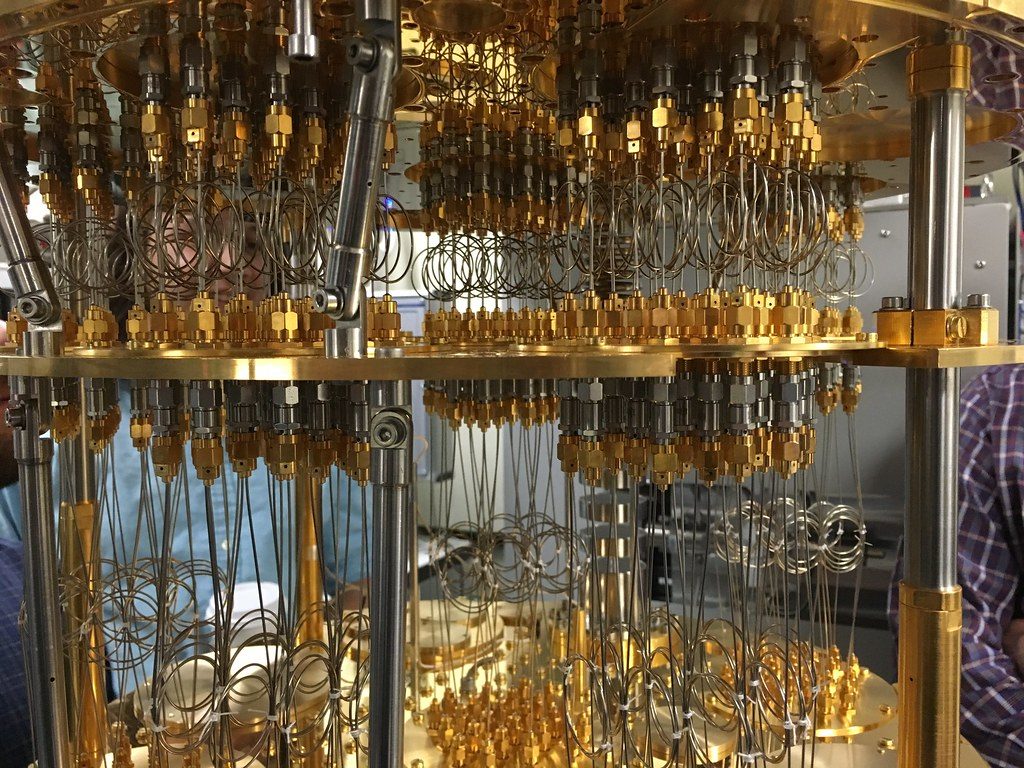
Image: “Inside an IBM Dilution Refrigerator” by IBM Research is licensed under CC BY-ND 2.0