Diffraqtion Raises $4.2 Million to Build Quantum Camera-Enabled Satellite and Telescope Constellations



Insider Brief
- Diffraqtion, an MIT and University of Maryland spinout, raised $4.2 million in pre-seed funding to commercialize a quantum camera enabling lower-cost satellite constellations for space domain awareness and Earth observation.
- The company’s quantum imaging system, developed from NASA and DARPA-backed research, claims up to 20× higher resolution and 1,000× faster processing than conventional optical systems, allowing high-precision imaging with smaller, cheaper platforms.
- Backed by investors including QDNL Participations and supported by a DARPA SBIR Direct-to-Phase 2 contract, Diffraqtion is advancing on-sky and space-based demonstrations and is participating in the U.S. Space Force Apollo Accelerator.
PRESS RELEASE — Diffraqtion, an MIT and University of Maryland spinout developing satellite constellations powered by a novel quantum camera, today announced the close of a $4.2 million pre-seed funding round, led by QDNL Participations, with participation from milemark•capital, Aether VC, ADIN, and a non-dilutive DARPA SBIR Direct-to-Phase 2 contract.
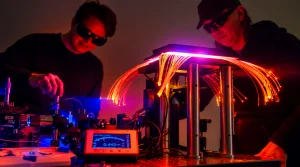
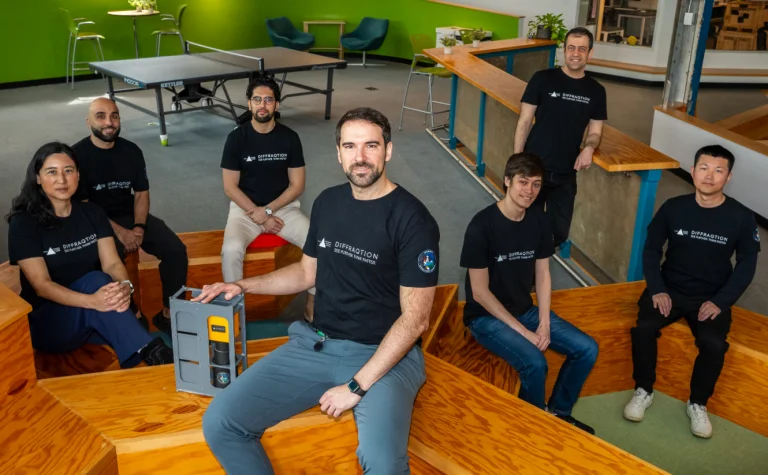
Founded by Johannes Galatsanos, Christine Wang, and Prof. Saikat Guha, Diffraqtion has developed a first-of-its-kind quantum camera that enables satellites and telescopes to see farther and process visual information dramatically faster than conventional systems. Built on Prof. Guha’s research with NASA and DARPA, the technology delivers up to 20× higher resolution and 1,000× faster processing, enabling ultra-high-resolution imaging systems at a fraction of the cost of today’s satellites and ground-based telescopes.
Diffraqtion’s novel approach unlocks large constellations of low-cost, high-precision imaging platforms for space domain awareness, defense, and commercial Earth observation, with applications ranging from orbital safety and intelligence to agriculture, disaster response, and environmental monitoring.

In recent weeks, the company has received multiple major recognitions, including:
- First place at SLUSH 100, selected from over 1,000 startups, resulting in an additional $1.1M equity prize from Cherry Ventures and General Catalyst
- TechConnect’s “2025 Best Space Innovation” $100k award
- A $1.5M DARPA SBIR Direct-to-Phase 2 contract supporting space situational awareness capabilities
Diffraqtion is also part of the U.S. Space Force’s Apollo Accelerator, where it is actively demonstrating and refining its quantum imaging technology with government partners. In early 2026, the company plans to conduct on-sky demonstrations with the University of California Observatories, followed by space-based demonstrations focused on space domain awareness.
“Space powers our communications, navigation, and defense, and through Earth Imaging, it supports everything from agriculture to disaster response,” said Johannes Galatsanos, CEO and Co-Founder of Diffraqtion. “Yet despite the boom in low-cost launches, we still lack clear, continuous visibility of what’s happening above and below the atmosphere. Our quantum camera changes that: it tracks smaller, faster objects to keep assets in orbit safe, while delivering ultra-high-resolution imaging for critical applications on Earth.”
“Quantum sensing can bring new capabilities to monitoring and protecting orbital infrastructure,” said Chad Rigetti, Venture Partner at QDNL Participations “Diffraqtion’s team combines deep photonics and quantum expertise with practical defense and space insight – exactly what’s needed to bring quantum imaging into operational reality.”
Diffraqtion’s technology marks a significant leap forward in intelligent vision for space, defense, and autonomous systems.
About the Leadership
Johannes Galatsanos, Co-Founder and CEO, has >15 years background in AI, Quantum Tech, and Operations. He’s an MIT and Oxford graduate, and has been an MIT researcher, Executive Director at Novartis, and Technical Consultant with a track record of building teams delivering Data and AI products across Manufacturing and R&D.
Christine Wang, Co-Founder and CTO, did her Ph.D. at Harvard and Post-Docs at EPFL and Max Planck Institute. She has >20 years experience in designing and prototyping photonics and optics devices for defense and commercial use, latest as Director of Optics and Photonics at Riverside Research and Principal Scientist at Draper Labs.
Prof. Saikat Guha, Co-Founder and CSA, is a world-renowned scholar in quantum sensing with over 100 papers and patents, >10,000 citations, and inventor of Diffraqtion’s patented quantum imaging IP. He’s an IEEE Fellow, Distinguished Chair Prof. at the University of Maryland, adjunct faculty at MIT, and Director at the NSF Center for Quantum Networks.
Mark Michael, VP Product, is the ex-CTO and Co-Founder of Kepler Communications, one of North America’s largest space companies. He is an Engineering graduate from University of Toronto and worked at IBM before Kepler.

Keep track of everything going on in the Quantum Technology Market. In one place.
Topics

Matt Swayne
With a several-decades long background in journalism and communications, Matt Swayne has worked as a science communicator for an R1 university for more than 12 years, specializing in translating high tech and deep tech for the general audience. He has served as a writer, editor and analyst at The Quantum Insider since its inception. In addition to his service as a science communicator, Matt also develops courses to improve the media and communications skills of scientists and has taught courses.
[email protected]

Stay Ahead of Quantum
Get the latest research, company news, and market intelligence every week.
MENTIONED IN THE ARTICLE

Diffraqtion
Diffraqtion is an American deep tech aerospace company founded in 2024 as an MIT and University of Maryland spinout to build deployable quantum cameras and the artificial intelligence systems that read them. Headquartered in Somerville Massachusetts the startup specializes in quantum sensing hardware paired with proprietary model layers to bypass the traditional diffraction limits of conventional optics.
→

Massachusetts Institute of Technology (MIT)
The Massachusetts Institute of Technology, located in Cambridge, Massachusetts, functions as a privately funded research university. It was founded in 1861 and has played a crucial part in advancing various fields of modern technology and science.
→

University of Maryland
The University of Maryland, College Park, situated in Maryland, is a public research university. Established in 1856, it holds the position of being the main campus of the University System of Maryland. It also holds the distinction of being the biggest university in both the state and the Washington metropolitan area.
→

NASA
The National Aeronautics and Space Administration (NASA) is the U.S. government agency driving pioneering research and technological development in both atmospheric flight (aeronautics) and space exploration (astronautics). NASA acts as a research organization, utilizing advanced wind tunnels, supercomputing, and flight test laboratories to advance aircraft aerodynamics, propulsion, and materials, while simultaneously involved in the design, construction, and operation of launch vehicles and spacecraft for deep space exploration. Through its aeronautics research directorate, the agency works to improve the safety, efficiency, and environmental impact of aviation, whereas its space programs focus on developing cutting-edge flight systems, robotic explorers, and human transportation capabilities.
→

Defense Advanced Research Projects Agency (DARPA)
The Defense Advanced Research Projects Agency (DARPA) is an independent research and development agency within the U.S. Department of Defense (DoD) established in 1958 to prevent and create strategic technological surprises for national security. Operating with a relatively small staff of program managers who are empowered to take high-risk, high-reward approaches, DARPA functions by funding cutting-edge research in academia, industry, and government laboratories rather than conducting research in-house. Its mission focuses on creating revolutionary technologies—such as the Internet (ARPANET), stealth technology, GPS, and mRNA vaccine platforms—that transition into practical military and civilian applications. DARPA programs are typically finite in duration and demand transformational breakthroughs rather than incremental improvements, positioning the U.S. at the forefront of technological innovation.
→

University of Toronto
The University of Toronto, situated in Toronto, Ontario, Canada, is a public research university located around Queen's Park. It was established by royal charter in 1827 as King's College, making it the initial higher education institution in Upper Canada. Originally under the Church of England's jurisdiction, the university adopted its current name in 1850 as it transitioned into a non-religious institution.
→

IBM
IBM is an iconic technology pioneer founded in 1911 as the Computing-Tabulating-Recording Company and officially renamed International Business Machines Corporation in 1924. Beyond foundational computing, IBM possesses a deep legacy in aerospace and defense from building the guidance computers and Instrument Unit for NASA's historic Apollo missions to partnering with Airbus on CIMON, the first AI assistant on the ISS.
→