NVIDIA Launches NVQLink to Bridge Quantum and Classical Supercomputing



Insider Brief
- NVIDIA unveiled NVQLink, an open system architecture linking quantum processors directly with GPU-based supercomputers, during its Global Technology Conference in Washington, D.C.
- Developed with input from U.S. national laboratories, NVQLink provides a low-latency, high-throughput interconnect that enables real-time control, calibration, and error correction for hybrid quantum–classical computing.
- The initiative brings together 17 quantum hardware companies, five controller builders, and nine national labs, positioning NVQLink as a standardized foundation for accelerated quantum supercomputing.
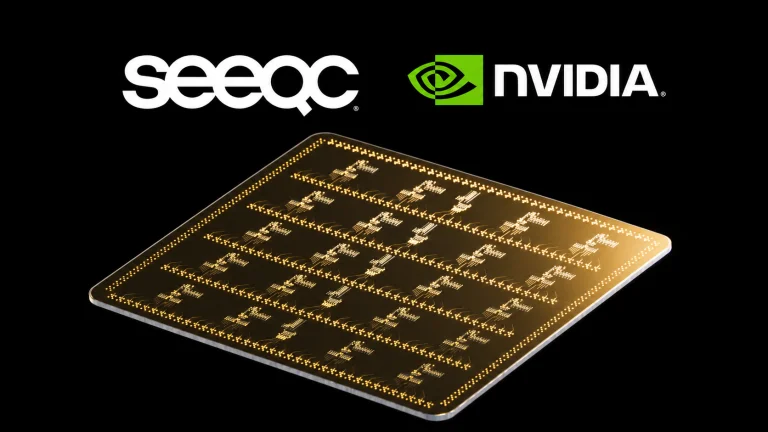
NVIDIA has unveiled NVQLink — an open system architecture designed to link quantum processors directly with GPU-based supercomputers — during Nvidia’s Washington, D.C. Global Technology Conference.
NVIDIA CEO Jensen Huang said the system could define the technical foundation for hybrid quantum–classical systems amnd likened NVQLink to “the Rosetta Stone” of the quantum era in his keynote — an underlying technical premise that is just as pragmatic as it is metaphorical.
“In the near future, every NVIDIA GPU scientific supercomputer will be hybrid, tightly coupled with quantum processors to expand what is possible with computing,” said Jensen Huang, founder and CEO of NVIDIA. “NVQLink is the Rosetta Stone connecting quantum and classical supercomputers — uniting them into a single, coherent system that marks the onset of the quantum-GPU computing era.”

The new platform connects the high-speed, high-throughput performance of NVIDIA’s GPU computing with quantum processing units (QPUs), allowing researchers to manage the intricate control and error-correction workloads required by quantum devices. According to a NVIDIA statement, the system was developed with guidance from researchers at major U.S. national laboratories including Brookhaven, Fermi, Lawrence Berkeley, Los Alamos, MIT Lincoln, Oak Ridge, Pacific Northwest, and Sandia.
Qubits, the basic units of quantum information, are extremely sensitive to noise and decoherence, making them prone to errors. Correcting and stabilizing these systems requires near-instantaneous feedback and coordination with classical processors. NVQLink is meant to meet that demand by providing an open, low-latency interconnect between quantum processors, control systems, and supercomputers — effectively creating a unified environment for hybrid quantum applications.
The architecture offers a standardized, open approach to quantum integration, aligning with the company’s CUDA-Q software platform to enable researchers to develop, test, and scale hybrid algorithms that draw simultaneously on CPUs, GPUs, and QPUs.
The U.S. Department of Energy (DOE) — which oversees several of the participating laboratories — framed NVQLink as part of a broader national effort to sustain leadership in high-performance computing, according to NVIDIA.
“Maintaining America’s leadership in high-performance computing requires us to build the bridge to the next era of computing: accelerated quantum supercomputing,” said U.S. Secretary of Energy Chris Wright in the statement. “The deep collaboration between our national laboratories, startups and industry partners like NVIDIA is central to this mission — and NVIDIA NVQLink provides the critical technology to unite world-class GPU supercomputers with emerging quantum processors, creating the powerful systems we need to solve the grand scientific challenges of our time.”
The initiative supports a broad coalition across the quantum ecosystem: 17 quantum hardware builders, five controller builders, and nine U.S. national labs are collaborating on the architecture. Among the companies participating are Quantinuum, IonQ, Pasqal, QuEra, Oxford Quantum Circuits, Rigetti, IQM, Atom Computing, and Infleqtion, along with control-system providers such as Quantum Machines, Qblox, Keysight Technologies, and Zurich Instruments.

Keep track of everything going on in the Quantum Technology Market. In one place.

Matt Swayne
With a several-decades long background in journalism and communications, Matt Swayne has worked as a science communicator for an R1 university for more than 12 years, specializing in translating high tech and deep tech for the general audience. He has served as a writer, editor and analyst at The Quantum Insider since its inception. In addition to his service as a science communicator, Matt also develops courses to improve the media and communications skills of scientists and has taught courses.
[email protected]

Stay Ahead of Quantum
Get the latest research, company news, and market intelligence every week.
MENTIONED IN THE ARTICLE

NVIDIA
NVIDIA Corporation is an American multinational technology company and a global player in accelerated computing and Artificial Intelligence (AI). Founded in 1993, the company pushes the aerospace frontier with the Space-1 Vera Rubin Module, a platform for orbital data centers that delivers massive AI-compute Space Computing. This NVIDIA technology enables satellites and autonomous spacecraft to process and fuse sensor data rapidly Space Computing.
→

U.S. Department of Energy (DOE)
The mission of the Department of Energy is to ensure America's security and prosperity by addressing its energy, environmental, and nuclear challenges through transformative science and technology solutions. In September, 2022, Research supported by ASCR demonstrated that classical machine learning algorithms can accurately predict ground state properties and classify quantum phases of matter using data generated from quantum experiments. In November, 2022, Research supported by Q-NEXT revealed that the performance of a sensor network is constrained by the intrinsic noise associated with the quantum states used in the network. In March, 2023, Research funded by DOE SC NP achieved the first experimental observation of entanglement between dissimilar particles, specifically positive and negative pions. In August, 2023, Research funded by DOE SC BER demonstrated strong preservation of entanglement in a two-photon absorption process involving organic molecules, offering a new approach for developing quantum light-based spectroscopy and microscopy.
→

Quantinuum
Quantinuum builds full-stack quantum computing solutions for practical deployment. Leveraging proprietary enhancements to trapped-ion QCCD architecture, the company has launched multiple commercial hardware generations that deliver leading two-qubit gate fidelity and industry-topping accuracy.
→

IonQ
IonQ is a developer in trapped ion quantum computing founded in 2015 that actively applies its technology to the aerospace and defense sectors. The company empowers satellite-based quantum networks and quantum enabled drones to improve positioning, navigation, and timing resilience in GPS denied environments, and collaborates with industry leaders like Airbus to optimize aircraft loading.
→

PASQAL
PASQAL’s quantum computers control neutral atoms with optical tweezers using lasers to manipulate quantum registers with up to a few hundred qubits. Location in Boston MA.
→

QuEra Computing
QuEra Computing uses research on neutral atoms, developed at Harvard University and the Massachusetts Institute of Technology, as the basis for a scalable, programmable quantum computer solution. QuEra’s quantum processing technology is based on trapping, energizing, and shuttling atoms with laser beams.
→

Oxford Quantum Circuits
Oxford Quantum Circuits (OQC) is a company that specializes in quantum computing technology aimed at addressing challenges like climate change and new drug discoveries. They offer Quantum Computing as-a-Service (QCaaS), making quantum computing accessible for breakthrough discoveries. OQC's core technology, the Coaxmon, ensures scalability and high-fidelity operation times in their superconducting quantum processors.
→

Rigetti Computing
Rigetti Computing develops integrated quantum computers and superconducting processors specialized for complex aerospace optimization and satellite communication tasks, including collaborations with the U.S. Air Force. Founded in 2013, the firm produces modular, multi-chip processors internally and provides cloud-based access for large-scale, complex simulations.
→