New Mexico Commits $315 Million to Quantum Push, Launches DARPA Partnership



Insider Brief
- New Mexico announced a $315 million package to develop a quantum industry, including investments in companies, fabrication facilities, and a statewide quantum network.
- The initiative includes $185 million from the state’s sovereign wealth fund for venture capital and up to $120 million in matching contributions with DARPA under the Quantum Benchmarking Initiative.
- The state also launched the Quantum Frontier Project with DARPA, aiming to test and validate quantum technologies as part of a national effort to determine if utility-scale quantum computing is achievable by 2033.
PRESS RELEASE — Fresh off of news that New Mexico initiated a multimillion dollar project to boost quantum tech in Albuquerque, the state’s leaders revealed another big — as in nine-figure big — bet on this potentially era-defining technology. State leaders on Tuesday announced a $315 million package of investments in companies, fabrication facilities, and infrastructure designed to seed a quantum industry with Albuquerque as its hub, Reuters reported.
The plan includes building a quantum network to connect laboratories and businesses across the state, with some projects expected to be operational by the middle of next year. Governor Michelle Lujan Grisham told Reuters that New Mexico’s appeal stems from its blend of scientific talent, affordable land, and relatively low energy costs. With a population of about two million, the state is already home to Los Alamos and Sandia national laboratories and a U.S. Air Force Research Laboratory branch.
A key portion of the package is $185 million from the state’s sovereign wealth fund, which will flow to private venture capital firms tasked with investing in quantum businesses that establish or expand operations in New Mexico. The goal, according to officials, is to create a pipeline for start-ups and scale-ups to develop technologies ranging from quantum processors to secure communications.

Reuters also reported that another $60 million each from the state and the Defense Advanced Research Projects Agency (DARPA) will support efforts to evaluate projects and prepare them for commercial viability. The governor’s office described the same arrangement as matching contributions of up to $120 million over four years, part of a broader federal initiative to test the claims of quantum developers.
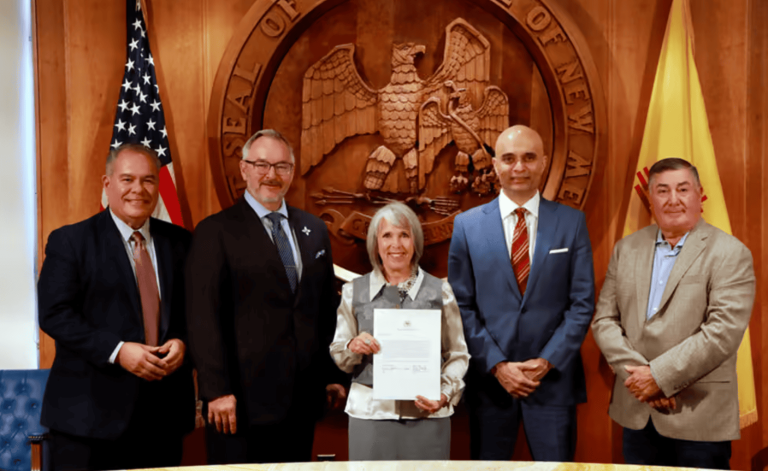
Separately, Gov. Lujan Grisham announced that New Mexico has signed an agreement with DARPA to establish the Quantum Frontier Project, a new partnership under DARPA’s Quantum Benchmarking Initiative (QBI). The program’s aim is to determine whether utility-scale quantum computing can be achieved by 2033.
“Quantum computing may prove to be the most consequential technology of this century for national security and breakthrough innovations,” Gov. Lujan Grisham said in the statement. “New Mexico, having once pioneered applied physics, is excited to partner with DARPA on the QBI program to stay at the forefront of frontier technology and bring our world-class research, development, and entrepreneurial ecosystem into the fold.”
DARPA officials said the state’s role will be critical to evaluating progress in the sector.
“New Mexico is the latest state to enter into partnership on QBI, and we are eager to leverage new facilities and expertise as we test and evaluate claims from a number of quantum computing companies about their progress in building a useful quantum computer,” said Joe Altepeter, QBI program manager. “World-class national laboratories in New Mexico, such as Sandia and Los Alamos, are already a part of QBI’s independent verification and validation team, and we look forward through the Quantum Frontier Project to tapping into more of the state’s quantum R&D and testing infrastructure to help us determine whether quantum computers will work or not.”
Economic Development Secretary Rob Black framed the effort as both a technology and jobs strategy. “This agreement makes it clear: New Mexico is stepping up to lead in the industries of tomorrow,” he said. “Quantum computing means jobs, innovation, and a stronger economy for our state, and we intend to seize this moment in the global race.”
The investment comes as momentum builds in the state’s quantum sector. Last month, the Economic Development Department selected Roadrunner Venture Studios to deploy $25 million to accelerate quantum innovation and commercialization. This week, Albuquerque is hosting IEEE Quantum Week, bringing together scientists, engineers, and entrepreneurs from around the world.
Read also: Mariachi Quantum: Mexico’s QC Era Begins

Keep track of everything going on in the Quantum Technology Market. In one place.

Matt Swayne
With a several-decades long background in journalism and communications, Matt Swayne has worked as a science communicator for an R1 university for more than 12 years, specializing in translating high tech and deep tech for the general audience. He has served as a writer, editor and analyst at The Quantum Insider since its inception. In addition to his service as a science communicator, Matt also develops courses to improve the media and communications skills of scientists and has taught courses.
[email protected]

Stay Ahead of Quantum
Get the latest research, company news, and market intelligence every week.
MENTIONED IN THE ARTICLE

Defense Advanced Research Projects Agency (DARPA)
The Defense Advanced Research Projects Agency (DARPA) is an independent research and development agency within the U.S. Department of Defense (DoD) established in 1958 to prevent and create strategic technological surprises for national security. Operating with a relatively small staff of program managers who are empowered to take high-risk, high-reward approaches, DARPA functions by funding cutting-edge research in academia, industry, and government laboratories rather than conducting research in-house. Its mission focuses on creating revolutionary technologies—such as the Internet (ARPANET), stealth technology, GPS, and mRNA vaccine platforms—that transition into practical military and civilian applications. DARPA programs are typically finite in duration and demand transformational breakthroughs rather than incremental improvements, positioning the U.S. at the forefront of technological innovation.
→

Air Force Research Laboratory Quantum Group
The Air Force Research Laboratory is partnering with industry, academia, and the Department of Defense to apply quantum information science to Air Force concerns. AFRL has formally joined the IBM Q Network, the first ever partnership of its kind in the Department of Defense. This alliance will provide AFRL and its collaborators with access to commercial quantum systems to explore practical applications relevant to the Air Force. Early applications include optimization problems, speed-up of machine learning algorithms and quantum chemistry simulation. The Extreme Computing facility by the Air Force Research Laboratory (AFRL), is now open in New York. It is involved in quantum computing research, ranging from development, integration and deployment of advanced computing technologies for the Department of the Air Force. The AFRL Information Directorate received funding for five major projects. They include: 1. $10 million for Distributed Quantum Networking Testbed and Quantum Cloud Computing Environment, 2. $4 million for Photonic Quantum Computing, which will develop a next-generation ion trap computer. 3. $10 million for Enhancements and Operational Readiness improvements for Trusted DoD/Federal Unmanned Aircraft Systems. This system will manage UAS traffic to support the emerging Federal Aviation Administration/National Aeronautics and Space Administration Advanced Air Mobility vision and provide a real-time interface to Air Traffic Control. 4. $10 million for a Joint All-Domain Command and Control testbed which creates an operational-like environment that allows the warfighter to test cutting-edge technology and tools and provide feedback for researchers. 5. $10 million for a Multi-Domain Radio Frequency Spectrum Test environment. Total government funding involved in the AFRL currently amounts to ~$44 million USD.
→