Quantum Computing Research Facility Launching at Montana State



Insider Brief
- Montana State University will open its new 12,600-square-foot Quantum Collaborative Research and Education (QCORE) facility with support from about 60 partners and $44.7 million in funding from the U.S. Air Force Research Laboratory.
- QCORE houses both superconducting and photonic quantum computers, making MSU one of only seven organizations globally with two different types of quantum systems and one of only five with a quantum network test bed.
- The launch will include a three-day summit on quantum systems, an open house on Aug. 22, and expanded partnerships, workforce training, and community outreach to grow Montana’s quantum ecosystem.
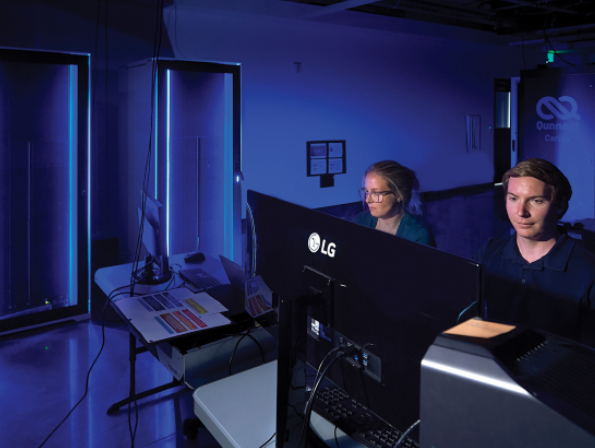
- Image: Catherine Hahola, assistant director of systems for Montana State University Information Technology, left, and Coltran Hopkins-Nichols, director of systems and research computing, work with quantum computers in the QCORE facility. (MSU photo by Kelly Gorham)
PRESS RELEASE — When Montana State University’s new QCORE facility opens its doors later this month, it will do so with the help of around 60 outside organizations, companies and individuals – including $44.7 million from the U.S. Air Force Research Laboratory, or AFRL.
The 12,600-square-foot scientific facility, located in the EngineWorks building at 2425 Technology Blvd. on MSU’s Innovation Campus, will host an open house from 3 to 6 p.m., Friday, Aug. 22, that’s free and open to the public.
QCORE, an acronym for Quantum Collaborative Research and Education, is an interdisciplinary research facility in MSU’s College of Letters and Science dedicated to the study of quantum computing.

“We’re leading Montana’s transformation into a global powerhouse for quantum-enabled technologies by 2035 by fostering economic growth, academic excellence and developing a resilient, future-focused workforce,” said Jayne Morrow, director of QCORE. “These capabilities are not just for research. These investments create entirely new computing and networking infrastructure for the state of Montana.”
In addition to Friday’s open house, QCORE will celebrate its opening with a three-day Grand Challenges in Quantum Systems Summit beginning Aug. 20. The summit will feature keynote addresses from Michael J. Hayduk, deputy director and information directorate of the AFRL, and Jacob Taylor, from the Institute for Advanced Computer Studies at the University of Maryland.
The event will also feature panel discussions and presentations by more than 25 individuals from Montana and around the world representing industry and academia, including from MSU, as well as participation by around 35 companies and organizations.
“The purpose of the summit is to unite with partners and stakeholders from around the world to identify and address the grand challenges in quantum systems where MSU’s ecosystem can uniquely drive solutions,” Morrow said.
QCORE began to take form after MSU received a $26.7 million grant from the AFRL in 2023. The funding purchased specialized equipment to test prototype quantum components in the extremely cold environments in which some of them operate.
Morrow said MSU is the world’s first university to have a Rigetti Novera superconducting quantum computer on site, and it’s the first university in the U.S. with an ORCA photonic quantum computer. QCORE has one of only five quantum network test beds in the world and, according to Morrow, is one of only seven organizations in the world to house two different types of quantum computers: photonic and superconducting.
MSU’s photonics-based Spectrum Lab, which is part of QCORE, also received around $18 million from AFRL to create a new multi-node network that’s part traditional networking and part quantum networking, Morrow said.
Quantum physics deals with the behavior of very small particles, smaller even than the protons and neutrons most people know as the parts that make up atoms. Scientists – including those at MSU’s Spectrum Lab and MonArk Quantum Foundry – are discovering how to manipulate quantum particles to create faster, more sensitive, more precise and more secure systems in electronics, including sensors, location systems, computers and medical equipment.
Two of the challenges facing the emerging field of quantum computing are the sheer size of the components and energy consumption. “These are challenging technical hardware issues, and that requires technical hardware solutions. Montana State University and QCORE are uniquely well-suited to help Montana’s industry address them,” Morrow said.
Over the past two decades, MSU has helped to establish a network of photonics and cryogenics companies in and around Bozeman, which are expected to be integral to cultivating advances in quantum research and private industries with strong workforce development.
Part of QCORE’s mission will be to nurture scientists and entrepreneurs attempting to incorporate those advances into useful components and devices, Morrow said. QCORE’s mission also includes research translation, providing a business incubator for startups and developing workforce education programs from K-12 up. QCORE has signed either sponsored-research partnerships or memoranda of understanding with 15 companies, Morrow said.
“We’re envisioning ourselves as a research facility that’s really got a lot of hard science built into it, but which is also directed at meeting the needs of industry,” she said. “But we also understand it’s important to connect this emerging field of quantum with the opportunities in our local communities around Montana. We have sent quantum kits to over 70 schools around Montana to give teachers resources to help kids engage in quantum systems and supported artists of all ages from around Montana to create Sunprints, which harness quantum mechanics to generate beautiful images.”
MSU senior Jack Schnepf, who is expected to graduate in December with a BFA in studio arts, created a series of paintings for the QCORE facility, which collectively comprise an installation titled, “The Shape of Uncertainty.” Schnepf is originally from Snoqualmie, Washington.

Keep track of everything going on in the Quantum Technology Market. In one place.

Matt Swayne
With a several-decades long background in journalism and communications, Matt Swayne has worked as a science communicator for an R1 university for more than 12 years, specializing in translating high tech and deep tech for the general audience. He has served as a writer, editor and analyst at The Quantum Insider since its inception. In addition to his service as a science communicator, Matt also develops courses to improve the media and communications skills of scientists and has taught courses.
[email protected]

Stay Ahead of Quantum
Get the latest research, company news, and market intelligence every week.
MENTIONED IN THE ARTICLE

Montana State University
Montana State University, situated in Bozeman, Montana, functions as a publicly funded research institution with a focus on land-grant principles. It holds the distinction of being the state's largest university and is classified within the "R1: Doctoral Universities – Very high research activity" category.
→

Air Force Research Laboratory Quantum Group
The Air Force Research Laboratory is partnering with industry, academia, and the Department of Defense to apply quantum information science to Air Force concerns. AFRL has formally joined the IBM Q Network, the first ever partnership of its kind in the Department of Defense. This alliance will provide AFRL and its collaborators with access to commercial quantum systems to explore practical applications relevant to the Air Force. Early applications include optimization problems, speed-up of machine learning algorithms and quantum chemistry simulation. The Extreme Computing facility by the Air Force Research Laboratory (AFRL), is now open in New York. It is involved in quantum computing research, ranging from development, integration and deployment of advanced computing technologies for the Department of the Air Force. The AFRL Information Directorate received funding for five major projects. They include: 1. $10 million for Distributed Quantum Networking Testbed and Quantum Cloud Computing Environment, 2. $4 million for Photonic Quantum Computing, which will develop a next-generation ion trap computer. 3. $10 million for Enhancements and Operational Readiness improvements for Trusted DoD/Federal Unmanned Aircraft Systems. This system will manage UAS traffic to support the emerging Federal Aviation Administration/National Aeronautics and Space Administration Advanced Air Mobility vision and provide a real-time interface to Air Traffic Control. 4. $10 million for a Joint All-Domain Command and Control testbed which creates an operational-like environment that allows the warfighter to test cutting-edge technology and tools and provide feedback for researchers. 5. $10 million for a Multi-Domain Radio Frequency Spectrum Test environment. Total government funding involved in the AFRL currently amounts to ~$44 million USD.
→
University of Maryland
The University of Maryland, College Park, situated in Maryland, is a public research university. Established in 1856, it holds the position of being the main campus of the University System of Maryland. It also holds the distinction of being the biggest university in both the state and the Washington metropolitan area.
→