Cornell–IBM Collaboration Make Advances Toward Topological Quantum Computing


Insider Brief
- Researchers from Cornell, IBM, Harvard, and the Weizmann Institute demonstrated the first error-resistant implementation of universal quantum gates using Fibonacci anyon braiding, advancing the development of topological quantum computing.
- The team encoded quantum information by braiding exotic quasi-particles in two dimensions, showcasing fault-tolerant behavior critical for scalable quantum computing.
- To validate the approach, the method was applied to a computationally hard problem involving chromatic polynomials, which grows exponentially beyond the reach of classical computers.
UNIVERSITY NEWS — The quantum computing revolution draws ever nearer, but the need for a computer that makes correctable errors continues to hold it back.
Through a collaboration with IBM led by Cornell, researchers have brought that revolution one step closer, achieving two major breakthroughs. First, they demonstrated an error-resistant implementation of universal quantum gates, the essential building blocks of quantum computation. Second, they showcased the power of a topological quantum computer in solving hard problems that a conventional computer couldn’t manage.
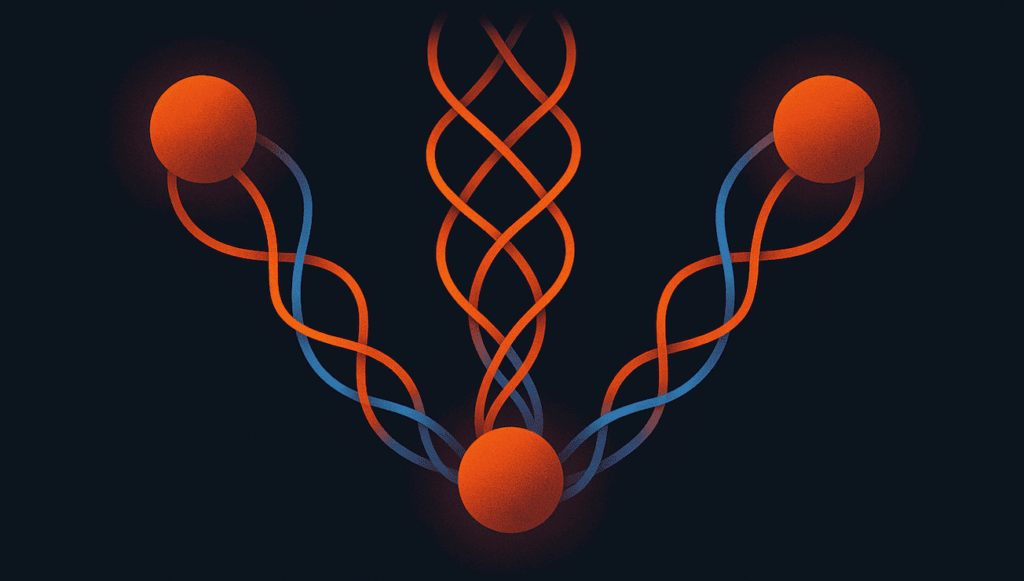
In “Realizing String-Net Condensation: Fibonacci Anyon Braiding for Universal Gates and Sampling Chromatic Polynomials” published in Nature Communications July 6, an international collaboration between researchers at IBM, Cornell, Harvard University and the Weizman Institute of Science demonstrated, for the first time, the ability to encode information by braiding – moving in a particular order – Fibonacci string net condensate (Fib SNC) anyons, which are exotic quasi-particles, in two dimensional space.

“This is really the first step towards universal topological quantum computing, or fault tolerant computing,” said co-corresponding author Eun-Ah Kim, Hans A. Bethe Professor of physics in the College of Arts and Sciences.
“The two-dimensionality is very important for being very fault tolerant and resistant to error. If you only do everything in one dimension, there is no such potential for fault tolerance,” said co-corresponding author Chao-Ming Jian, assistant professor of physics (A&S).
The researchers demonstrated the power of their method on a known hard problem, rather than one invented for the experiment. On a small scale, they could verify the quantum computer’s results using a classical computer as a proof of principle.
The hard problem they chose involved chromatic polynomials, originated from a counting problem of graphs with different colored nodes and a few simple rules. Classical computers can calculate how many possible colorings are allowed in a simple graph with just a few nodes and a few colors. But as soon as the graph enlarges with many nodes and many connections, the number of possibilities quickly becomes exponentially large. A classical computer cannot compute that many possibilities.
The protocol the researchers used – sampling the chromatic polynomials for a set of different graphs where the number of colors is the golden ratio – is scalable, so other researchers with quantum computers can duplicate it at a larger scale.
“Someone can follow our protocol and do something that is classically not possible,” said Kim. “We set it out as a challenge to anybody.”
Studying topologically ordered many-body quantum systems – systems with a large number of interacting quantum particles – and their applications in quantum computation presents tremendous challenges for quantum researchers. Being able to draw on the resources, expertise and insight of scientists from around the world – in both industry and academia – for their team was essential to achieve their results, said Kim.
“The researchers at IBM were critical in understanding the theory of the topological state and how to design a protocol to implement it on a quantum computer, which they provided,” she said. “Our other colleagues made essential contributions with the hardware simulations, connecting theory to experiment and determining our strategy.”
Co-authors include Zlatko K. Minev, Swarnadeep Majumder and Guanyu Zhu, IBM Quantum, T.J. Watson Research Center; Khadijeh Najafi, IBM Quantum, T.J. Watson Research Center and MIT-IBM Watson AI Lab; Juven Wang, Harvard University and the London Institute for Mathematical Sciences, Royal Institution, U.K.; and Ady Stern, Weizmann Institute of Science, Israel.
The research was supported by the National Science Foundation, the U.S. Department of Energy and the Alfred P. Sloan Foundation.

Keep track of everything going on in the Quantum Technology Market. In one place.

Matt Swayne
With a several-decades long background in journalism and communications, Matt Swayne has worked as a science communicator for an R1 university for more than 12 years, specializing in translating high tech and deep tech for the general audience. He has served as a writer, editor and analyst at The Quantum Insider since its inception. In addition to his service as a science communicator, Matt also develops courses to improve the media and communications skills of scientists and has taught courses.
[email protected]

Stay Ahead of Quantum
Get the latest research, company news, and market intelligence every week.
MENTIONED IN THE ARTICLE

IBM
IBM is an iconic technology pioneer founded in 1911 as the Computing-Tabulating-Recording Company and officially renamed International Business Machines Corporation in 1924. Beyond foundational computing, IBM possesses a deep legacy in aerospace and defense from building the guidance computers and Instrument Unit for NASA's historic Apollo missions to partnering with Airbus on CIMON, the first AI assistant on the ISS.
→

Harvard University
Harvard University, located in Cambridge, Massachusetts, is a private Ivy League research institution. Established in 1636 under the name Harvard College and in honor of its initial supporter, clergyman John Harvard, it holds the distinction of being the oldest higher education institution in the United States. Its global reputation, financial resources, and rankings have positioned it as one of the world's most esteemed universities.
→

Weizmann Institute of Science
The Weizmann Institute of Science, founded in 1934, is a public research university located in Rehovot, Israel. Unlike other universities in Israel, it focuses exclusively on offering graduate and postgraduate degrees in the natural and exact sciences.
→

U.S. Department of Energy (DOE)
The mission of the Department of Energy is to ensure America's security and prosperity by addressing its energy, environmental, and nuclear challenges through transformative science and technology solutions. In September, 2022, Research supported by ASCR demonstrated that classical machine learning algorithms can accurately predict ground state properties and classify quantum phases of matter using data generated from quantum experiments. In November, 2022, Research supported by Q-NEXT revealed that the performance of a sensor network is constrained by the intrinsic noise associated with the quantum states used in the network. In March, 2023, Research funded by DOE SC NP achieved the first experimental observation of entanglement between dissimilar particles, specifically positive and negative pions. In August, 2023, Research funded by DOE SC BER demonstrated strong preservation of entanglement in a two-photon absorption process involving organic molecules, offering a new approach for developing quantum light-based spectroscopy and microscopy.
→