Oxford Scientists Develop Technique to Find Materials For Fault-Tolerant Quantum Computers



Insider Brief
- Oxford researchers have developed a powerful new technique to identify materials capable of supporting stable quantum states, marking a major step toward scalable, fault-tolerant quantum computing.
- Using a novel scanning method called Andreev STM, the team confirmed that uranium ditelluride (UTe₂) is an intrinsic topological superconductor—a long-sought material believed to host robust quantum particles.
- The technique now enables researchers to efficiently screen other materials for topological superconductivity, potentially replacing complex and costly synthetic quantum circuits with simpler, crystalline alternatives.
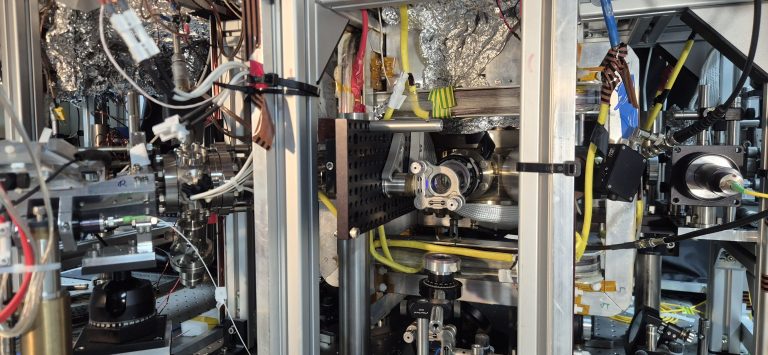
- Image: Joseph P. Carroll supervising operations at one of Davis Group Andreev scanning tunneling microscope (STM). Credit: Catherine Dawson, Davis Group. (Catherine Dawson, Davis Group.)
PRESS RELEASE — A research study led by Oxford University has developed a powerful new technique for finding the next generation of materials needed for large-scale, fault-tolerant quantum computing. This could end a decades-long search for inexpensive materials that can host unique quantum particles, ultimately facilitating mass production of quantum computers. The results have been published in the journal Science.
Quantum computers could unlock unprecedented computational power far beyond current supercomputers. However, the performance of quantum computers is currently limited, due to interactions with the environment degrading the quantum properties (known as ‘quantum decoherence’). Physicists have been searching for materials resistant to quantum decoherence for decades, but the search has proved experimentally challenging.
In this new study, researchers from the Davis Group at Oxford University have demonstrated a highly effective new technique to identify such materials, referred to as topological superconductors.

A topological superconductor is an unprecedented form of quantum matter that can host exotic quantum particles referred to as Majorana fermions. In theory, these particles can store information within their shape and structure (topology), instead of how they usually do – within the state of the particle itself. This means that the information is more stable and unaffected by local perturbations such as disorder and noise. As a consequence, they can store quantum information permanently, without this being degraded by the quantum decoherence effects which limit current quantum computers.
Up to now, there has been no effective technique to determine definitively whether a given superconducting material can be the platform for advanced topological quantum computing. In this new study, the Oxford researchers verified that the known superconductor uranium ditelluride (UTe 2) is an intrinsic topological superconductor.
Since its discovery in 2019, UTe2 had been considered the leading candidate material for intrinsic topological superconductivity. The electron pairs in UTe2 were believed to be highly unusual with their spins aligned, a necessary condition for intrinsic topological superconductivity and thus topologically protected, superconductive surface states. However, no research had definitively demonstrated these phenomena in UTe2 – until now.
The researchers used a scanning tunneling microscope (STM), which uses an atomically sharp superconducting probe to obtain ultra-high-resolution images at the atomic scale, without using light or electron beams. The experiments used an entirely new operating mode invented by Professor Séamus Davis (called the Andreev STM technique).
This method is specifically attuned only to electrons in a special quantum state (topological surface state) that is predicted to cover the surface of intrinsic topological superconductors.
When implemented, the method performed exactly as theory suggested, enabling the researchers to not only detect the topological surface state but also to identify the intrinsic topological superconductivity of the material.
The results indicated that UTe2 is indeed an intrinsic topological superconductor, but not exactly the kind physicists have been searching for. Although, based on the reported phenomena, Majorana quantum particles are believed to exist in this material, they occur in pairs and cannot be separated from each other.
However, the Andreev STM experimental technique used is a breakthrough in itself. This novel technique can now allow physicists to determine accurately and directly whether other materials harbour intrinsic topological superconductivity, so as to provide promising platforms for topological quantum computing.
Intrinsic topological superconducting materials remain a profound challenge to find and are largely a theoretical concept at present, yet the field is advancing rapidly. Researchers worldwide are actively investigating the potential candidates and technology needed to harness their properties. Earlier this year, Microsoft announced the Majorana 1, as “the world’s first Quantum Processing Unit powered by a Topological Core”, supposedly hosting topological qubits. Microsoft achieved this device by creating a synthetic topological superconductor based on elaborately engineered structures made of conventional superconductors.
However, the Davis Group’s new work means that scientists can now identify simple crystalline materials to replace such complicated and extremely expensive artificial circuits, potentially leading to economical topological qubits for the next generation of quantum computing.
Professor Séamus Davis (Department of Physics, University of Oxford) said: “The invention of the Andreev STM technique, the detection of the superconductive topological surface state, the identification of intrinsic topological superconductivity, and the precise categorization of the latter are all firsts in physics. In combination, these can massively accelerate our ability to identify the right materials to enable the revolution that quantum computing will bring.”
Lead author Dr Shuqiu Wang (then of Davis Group in Oxford but now Assistant Professor at the University of Bristol) said: “It is truly exciting to see the first spectroscopic signature of intrinsic topological superconductivity. This major scientific discovery only becomes possible with our newly invented spectroscopic technique. I look forward to discovering more intrinsic topological superconductors and their fascinating and exotic physics that have yet to be revealed using the Andreev STM technique!”
The study also involved researchers from University of California – Berkeley and Lawrence Berkeley National Laboratory, Cornell University, University of Bristol, University of Maryland, Washington University, University College Cork, and University of Notre Dame.

Keep track of everything going on in the Quantum Technology Market. In one place.

Matt Swayne
With a several-decades long background in journalism and communications, Matt Swayne has worked as a science communicator for an R1 university for more than 12 years, specializing in translating high tech and deep tech for the general audience. He has served as a writer, editor and analyst at The Quantum Insider since its inception. In addition to his service as a science communicator, Matt also develops courses to improve the media and communications skills of scientists and has taught courses.
[email protected]

Stay Ahead of Quantum
Get the latest research, company news, and market intelligence every week.
MENTIONED IN THE ARTICLE

Microsoft
Microsoft engages in the creation and licensing of software for both consumer and enterprise use. The company is renowned for its development of Windows operating systems and the Office suite designed for productivity. Microsoft's structure encompasses three major segments of roughly equal size: productivity and business processes, which encompasses legacy Microsoft Office, cloud-based Office 365, Exchange, SharePoint, Skype, LinkedIn, and Dynamics; the intelligence cloud, which includes offerings like Azure, Windows Server OS, and SQL Server; and more personal computing, which covers Windows Client, Xbox, Bing search, display advertising, and a range of Surface laptops, tablets, and desktops.
→

University of Oxford
Oxford stands as a hub for education, instruction, and scholarly exploration, holding the distinction of being the oldest university in the English-speaking realm.
→

Lawrence Berkeley National Laboratory
Lawrence Berkeley National Laboratory, operating under the U.S. Department of Energy, spearheads unclassified scientific research pivotal to climate technology. Their innovative work includes developing advanced energy-efficient technologies, renewable energy solutions, and cutting-edge climate modeling tools. These efforts are crucial in mitigating climate change, enhancing energy sustainability, and informing policy decisions to foster a resilient, low-carbon future.
→

Cornell University
Cornell University, a private Ivy League research university, is situated in Ithaca, New York. It was established in 1865 by Ezra Cornell and Andrew Dickson White.
→
University of Maryland
The University of Maryland, College Park, situated in Maryland, is a public research university. Established in 1856, it holds the position of being the main campus of the University System of Maryland. It also holds the distinction of being the biggest university in both the state and the Washington metropolitan area.
→