France, Germany, and the Netherlands Launch $33M Trilateral Quantum Initiative


Insider Brief:
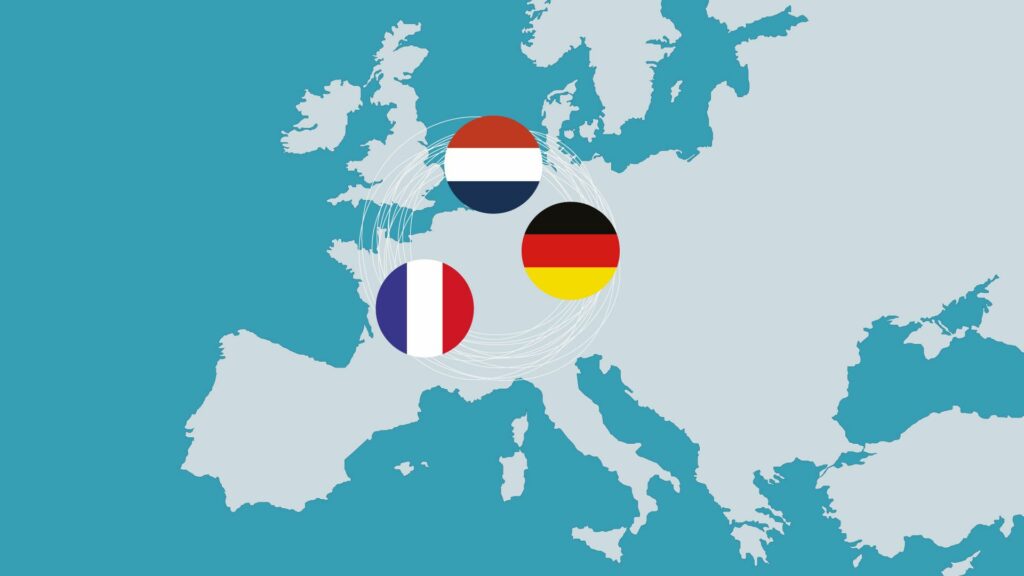
- France, Germany, and the Netherlands launched a trilateral quantum innovation call, selecting high-impact projects with over €30 million (approximately $33.8 million) in combined funding, including €11 million (approximately $12.4 million) for French partners through France 2030.
- The initiative attracted 120+ applications in quantum computing, communication, and sensing, and selected projects involving leading institutions like IQM, Quandela, Alice&Bob, and Sorbonne University.
- The funded projects are centered around scaling quantum computing, securing quantum networks, and advancing quantum sensing, to reinforce Europe’s leadership through cross-border collaboration and commercialization.
- Editor’s Note: This article was translated from French to English using ChatGPT.
PRESS RELEASE — France, the Netherlands, and Germany have taken a major step forward in advancing Europe’s position in quantum technology by successfully completing the first trilateral quantum innovation call. This initiative, designed to foster collaboration and accelerate the commercialization of quantum technologies, resulted in the selection of high-impact projects receiving a combined funding of over €30 million (approximately $33.8 million)—including €11 million (approximately $12.4 million) for French partners through the France 2030 plan.
Launched in March 2024, the trilateral call attracted more than 120 applications from companies and research institutions eager to collaborate in quantum computing, communication, and sensing. Through a rigorous two-stage selection process, final projects were chosen to advance Europe’s leadership in quantum innovation.
The Partners
The selected projects bring together leading quantum companies and research institutions from the Netherlands, France, and Germany, forming a diverse consortium of expertise and innovation.

In particular, the projects involving French partners include:
- Ad Astra: Accelerates error correction at minimal cost
- Partners: IQM Quantum Computers, Silent Waves, Orange Quantum Systems, QuantECA – Institut Néel CNRS
- T-UF-TopiQC: Develops a platform for error correction in photonic quantum computing
- Partners: Quandela, C2N – CNRS, Universität Paderborn, Swabian Instruments, Single Quantum, MicroAlign, Qubit Pharmaceuticals
- MEETQ: Enables the scaling of European quantum computing by interconnecting quantum memories and superconducting qubits
- Partners: WeLinQ, QphoX, LIP6 Sorbonne University
- AUTOCAT: Also targets scalability by combining noise-biased cat qubits, advanced control electronics, automatic calibration, and advanced algorithms
- Partners: Alice&Bob, Institut Néel – CNRS, Qblox, Qruise
Preparing Europe’s Quantum Future
The funded projects will focus on scalable quantum computing, secure quantum networks, and advanced quantum sensing technologies—reinforcing Europe’s ambition to lead the quantum revolution. The funding will support the transition from fundamental research to practical applications, helping to solve real-world challenges and develop a thriving European quantum industry.
By promoting cross-border collaboration, this initiative emphasizes the importance of a united European approach to quantum technology development—ensuring that Europe remains at the forefront of this rapidly evolving field.
SOURCE: France 2030

Keep track of everything going on in the Quantum Technology Market. In one place.

Cierra Choucair
Cierra Choucair is a journalist and data analyst at The Quantum Insider, where she covers quantum computing and emerging technologies. With a background that blends scientific analysis, public communication, and product storytelling, she bridges technical complexity and industry insight across research, startups, and policy. She is the author of The Daily Qubit, a widely read newsletter spotlighting quantum research, use cases, and industry trends.

Stay Ahead of Quantum
Get the latest research, company news, and market intelligence every week.
MENTIONED IN THE ARTICLE
IQM
IQM Finland builds scalable hardware for universal quantum computers, focusing on superconducting technology.
→

Quandela
Quandela is a French startup that specializes in photonic quantum computing by providing modular, scalable, and energy-efficient photonic quantum computers, accessible both on the cloud and on premise. They provide prototyping services with their Perceval simulator alongside their general purpose chips optimized chips, and development of algorithms and protocols which provide photonic solutions for applications ranging from pharmaceutical and material design, to quantum machine learning, networking and optimization.
→
Alice&Bob
Alice&Bob are working towards building an error corrected, fault tolerant quantum computer. They are working with superconducting circuits called ‘Cat Qubits’ which reduce the hardware required for error correction. With a cat Qubit, it is possible to stabilize two particular states in which quantum information is encoded autonomously.
→

Sorbonne University
Sorbonne University is a French public research university situated in Paris. Its history dates back to 1257 when Sorbonne College was founded by Robert de Sorbon as one of Europe's earliest universities.
→

Orange Quantum Systems
Orange QS delivers test equipment to create better quantum chips
→

CNRS
The French National Centre for Scientific Research is among the world's leading research institutions. Its scientists explore the living world, matter, the Universe, and the functioning of human societies in order to meet the major challenges of today and tomorrow. Internationally recognised for the excellence of its scientific research, the CNRS is a reference in the world of research and development, as well as for the general public.
→

Swabian Instruments
Swabian Instruments is a test and measurement company that specializes in digital data acquisition and signal generation systems, including those for quantum information applications. They provide versatile solutions for managing digital signals by integrating high-performance hardware with flexible software toolkits and streaming data paths, enabling real-time processing and control.
→

QphoX
QphoX is a quantum transduction company building the world's first quantum modem™ device, connecting quantum computers across a quantum network.
→