

Insider Brief
- A new study finds it is fundamentally impossible to create a universal protocol that improves the quality of entangled quantum states across all systems.
- Researchers from UChicago, UIUC, and Microsoft showed that no entanglement purification method can guarantee fidelity improvement under all conditions, even when considering all mathematically allowed operations.
- The findings suggest future quantum technologies must use system-specific error management strategies rather than relying on one-size-fits-all solutions.
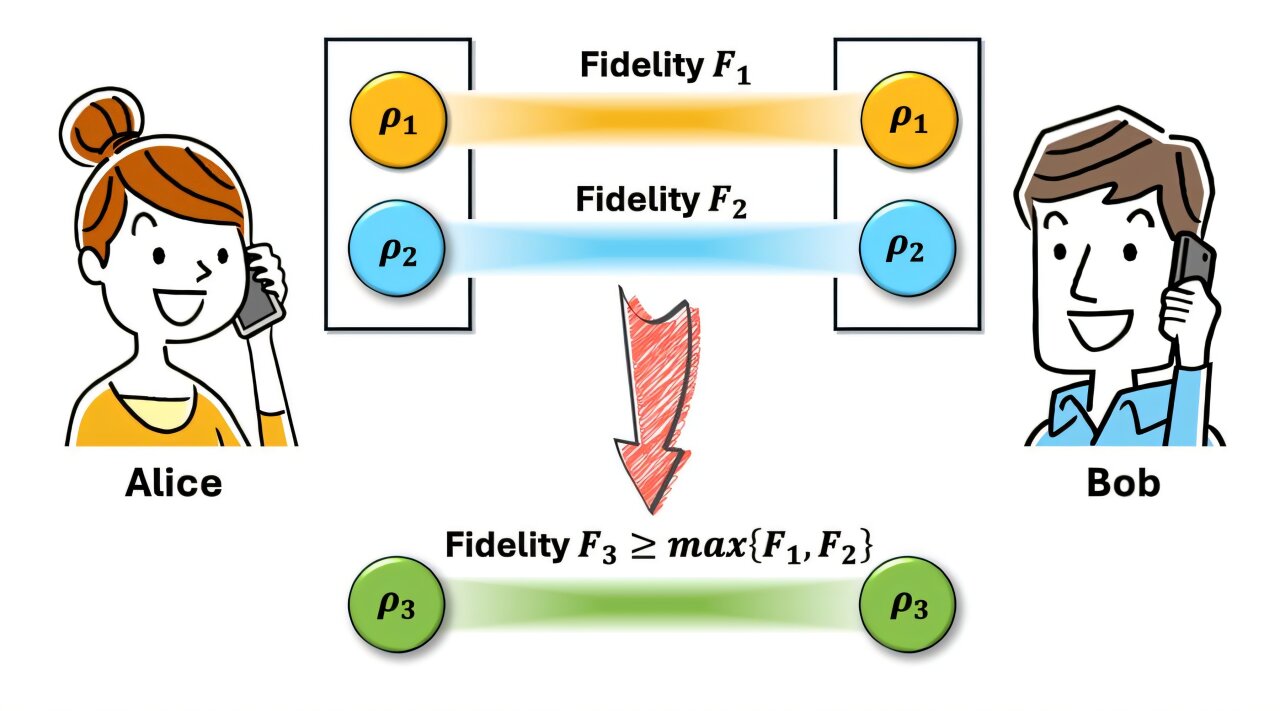
- Image: Researchers found that no universal entanglement purification protocol is guaranteed to improve fidelity of entangled states in all possible quantum systems. (Zhong Lab)
PRESS RELEASE — Quantum entanglement — a connection between particles that produces correlations beyond what is classically possible — will be the backbone of future quantum technologies, including secure communication, cloud quantum computing, and distributed sensing. But entanglement is fragile; noise from the environment degrades entangled states over time, leaving scientists searching for methods to improve the fidelity of noisy entangled states.
Now, researchers at the University of Chicago Pritzker School of Molecular Engineering (UChicago PME), University of Illinois Urbana-Champaign, and Microsoft have shown that it is fundamentally impossible to design a single one-size-fits-all protocol to counteract that noise.
“In quantum information, we often hope for a protocol that works in all scenarios — a kind of cure-all,” said Asst. Prof. Tian Zhong, senior author of the new work published in Physical Review Letters. “This result shows that when it comes to purifying entanglement, that’s simply too good to be true.”

The findings, he said, instead highlight the importance of tailoring noise-minimizing solutions to specific quantum systems.
Searching for solutions
To counteract the degradation of entangled states due to noise, scientists often use entanglement purification protocols (EPPs), which combine multiple imperfect entangled pairs to try to extract fewer pairs with less noise. But the team knew that certain systems are hard to clean of noise – often because the input states of EPPs are almost never identical in reality. Entanglement states vary based on how and when they are created, stored, and processed.
Graduate student Allen Zang from UChicago PME, and Xinan Chen from UIUC are the co-first authors of this paper. “We knew that existing input-independent protocols are not guaranteed to improve the fidelity of the entangled states,” said Zang. “We wondered whether there was any possible protocol that can always guarantee improvements, a property we call universality.” said Chen.
Zang, Chen and their colleagues began by tackling the question within a set of broadly-used EPPs, applying the protocols to known quantum operations. However, the idea of “universality” failed. Surprised, they broadened their analysis to all mathematically possible purification methods allowed under the rules of quantum mechanics.
Still the result held: no universal EPP is guaranteed to improve fidelity of entangled states in all possible quantum systems.
“Importantly, we’re not saying purification protocols don’t work,” said Eric Chitambar, Assoc. Professor of Electrical and Computer Engineering at UIUC. “But no single method works in all cases.”
A fundamental limit
The work carries real implications for the design of quantum communication networks, where entangled states must be generated, stored, and transmitted over long distances. In these systems, blindly applying a purification protocol — without knowing the exact state of the system — can backfire.
Instead, the authors say, the results offer guidance: rather than seeking a universal solution, researchers should focus on tailoring error management strategies to the specific systems and error models they’re working with.
“This result tells us not to waste time searching for a protocol that doesn’t exist, and instead put more emphasis on understanding the unique characteristics of specific quantum systems,” said Martin Suchara, Director of Product Management at Microsoft, one of the co-authors.
The team is now exploring how this kind of theoretical boundary might apply to other quantum resources. They’re also investigating whether customized purification methods could still be developed for systems with well-understood errors — or whether a nearly universal method might exist under stricter constraints.
Citation: “No-Go Theorems for Universal Entanglement Purification,” Zang et al., Physical Review Letters, May 13, 2025. DOI:10.1103/PhysRevLett.134.190803
Funding: This work was supported by the NSF Quantum Leap Challenge Institute for Hybrid Quantum Architectures and Networks (NSF Award 2016136), the Marshall and Arlene Bennett Family Research Program, and the U.S. Department of Energy.