MITRE Builds New Quantum Imaging Using NVIDIA CUDA-Q



Insider Brief
- MITRE and NVIDIA are partnering to develop simulation tools that enhance the design and optimization of quantum imaging systems, including MITRE’s Walsh Imaging technology.
- Walsh Imaging enables real-time visualization of nanoscale electromagnetic activity in semiconductors and neurons, offering higher sensitivity and precision than traditional methods.
- The collaboration uses NVIDIA’s CUDA-Q platform and DGX SuperPOD to accelerate simulations, cutting optimization time from days to under an hour.
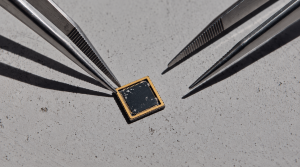
PRESS RELEASE — MITRE and NVIDIA are collaborating on simulation tools to better design and optimize quantum imaging systems. The noninvasive system created by MITRE, called Walsh Imaging, can produce images of nanoscale electromagnetic signals that can be used to understand how a semiconductor, or a brain’s neurons, are reacting in real time.
“Walsh Imaging unlocks new potential across security, medicine, and the microelectronics sector through its ability to see small changes in electrical activity in cells and transistors at their natural scale, the nanoscale,” said Nima Leclerc, a quantum research scientist at MITRE. “I’m excited to partner with leading experts in neuroimaging and microelectronics to transition this capability out of the lab and into the real world.”
The system images semiconductors to monitor transistor computation or image neurons in the brain as they respond to drug intervention. Using a novel imaging technique, the Walsh Imaging protocol can show electromagnetic fields with more sensitivity and precision than traditional technologies.

Quantum imaging uses quantum mechanics to measure and show nanoscale changes in the environment, far beyond conventional imaging means. These quantum imaging techniques use the sensitivity of electrons in diamonds to respond to small changes in the magnetic field in their environment, for different points in space and time. Quantum imaging has implications for healthcare and cybersecurity. Designing these imaging systems relies on detailed simulations of the quantum sensors involved, only possible by drawing on the GPU-accelerated power of NVIDIA CUDA-Q platform.
Using NVIDIA DGX SuperPOD and MITRE’s Federal AI Sandbox, MITRE is able to build an environment for modeling and simulating the complex components needed for the Walsh Imaging system. MITRE is collaborating with NVIDIA to implement these simulation tools at scale, reducing the time needed to simulate and optimize these systems from days to less than an hour.
“This work shows the broad importance of accelerated simulations of quantum systems,” said Tim Costa, senior director of CAE, quantum and CUDA-X at NVIDIA. “MITRE’s work on quantum sensors demonstrates the reach of quantum technologies and how NVIDIA accelerated computing plays a crucial role.”

Keep track of everything going on in the Quantum Technology Market. In one place.

Matt Swayne
With a several-decades long background in journalism and communications, Matt Swayne has worked as a science communicator for an R1 university for more than 12 years, specializing in translating high tech and deep tech for the general audience. He has served as a writer, editor and analyst at The Quantum Insider since its inception. In addition to his service as a science communicator, Matt also develops courses to improve the media and communications skills of scientists and has taught courses.
[email protected]

Stay Ahead of Quantum
Get the latest research, company news, and market intelligence every week.
MENTIONED IN THE ARTICLE

National Security Engineering Center (MITRE)
NSEC delivers research, engineering, and analytical solutions to the Department of Defense and the Intelligence Community. Since 1958, NSEC has contributed transformational innovations to essential systems such as the Semi-Automated Ground Environment (SAGE), the nation’s first air-defense system. These include Joint STARS, the Air Force/Army airborne ground surveillance, battle management, command and control aircraft, and Intelink, the first secure intranet used by the Intelligence Community. A team of physicists led by MITRE’s Gerry Gilbert, a theoretical physicist and quantum expert, are working on a quantum moonshot: a mission to build a scalable universal quantum computer.
→

NVIDIA
NVIDIA Corporation is an American multinational technology company and a global player in accelerated computing and Artificial Intelligence (AI). Founded in 1993, the company pushes the aerospace frontier with the Space-1 Vera Rubin Module, a platform for orbital data centers that delivers massive AI-compute Space Computing. This NVIDIA technology enables satellites and autonomous spacecraft to process and fuse sensor data rapidly Space Computing.
→