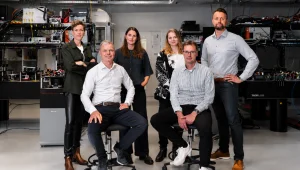
Welinq Launches Its Storage Solution for Quantum Computing Scale-Out



Insider Brief
- Welinq has launched the first commercial quantum memory for data centers, enabling scalable networking of quantum processors with record-breaking performance.
- The fully integrated system features over 90% storage-and-retrieval efficiency, up to 200 microseconds of storage time, and room-temperature operation without cryogenics.
- Welinq is expanding its quantum networking infrastructure with new deployments, partnerships, and the araQne compiler to optimize distributed quantum computing.
PRESS RELEASE — Welinq, a leader in quantum networking technology, has launched the first commercial quantum memory designed specifically for quantum data centers with world-record performance. Quantum computing is reaching a turning point: with more than 100 individual quantum computers deployed in dedicated infrastructures, the next challenge is networking them into scalable, high-performance architectures.
Just as classical data centers rely on distributed computing and high-speed interconnects, the future of quantum computing depends on optical networking and resource sharing between quantum processors. Welinq’s quantum memory acts as the backbone of this infrastructure, making it possible to link quantum processors into powerful, scalable networks.
A Fully Integrated, Ready-to-Use Product
Welinq’s new memory is a fully integrated system allowing for plug-and-play deployment in quantum data centers and quantum communication networks. Key features include:

- Over 90% on-demand storage-and-retrieval efficiency for single photons—the highest recorded for quantum memory.
- Storage durations of up to 200 microseconds.
- Compact form factor, fitting into a standard 19-inch industrial rack for easy integration.
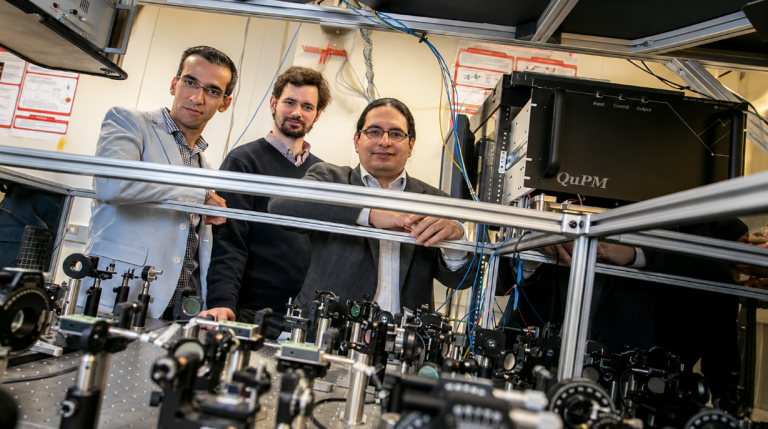
- Room-temperature operation using a proven neutral-atom approach with technological maturity, eliminating the need for cryogenic systems thanks to the precise trapping of atoms by laser beams.
Julien Laurat, Professor at Sorbonne Université, CSO Hardware and Co-founder of Welinq, the pioneer of this technology, says:
“Quantum memories have been a central focus of research for years, but transitioning from academic demonstrations to a deployable commercial solution in just two years was a major engineering challenge.”
A Key Advancement for Scaling Quantum Technologies
Today, quantum processors operate in isolation, limiting their computing power. Welinq’s quantum memory enables quantum processors to work together, forming a distributed quantum architecture—the only viable way to scale quantum computing beyond single QPUs.
- As a quantum buffer, Welinq’s memory allows for entanglement distribution and qubit synchronization across processors.
- For quantum communications, it enables the creation of large-scale secure networks, forming the backbone of the emerging quantum internet.
“Welinq’s quantum memory will unlock new applications and drive breakthroughs in quantum computing and communication. Its impact will be transformative across industries such as cybersecurity, energy, and healthcare,” says Eleni Diamanti, Research Director at CNRS, Lead of the Paris Center for Quantum Technologies, CSO Protocols and Co-founder of Welinq.
Looking Ahead: Building Infrastructures for the Quantum Future
Several units of Welinq’s quantum memory are now in production and being deployed across Europe, marking a major milestone in the industrialization of quantum technologies. Welinq is removing the barriers to building the first quantum data centers by providing all the solutions enabling the end-to-end connection between any quantum computers. The company is pioneering quantum networking hardware with efficient quantum photonics devices and storage capabilities, as well as developing high-performance light-qubit interfaces across various quantum computing technologies. This is complemented by a robust software backbone that enables network orchestration.
Earlier this year, Welinq launched the araQne quantum compiler, designed to optimize algorithm partitioning across networked quantum processors efficiently.
Beyond technological advancements, Welinq has fostered a thriving community around distributed quantum computing. The company has recently announced key partnerships with Pasqal, Quandela, and QphoX and has spearheaded AQADOC, the world’s first initiative dedicated to distributed quantum algorithms developed alongside industry leaders and end-users in the energy sector.
Tom Darras, CEO and Co-founder of Welinq, concludes:
“Quantum technologies need the right infrastructure, and we are building it. Our quantum memory product announced today is a cornerstone for quantum networking that will power the quantum revolution.”

Keep track of everything going on in the Quantum Technology Market. In one place.
Topics

Matt Swayne
With a several-decades long background in journalism and communications, Matt Swayne has worked as a science communicator for an R1 university for more than 12 years, specializing in translating high tech and deep tech for the general audience. He has served as a writer, editor and analyst at The Quantum Insider since its inception. In addition to his service as a science communicator, Matt also develops courses to improve the media and communications skills of scientists and has taught courses.
[email protected]

Stay Ahead of Quantum
Get the latest research, company news, and market intelligence every week.
MENTIONED IN THE ARTICLE

CNRS
The French National Centre for Scientific Research is among the world's leading research institutions. Its scientists explore the living world, matter, the Universe, and the functioning of human societies in order to meet the major challenges of today and tomorrow. Internationally recognised for the excellence of its scientific research, the CNRS is a reference in the world of research and development, as well as for the general public.
→

PASQAL
PASQAL’s quantum computers control neutral atoms with optical tweezers using lasers to manipulate quantum registers with up to a few hundred qubits. Location in Boston MA.
→

Quandela
Quandela is a French startup that specializes in photonic quantum computing by providing modular, scalable, and energy-efficient photonic quantum computers, accessible both on the cloud and on premise. They provide prototyping services with their Perceval simulator alongside their general purpose chips optimized chips, and development of algorithms and protocols which provide photonic solutions for applications ranging from pharmaceutical and material design, to quantum machine learning, networking and optimization.
→

QphoX
QphoX is a quantum transduction company building the world's first quantum modem™ device, connecting quantum computers across a quantum network.
→