

PRESS RELEASE — Q-CTRL, an emerging leader producing useful quantum technologies, today announced the company’s U.S. office will receive a $230,000 Phase-1 SBIR grant from the U.S. Department of Energy (DOE) for advanced scientific computing research.
Q-CTRL’s funding is one of 158 grants totaling $35 million nationwide to support scientific innovation and clean energy development. Q-CTRL will leverage the grant to fund a project automating quantum computer hardware through AI in collaboration with Sandia National Laboratories, a U.S. Department of Energy science and engineering lab for national security and technology innovation. Quantum technology is expected to address several issues related to climate change including battery design and materials science for efficient energy production and distribution.
DOE Small Business Innovation Research (SBIR) and Small Business Technology Transfer (STTR) awards aim at transforming DOE-supported science and technology breakthroughs into viable products and services. The awards also support the development of specialized technologies and instruments that aid in scientific discovery.
“Supporting small businesses will ensure we are tapping into all of America’s talent to develop clean energy technologies that will help us tackle the climate crisis,” said U.S. Secretary of Energy Jennifer M. Granholm. “DOE’s investments will enable these economic engines to optimize and commercialize their breakthroughs, while developing the next generation of climate leaders and helping to build a sustainable future to benefit all Americans.”

Q-CTRL’s project aims to eliminate the need for expert-level manual intervention in operating quantum computers, a key hurdle preventing the technology from reaching its full potential. Working with Sandia National Laboratories, Q-CTRL is using the grant to build new tools for quantum computer automation via its expertise in machine learning and AI applied to quantum hardware. In addition, the funding will allow Q-CTRL to expand its presence in the U.S., including growing its current office in Los Angeles.
The project builds on several recent technical demonstrations from the Q-CTRL team, including the first use of deep learning to autonomously design quantum logic gates – the building blocks of quantum algorithms – which outperform the best human-designed alternatives.
“We are honored the DOE recognized Q-CTRL’s track record in advancing the field of quantum computing, which will solve complex problems in climate science, finance, defense and other fields,” said Q-CTRL Founder and CEO Professor Michael J. Biercuk. “Automating essential processes for operating quantum computers will be critical to the technology’s success, and we look forward to working with Sandia National Laboratories to make this vision a reality.”
Q-CTRL specializes in using control engineering to make quantum hardware useful in real-world settings – whether in data centers, on aircraft, or even in space. Its solutions have been validated to deliver 10-100X improvements in the performance of quantum hardware, including demonstrations on IBM quantum computers.
Recently, the company announced a $25 million Series B funding round led by Airbus Ventures. Q-CTRL was also named to the Most Innovative Companies List by The Australian Financial Review and BOSS Magazine and a winner of the InnovationAus Australian Hero Award for its technology’s potential to make quantum computing useful by improving quantum computer stability.
To learn more about Q-CTRL, please visit: q-ctrl.com.
About Q-CTRL
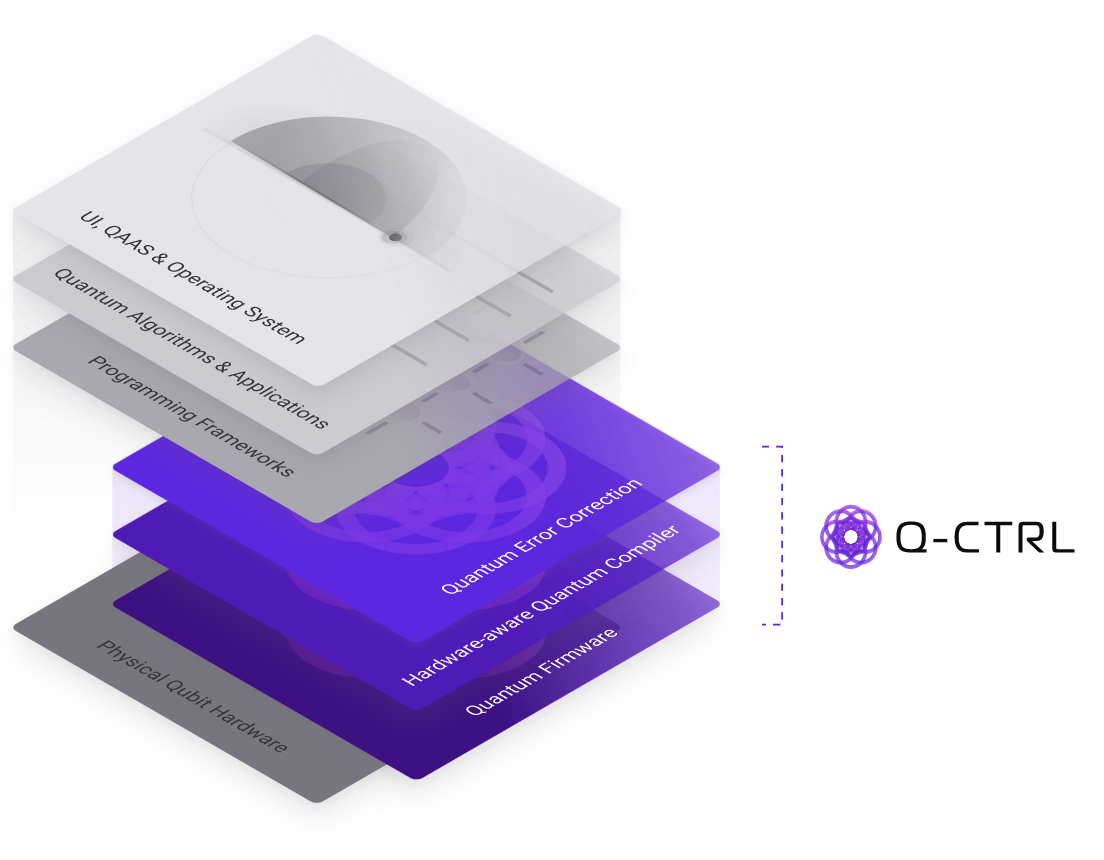
Q-CTRL is building the quantum technology industry by overcoming the fundamental challenge in the field – hardware error and instability. Q-CTRL’s quantum control infrastructure software for R&D professionals and quantum computing end users delivers the highest performance error-suppressing techniques globally, and provides a unique capability accelerating the pathway to the first useful quantum computers. This foundational capability also applies to a new generation of quantum sensors, and enables Q-CTRL to shape and underpin every application of quantum technology.
Q-CTRL has assembled the world’s foremost team of expert quantum-control engineers, providing solutions to many of the most advanced quantum computing and sensing teams globally. Q-CTRL has been an inaugural member of the IBM Quantum Startup network since 2018, and recently announced a partnership with Transport for NSW, delivering its enterprise infrastructure software to transport data scientists exploring quantum computing. Q-CTRL is funded by SquarePeg Capital, Sierra Ventures, Sequoia Capital China, Data Collective, Horizons Ventures, Main Sequence Ventures, In-Q-Tel, Airbus Ventures, and Ridgeline Partners. The company has international headquarters in Sydney, Los Angeles, and Berlin.
If you found this article to be informative, you can explore more current quantum news here, exclusives, interviews, and podcasts.